Shrub · Rosaceae
Scarlet Firethorn
Pyracantha coccinea
Fast, fearless, and bristling with thorns, firethorn delivers a flood of white spring flowers and orange-red winter berries.
Full sun
Every 7–14 days
USDA 6–9
6–18 ft · 1.8–5.5 m
Overview
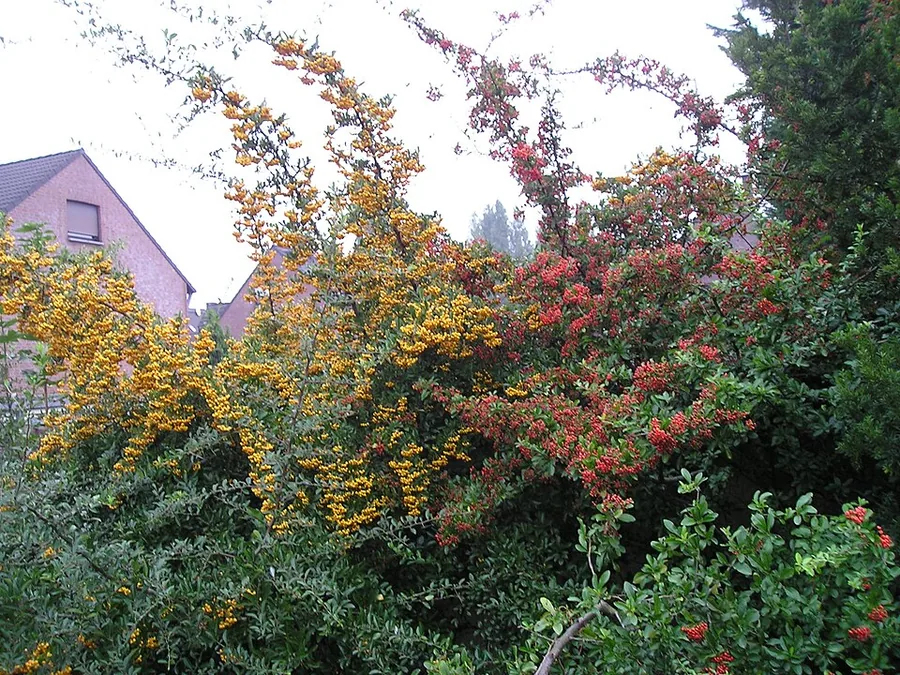
Firethorn nails its name from two directions at once, blazing with orange-red berries through winter and brandishing stiff, needle-sharp thorns down every branch. It is a fast-growing evergreen shrub in the rose family that powers through heat, drought, and cold the moment it digs in. That grit is why growers grab it for a hedge, a barrier, or an espalier trained flat against a wall.
The payoff rolls out across two seasons. Small white flowers swarm the plant in late spring, and by fall those blooms have swelled into heavy bunches of berries that cling on all winter. Birds strip the fruit through the cold months, turning firethorn into a magnet for winter wildlife and a burst of color when almost nothing else is fruiting.
All that drive comes with one catch to plan around. The long spur thorns mean business, so a firethorn parked next to a path or doorway will snag every passerby. Hand it room, plant it where the thorns fight for you instead of against you, and tackle it in thick gloves every time.
Care
The short version: plant it in full sun to fire up the flowers and berries, give it sharp-draining soil, and water deeply only while it digs in, after which it powers through drought solo. Prune in late winter and keep those gloves on.
Light
Firethorn flowers and fruits hardest in full sun, and that is where it cranks out the biggest haul of berries. It puts up with partial shade and partial sun, but the deeper the shade, the more the blooms and berries drop off, so chase the brightest spot you have.
Water
Soak it deeply while it digs in and through any long, dry heat, then back off and let the soil dry between drinks. Once the roots take hold, firethorn turns genuinely drought tolerant and barely needs a thing, calling for water only every 7 to 14 days at most.
Soil
It thrives in clay, loam, or sand as long as the drainage runs sharp, since soggy roots are the one thing it flat-out refuses. A wide pH range from 6.0 to 8.0 keeps it happy, and that span swallows up nearly every garden soil.
Temperature
Firethorn powers through both cold and heat, taking anything from about -9°F to 100°F (-23°C to 38°C) without flinching. That range is exactly what makes it such a workhorse across zones 6 through 9.
Humidity
Plain outdoor humidity is a non-issue here. What really counts is good airflow, since crowded, still air is what hands fire blight and scab a foothold, so give the shrub space to breathe.
Feeding
A balanced slow-release shrub fertilizer in early spring covers it, and in decent soil even that is skippable. Hold the nitrogen down, because soft, lush growth is exactly the kind of thing fire blight pounces on.
Pruning
Prune in late winter to early spring, and skip the heavy cuts in late summer or fall, since the flowers and berries form on last year's wood. It takes shearing as a hedge or training as an espalier in stride, but glove up every time because of those thorns.
Repotting
Firethorn rarely needs repotting and would rather stay put. In a container, keep watch for roots circling the pot or shooting out the drainage holes, water blasting straight through, or new growth that stalls, and bump it up a size the moment they show.
Size & spacing
This shrub goes big, climbing 6 to 18 feet (1.8 to 5.5 m) tall and spreading 8 to 18 feet (2.4 to 5.5 m) wide. Hand it real room to stretch out, or plan to rein it in with regular pruning.
When to plant
Firethorn rips through zones 6 through 9, and slipping it into the ground during mild spring or fall sets it racing. White flowers burst open in late spring, and then the orange-red berries take over in fall and blaze on through winter to feed the birds. The timing could hardly be easier.
Northern hemisphere
Southern hemisphere
Typical months for a temperate climate: start earlier in warm zones, later where spring frosts linger.
- Plant: Spring or fall
- Harvest: White flowers late spring to early summer; showy orange-red berries fall through winter
Hardiness
USDA hardiness zones: 6–9
Temperature: down to -23°C
Troubleshooting
Firethorn shrugs off most trouble, but when something does crop up it is fungal, bacterial, or a hungry insect, and it shows on the new growth, the fruit, or the underside of the leaves. Pounce early, because a problem like fire blight tears down a branch in no time. Match what you see below, then act while it still turns the tide.
Shoots blacken, wilt, and hook over at the tip
That is fire blight, a bacterial infection firethorn catches in a heartbeat, and it tears down a branch fast. Cut the infected wood out at least 12 inches below the damage on a dry day, and swipe your blades with alcohol between every cut so it never rides along to the next branch. Dial back nitrogen and overhead water, and grab a resistant cultivar like Mohave or Teton when you replant.
Fix:
- Prune out infected wood at least 12 inches below visible damage during dry weather
- Disinfect pruning tools between every cut with 70 percent alcohol or diluted bleach
- Remove and destroy prunings; do not compost
- Choose resistant cultivars such as Mohave, Apache, Teton, or Navaho when replanting
Sooty black scabs spotting the leaves and berries
This is Pyracantha scab, a fungus that splatters velvety dark blotches and turns the fruit a cracked olive-brown instead of that bright orange-red. Rake up the fallen leaves and berries to leave the spores nowhere to overwinter, then thin out crowded growth so air rushes through. Scab-resistant cultivars such as Mohave or Fiery Cascade dodge the whole mess from day one.
Fix:
- Rake up and remove fallen leaves and fruit to reduce fungal inoculum
- Improve air circulation by thinning crowded growth
- Plant scab-resistant cultivars such as Mohave, Apache, or Fiery Cascade
Pale, stippled leaves with dark specks underneath
That bleached, speckled look is the work of the hawthorn lace bug, which feeds on the underside of the leaves and dumps dark varnish-like droppings behind. Flip a leaf and the bugs and their cast skins jump right out. Spray the undersides with insecticidal soap or horticultural oil and repeat as needed, and a strong jet of water blasts back a light infestation.
Fix:
- Spray leaf undersides with insecticidal soap or horticultural oil, repeating as needed
- Encourage natural predators
- Hose off light infestations with a strong water spray
Toxicity
Good news for the eager grower: firethorn rates low in toxicity and never lands on the ASPCA poison lists. Birds devour the fruit all season, and a few berries do nothing worse than a mild stomach upset to a nosy pet or child. The real thing to respect is the needle-sharp thorns, which pack a painful jab, so handle the plant with care and plant it well clear of paths and play areas.
Toxic to
People
Safe for
Cats · Dogs · Horses · Rabbits · Livestock · Birds
People Caution
The flesh of the berries is essentially harmless, with only trace cyanide-like compounds locked in the seeds, so a few cause no real trouble. The actual hazard is the thorns. Their long, needle-sharp spurs deliver painful puncture wounds, so glove up to prune and keep children clear of the branches.
Cats Mild
The berries rate low risk, so a quick nibble usually passes without any drama. A cat that wolfs down a big mouthful might drool or have a brief bout of vomiting before bouncing back. The thorns are the sharper worry, since a curious paw or face can get pricked.
Dogs Mild
Most dogs can gulp a few berries with zero ill effect. Let one polish off a real pile and you might spot some loose stool or a single round of vomiting that clears on its own. Watch instead for puncture scratches from the thorns when a dog barrels through the shrub.
Horses Mild
Firethorn is no known poisoning risk for horses, and the berries carry only trace cyanide-like compounds. A horse that strips a hedge of fruit might get a mild, passing stomach upset. The stiff thorns are far more likely to scratch the muzzle than the berries are to do harm.
Rabbits Mild
A rabbit shrugs off the odd berry without poisoning, though the fruit is no part of a healthy diet and large amounts can loosen the gut. Offer browse better suited to a rabbit and leave the firethorn be. The thorns can injure a small animal pushing into the base of the shrub.
Livestock Mild
Cattle, goats, and sheep graze around firethorn without serious poisoning, and the berries rank low in toxicity. Heavy browsing of the fruit might bring a touch of digestive upset, nothing more. Just remember the spur thorns can scratch grazing stock that lean into the hedge.
Birds None
Birds gorge on the orange-red berries freely all through fall and winter, and the fruit is one of the plant's biggest draws for wildlife. No concern here whatsoever. The shrub even hands nesting birds a thorny, well-guarded shelter.
Wear thick gloves and eye protection when pruning or handling; the stiff, needle-like thorns inflict painful puncture wounds and localized swelling. Site away from walkways and play areas. Berries are low risk but discourage children and pets from eating large amounts.
Helpline numbers

United States
ASPCA Animal Poison Control: (888) 426-4435 (fee applies)
Poison Control: (800) 222-1222



Canada
Poison Centres: 1-844-764-7669
Varieties
Firethorn comes in a great spread of named forms, split up by berry color, by size, and by how hard they fight off disease. Dig into these first, since they pop up everywhere.
Mohave
A go-to for its strong resistance to both scab and fire blight, and it cranks out a heavy crop of orange-red berries.
Apache
A compact, disease-resistant pick that fires up with bright red berries.
Lowboy
Stays low and spreads wide, which makes it a champ as a groundcover or a cover for a bank.
Lalandei
A vigorous old cold-hardy cultivar with orange-red berries that takes to being espaliered against a wall like a natural.
Teton
Shoots up upright and narrow with yellow-orange berries and solid resistance to fire blight.
How to propagate
Crank out more firethorn from a cutting or from seed, but only one of them hands you a dead-on copy of the plant you fell for.
Stem cuttingsModerate
Summer, taking semi-hardwood cuttings of current-season growth · Several weeks to root, then grow on for transplanting the following season
To clone a named cultivar, cuttings are the surefire move. Take semi-hardwood cuttings of this year's growth in summer and dip them in rooting hormone to stack the odds in your favor. They root over several weeks, then you grow them on and set them out the next season.
SeedModerate
Fall to spring; seed is naturally bird-dispersed · Slow and variable; seedlings of named cultivars will not come true to type
Seed works too, though it really tests your patience. The seed needs a cold spell to crack dormancy, and germination crawls along, slow and uneven, from fall into spring. Birds fling it far and wide after gorging on the berries, but seedlings of a named cultivar will not match the parent, so cuttings win out when you are after a specific plant.
Myths
Firethorn berries are highly poisonous and will seriously harm any child or pet that eats them.
Not so. Firethorn never makes the ASPCA toxic-plant lists, and the berries rate low in toxicity. Birds feast on them all winter, the flesh is essentially harmless, and only trace cyanide-like compounds hide in the seeds. A few berries are safe, and a big helping at most brings a mild stomach upset. The real danger is the thorns, not the fruit.