Shrub · Rosaceae
Loganberry
Rubus × loganobaccus
Give it full sun, rich soil, and a sturdy trellis, and the loganberry pours out a long summer of tart-sweet fruit.
Full sun
Every 5–7 days
USDA 5–9
5–7 ft · 1.5–2 m
Overview
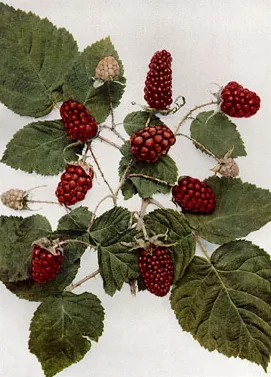
The loganberry sprang from a cross between a blackberry and a raspberry, bred long ago and grown ever since for its big, deep red fruit. It sits squarely in the rose family beside its bramble cousins, and just like a blackberry it grips its core when you pick. The flavor lands right between its parents, brighter than a raspberry and fuller than a blackberry, which makes every handful worth chasing.
It powers along as a trailing perennial, firing out long, fast canes that leap for a fence or trellis instead of standing alone. The plant keeps going for years, while its canes race through a two-year cycle: they shoot up one season, fruit the next, then bow out. Nail that cycle and pruning falls right into place.
This one thrives in the open garden, hardy across USDA zones 5 to 9 and eager for room to sprawl. It asks for little, though hard cold does knock it back, and it will pile into a thicket fast if the cane tips root where they land. Hand it a sheltered, sunny spot and stay on top of those canes, and it pays you back in spades.
Care
The short version: full sun, rich well-drained soil, and a dependable 1 to 2 inches of water a week. Run the canes up a trellis, feed in early spring, and clear out each cane the year after it fruits.
Light
Loganberries crop hardest in full sun, and that is exactly where the fruit turns its sweetest. They will shrug off a little partial shade, but the shadier the spot, the fewer and smaller the berries you get to pick.
Water
Pour on 1 to 2 inches of water a week, and crank that up while the plant flowers and the fruit swells. Keep the soil moist but never sodden, since the canes recoil from sitting in waterlogged ground.
Soil
Dig it into rich, well-drained loam loaded with organic matter and the roots will take off. A slightly acidic pH between 5.5 and 6.5 hits the mark, and sharp drainage keeps everything healthy.
Temperature
This plant powers through a wide range, from about 5°F to 86°F (-15°C to 30°C), which drops it into USDA zones 5 to 9. Hard cold still bites, though, so shelter or cover the canes where winters really hammer down.
Humidity
Everyday outdoor humidity in the 40% to 70% band is no trouble at all. Airflow is the thing to chase, since still, damp air around crowded canes is just what gray mold and purple blotch jump on.
Feeding
Feed it in early spring as new growth breaks, reaching for a nitrogen-rich balanced fertilizer such as 10-10-10 and finishing with compost. One seasonal feed is all it takes to drive a powerful flush of canes.
Pruning
Pruning tracks the cane cycle, plain and simple. Cut the spent floricanes that just fruited right to the ground after harvest, run the fresh primocanes up the trellis, then tidy and tie the lot over late winter.
Repotting
This is a ground plant that hardly ever sees a pot. If you do container-grow one, refresh it or move it up every 1 to 2 years in late winter, and watch for roots circling the pot or water running straight through.
Size & spacing
Plants shoot to 5 to 6.5 feet (150 to 200 cm) tall and sprawl a sweeping 6 to 10 feet (1.8 to 3 m) wide along the trellis. Turn those long trailing canes loose with plenty of room to run.
When to plant
The loganberry runs on the seasons outdoors, not any indoor clock. Get young plants out in early spring once hard frost clears, or in late fall where winters stay mild. It bursts into bloom in late spring, and the fruit rolls in from late June through August.
Northern hemisphere
Southern hemisphere
Typical months for a temperate climate: start earlier in warm zones, later where spring frosts linger.
- Plant: Early spring after the danger of hard frost has passed, or late fall in mild-winter regions
- Harvest: Blooms late spring; harvest late June through August
Hardiness
USDA hardiness zones: 5–9
Temperature: down to -29°C
Troubleshooting
Nearly every loganberry hiccup lands on the canes or the ripening fruit, and a damp stretch usually kicks it off. Jump on the early signs and you head it off before it races down the row. Pin down what you are seeing below, then move on it while it still pays off.
Purple-brown blotches racing along the canes
Those spreading marks spell purple blotch, a fungus that grabs the canes and tears ahead in wet weather and a crowded planting. It kicks off small at the nodes, then the spots swell and merge. Cut out the infected canes, thin the rest to drive air through, and only reach for a labeled fungicide if it truly digs in.
Fix:
- Prune out and destroy infected canes
- Thin canes to open the canopy
- Apply a labeled fungicide if infection is severe
Soft berries furred over with gray mold
That fuzzy coat is gray mold, powered by botrytis, and it storms in during damp, humid spells right as the fruit ripens. The berries go soft, then cave under the gray fur. Strip off and bin anything infected, pick ripe fruit often so none lingers, and open the canopy up so the berries dry fast.
Fix:
- Remove and discard infected fruit
- Harvest ripe berries promptly and frequently
- Improve airflow around the canopy
Canes that stay brown and never break bud in spring
Trailing brambles like the loganberry take the cold hard, so a rough winter can leave you with dead canes even when the crown below powers through. Hunt for brown, brittle wood that snaps instead of bending. Cut those dead canes back to live tissue or the ground, and in cold spots mulch the crown and lower or cover the canes before winter slams in.
Fix:
- Prune dead canes back to live tissue or the ground
- Protect canes over winter in cold sites
Toxicity
Great news for a home full of pets and kids: the loganberry packs nothing poisonous. The berries are a safe snack and every part of the plant is harmless to swallow. The only real hazard is physical, since standard canes bristle with sharp prickles, so pull on gloves to prune and grab a thornless cultivar if scratches would put you off.
Safe for
People · Cats · Dogs · Horses · Rabbits · Livestock · Birds
Cats None
Safe to have around a cat. One that nibbles a leaf faces no danger at all, though the prickles on thorned canes can scratch a curious nose.
Dogs None
Nothing toxic in here, so a dog can share a few ripe berries. Gulp down a heap of leaves and it might get a passing upset stomach, but nothing more.
Horses Safe
Horses can graze near the canes with no harm done. The thorns are the one thing to watch, since a sharp prickle can scratch the muzzle.
Rabbits Safe
Rabbits can browse the leaves and fruit to their hearts' content. The plant carries nothing poisonous, so it counts as safe forage.
Livestock Safe
Cattle, goats, and sheep can graze the foliage with no risk of poisoning. The stems do bristle with prickles, so the thorns are the only real concern.
Birds Safe
Birds go wild for the ripe berries and come to no harm from them. They help themselves to the crop and scatter the seed as they go.
People Safe
The berries are a treat eaten fresh or cooked, and the whole plant is safe. The thorns on standard forms are the only thing that bites back, so glove up before you prune.
Thorned forms bear sharp prickles that can scratch pets and handlers, while thornless cultivars exist; wear gloves when training or pruning canes.
Varieties
The loganberry keeps things simple with just a couple of forms to know, split mostly by whether the canes carry thorns. Meet the two you are most likely to track down.
Thornless Loganberry (L654)
Its smooth, spineless canes make picking and training a breeze next to the thorned form.
Loganberry LY59
This is the standard thorned, heavy-cropping clone that growers have raised commercially for years.
Companions
The loganberry shares soil diseases with a few common crops, so the smarter move is knowing what to keep it away from rather than what to plant beside it.
Keep apart
Solanaceous crops (tomato, potato, pepper, eggplant): Share Verticillium wilt; avoid planting brambles where these crops recently grew
Wild brambles: Can harbor viruses and diseases that spread to cultivated canes
How to propagate
Multiplying loganberries is a blast, and the plant does the heavy lifting the moment a cane tip drops down and grabs the soil.
LayeringEasy
Late summer to early fall · Roots in about 4 to 8 weeks; transplant the rooted tip the following spring
Tip-layering is the go-to move for making more trailing brambles, and it barely asks a thing of you. In late summer or early fall, bend a growing cane tip down and bury it in the soil, where it fires out roots in about 4 to 8 weeks. Leave it put, then lift the rooted tip to its new spot the following spring.
Stem cuttingsModerate
Summer (softwood) or late winter (hardwood) · Several weeks to a few months to root and establish
Cuttings run less common than tip layering but work a treat for bulking up the thornless clones. Take softwood cuttings in summer or hardwood ones in late winter, and give them several weeks to a few months to root and settle before you count them as established.
Myths
A loganberry is just a kind of raspberry.
Not so fast, because it is a cross between a blackberry and a raspberry, and it runs with the trailing blackberries rather than the raspberries. Like a blackberry, it holds onto its core when you pick the fruit, which is the fastest way to tell the two apart.
Every loganberry plant has thorns.
Not true, since both thorned and thornless cultivars are out there, so prickles are never a given. Choose a spineless form and the picking and pruning get much easier, with no sharp canes to battle through.