Shrub · Rosaceae
Rugosa Rose
Rosa rugosa
The rugosa rose powers through salt spray and deep cold, blooms all summer long, and finishes the season loaded with red hips.
Full sun
Every 7–14 days
USDA 2–7
4–6 ft · 1.2–1.8 m
Overview
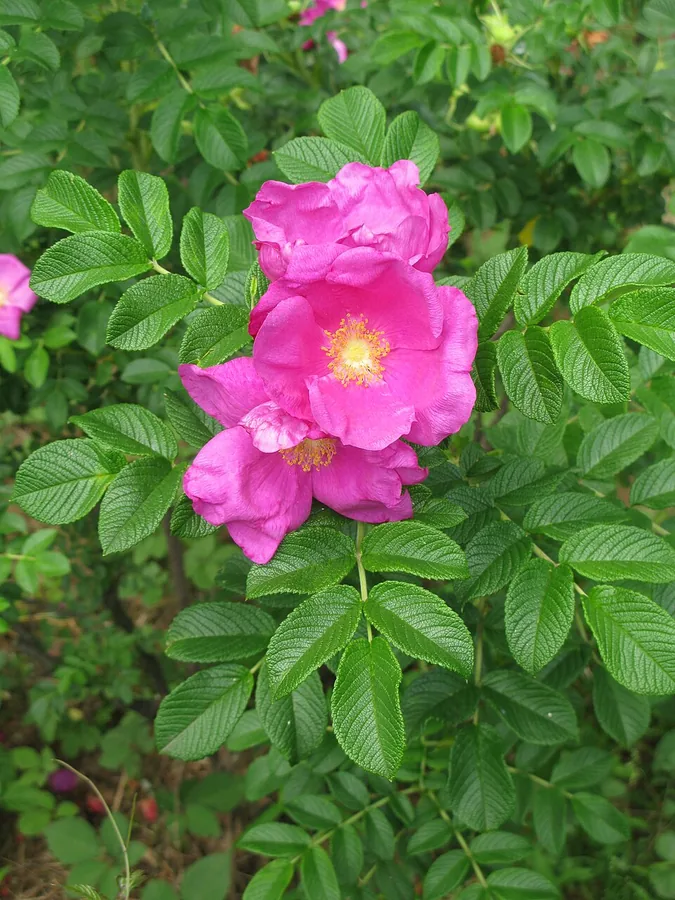
Here is a rose that loves to grow. The rugosa rose throws itself into the job, asking for almost nothing and handing back fragrant flowers and a huge crop of glowing hips. It sprang from the coasts of eastern Asia and took to the seaside with such gusto that gardeners nicknamed it the beach rose. One look at its wrinkled, leathery leaves and thickly prickled stems and you know this is no fragile hothouse rose.
Toughness is where it really shines. It powers through salt spray, drought, and biting cold near the bottom of its range, grips banks and dunes with fast-spreading roots, and brushes aside most of the diseases that flatten other roses. Its blooms burst open single or double, from white to pink to a deep reddish purple, and the fragrance rolls right across the garden.
All that drive comes with a flip side worth respecting. The plant suckers hard and races into dense thickets, and along parts of the North American coast it has bolted out of gardens and shoved aside native plants. Keep it somewhere you can rein it in and it rewards you as one of the easiest roses going, capped off by red hips that are edible and bursting with vitamin C.
Care
The short version: plant it in full sun and just about any soil, sandy or salty included, and watch it take off. Water it well while it roots in, then let it run on its own, feed it sparingly, and prune in late winter to shape it and keep those eager suckers in check.
Light
Plant it in full sun and it repays you with the biggest flush of flowers and the toughest disease resistance going. It will soldier on in partial shade, but shade and crowding leave it damp and quick to spot, so chase the sun for the best show.
Water
Water it deeply and often while it roots in, then back right off, because a settled rugosa turns drought tolerant and powers through dry spells. Water at the base in the morning, never over the top, and you keep the foliage dry and disease at arm's length.
Soil
This rose digs into almost anything you give it, from sandy and gravelly coast to clay and poor ground. It leans toward moist, well-drained, slightly acidic loam and a pH from 6.0 to 7.5, but it is not remotely picky.
Temperature
Its range is jaw-dropping, running from a brutal -51°F to 86°F (-46°C to 30°C). That deep cold hardiness is exactly what lets it take off in the far north where other roses simply quit.
Humidity
There is no humidity figure to chase here, so put the meter away. Air movement is the real driver, since still, crowded air is what hands leaf diseases their opening.
Feeding
Keep feeding light, because this rose actually revels in lean soil. One quick feed of balanced or rose fertilizer in spring is all it wants, and piling on more does more harm than good.
Pruning
Come late winter to early spring, shape it up and cut out any dead or weak canes to keep it charging. Dig or pull the suckers in the same go, or this eager grower will keep marching outward.
Repotting
A rugosa is happiest turned loose in the ground and rarely wants a pot, so repotting barely comes up. If you do run one in a container, size it up when roots circle the base or burst out the drainage holes, or when it wilts right after every watering.
Size & spacing
Expect a rounded shrub that hits 4 to 6 feet (120 to 180 cm) tall and just as wide, so hand it plenty of room to stretch. Then leave a bit more, because those suckering roots love to grab extra ground.
When to plant
Get a rugosa rose in the ground in spring or fall and it grabs hold fast. The flowers pop in late spring and keep firing through summer, and by late summer the red hips ripen and cling to the canes deep into winter.
Northern hemisphere
Southern hemisphere
Typical months for a temperate climate: start earlier in warm zones, later where spring frosts linger.
- Plant: Spring or fall
- Harvest: Blooms late May to July with intermittent rebloom until frost; showy red-orange hips ripen August into winter.
Hardiness
USDA hardiness zones: 2–7
Temperature: down to -46°C
Troubleshooting
This rose is such a strong grower that real trouble rarely gets a foothold. Most of what turns up is either eager suckers wandering off or a bit of spotting on the leaves, so catch the early signs below and jump in before anything spreads.
A twisted red broom bristling with extra thorns
A tight, warped broom of red shoots loaded with oddball prickles flags rose rosette disease, a virus ferried by tiny eriophyid mites with no cure once it lands. Dig out and destroy the infected plant fast to guard the roses around it. Milder clustered, stressed growth usually traces to aphids, scale, thrips, or spider mites, and a hard jet of water or a quick cut of the worst canes knocks them right back.
Fix:
- Promptly remove and destroy plants showing rose rosette symptoms to protect nearby roses
- Treat heavy insect infestations with a strong water spray or appropriate control
- Remove and dispose of badly infested canes
Fresh shoots shooting up far from the crown
That is the rugosa rose flexing its natural suckering habit, the very trait that lets it build a thicket in record time. Its shallow roots keep firing up new canes well away from the crown, so cut and dig them the moment they show, or box the plant behind a root barrier from day one. Growing near dunes or wild ground? Reach for a tidy named cultivar instead.
Fix:
- Cut and dig out suckers as they appear
- Install a root barrier or plant in a contained bed
- Choose a better-behaved named cultivar instead of the straight species
Spotted, blistered leaves dropping early
Rugosa brushes off most rose diseases, but rust, black spot, and powdery mildew can still muscle in where it is damp, shady, and crowded. Strip the marked leaves and rake up the fallen ones so the spores get no place to overwinter. Thin the canes to open up airflow and water at the base in the morning, never overhead, and the shrub bounces right back.
Fix:
- Remove and dispose of affected leaves and fallen debris
- Improve air circulation by thinning canes
- Water at the base in the morning rather than overhead
Toxicity
Great news for anyone keen to plant it: every part of the rugosa rose is non-toxic to cats, dogs, horses, and people, and the hips are edible and packed with vitamin C. The only thing that fights back is physical, the sharp prickles running down every cane, so grab your gloves and dig in.
Safe for
People · Cats · Dogs · Horses · Rabbits · Livestock · Birds
Cats None
No toxic compound lurks here, so a curious cat that grabs a petal or leaf is fine. Just keep an eye on the sharp prickles, which can scratch a paw or mouth.
Dogs None
A dog can chomp the leaves, flowers, or ripe hips with zero poisoning risk. Steer it clear of the thorny canes, since a bristling stem is the only real hazard here.
Horses None
Horses can graze the foliage and hips with no ill effect at all. The dense prickles are the catch, ready to prick a soft muzzle that reaches in.
Rabbits None
Rabbits happily browse the leaves and stems, and the hips make a great treat. Nothing in the plant is poisonous to them.
Livestock None
Cattle, goats, and sheep can graze the shrub without harm. The thorny canes mostly wave animals off rather than injure them.
Birds None
Birds go wild for the red hips and fling the seed far and wide, which is part of how this rose spreads on its own. Eating any part of it does them no harm.
People None
The hips are edible and loaded with vitamin C, brilliant in teas, jams, and syrups, and the petals are edible too. Just glove up around the canes, because those sharp prickles are the one thing that bites back.
Stems are densely covered in sharp, needle-like prickles that can cause scratches and puncture wounds; wear gloves and long sleeves when handling or pruning.
Varieties
Most rugosa roses you can buy are named cultivars, each one selected for a knockout flower color, a strong scent, or a tidier shape. These are the standouts you are most likely to track down.
Hansa
A powerhouse grower whose double, reddish-purple flowers throw a strong scent and set big red hips.
Blanc Double de Coubert
A tough, disease-resistant standout with semi-double, pure white blooms and an intense fragrance.
Frau Dagmar Hastrup
A compact charmer with single silvery-pink flowers that load up into a heavy crop of large red hips.
F.J. Grootendorst
Its small red flowers come fringed like a carnation and pile into clusters for bloom that hardly ever quits.
How to propagate
Multiplying a rugosa rose is a genuine thrill, and it hands you three ways to do it: lift one of its many suckers, root a summer cutting, or grow it from the seed tucked inside the hips.
DivisionEasy
Late winter to early spring or fall · 1 to 2 seasons
Because rugosa grows on its own roots and pumps out suckers nonstop, the quickest win is to slice a rooted sucker off the parent and replant it in late winter to early spring or in fall. Give it a season or two to dig in, and it powers on as a perfect copy of the original.
Stem cuttingsModerate
Summer (softwood or semi-hardwood) · Several weeks to root, then 1 to 2 seasons to establish
Nurseries lean hard on cuttings, snipped in summer from healthy current-season growth as softwood or semi-hardwood. They root over several weeks, then take a season or two to bulk up into a sturdy shrub.
SeedModerate
Sow cleaned seed from ripe hips in fall, or stratify and sow in spring · 1 or more years
Every ripe hip is crammed with 20 to 120 seeds, so material is never the problem, though patience is. Sow cleaned seed in fall, or cold-stratify and sow in spring, then brace for slow, uneven sprouting and a year or more before the seedlings hit their stride.
Myths
The rugosa rose is a well-behaved native you can plant anywhere along the coast.
Not so. It hails from eastern Asia, not North America, and it has bolted out of gardens to turn invasive along the coasts of New England, Virginia, and parts of Canada. There it throws up dense thickets that crowd out the native dune plants, which is why it landed on Maine's advisory list and why it belongs nowhere near wild ground.
Because roses are non-toxic, the whole plant is completely safe to handle.
The eating checks out, since the leaves, flowers, and hips are safe for people and pets, so scratch the poison worry off the list. The canes are the catch, packed with sharp, needle-like prickles that scratch and puncture, so pull on gloves and long sleeves before you prune.