
Introduction
Anthracnose disease is a fungal disease that puts dark sunken lesions on leaves, stems, twigs, and fruit. Most people meet it on a shade tree first. But the same kind of trouble hits tomatoes, peppers, beans, mangoes, and many other crops in the garden. It is one connected problem wearing different masks, and that is why a fix for your maple often points the way to a fix for your tomatoes.
The plant disease is no small matter at the global scale. The fungus group behind most cases is Colletotrichum. It accounts for about 20% of yearly crop losses worldwide, plus another 10% lost after harvest. A survey of 495 plant pathologists ranked it the 8th most damaging group of plant-killing fungi. So the spots on a backyard leaf come from one of the heaviest hitters in farming.
This guide pulls trees, vegetables, and fruit into one place, with the science to back it up. You will learn how to spot the disease early, how to stop it before it spreads, and what actually works once it shows up. Think of it as your full playbook from first symptom to final treatment.
Here is the part that changes how you fight it. Fungicides shield healthy tissue, but they cannot cure a leaf that is already sick. The real work happens before the first spot appears. The disease loves cool to warm, wet, humid weather. It rides from leaf to leaf on splashing water, so it flares up after rainy spells and overhead watering.
What Is Anthracnose Disease
Anthracnose disease is a fungal disease that causes dark, sunken spots on leaves, stems, fruit, and twigs. You see it most on shade trees, vegetables, and fruit during cool, wet spring weather. The name sounds like one problem, but it points to a whole family of related infections.
The main culprit is a fungus called Colletotrichum. This single group holds about 340 known species, and one of them, Colletotrichum gloeosporioides, is the most common cause on warm-climate crops. Each species tends to attack its own set of hosts, so the bug on your maple is rarely the same one hitting your tomatoes.
Fungi are by far the biggest threat to plants. They make up roughly 90% of all known plant pathogens, and Colletotrichum sits near the top of that list. A survey of 495 plant pathologists ranked it the 8th most damaging fungal group in the world. That standing tells you this is a serious plant disease, not a minor cosmetic flaw.
The causal pathogen often slips into healthy-looking tissue and then goes quiet. This latent phase can last days or even months with no spots and no rot at all. The fungus waits, then breaks out once the fruit ripens or the weather turns wet, which is why a clean-looking plant can rot almost overnight.
Think of anthracnose the way you think of a shared surname. One last name can cover dozens of relatives who look alike but act on their own. So expect a family of fungal disease problems here, not one bug with one tidy fix.
Colletotrichum spp., among the most destructive crop pathogens, account for approximately 20% of global annual yield losses, with an additional 10% lost after harvest.
Spotting Anthracnose Symptoms
I knelt at the raised tomato beds after a week of rain and checked the lower fruit. I found dark sunken lesions on the bottom row, each one weeping a faint pink ooze. At the fence line the old sycamore dropped blotched leaves all that same spring. Two plants. One disease. It just wears a different face on each host.
That is the tricky part with anthracnose symptoms. The signs shift by plant part and by weather, so a tomato grower and an oak owner can stare at the same fungus and not know it. The fix is to read symptoms the way a diagnostician does, one part at a time.
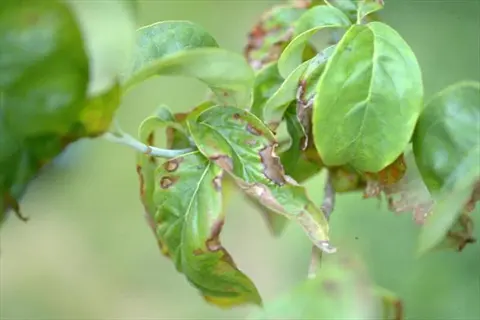
Start with the leaves, then the stems and twigs, then the fruit. On most plants you will spot small leaf spots first, often water-soaked or yellow-brown, that grow into larger blotches. On shade trees these run along and between the veins, which is your first clue it is anthracnose and not a scattered, rounded leaf-spot disease.
Weather steers what you see. Dry heat pushes the disease toward foliar blight and scorched, curling leaves, while long wet spells drive it into stems and fruit. Heavy spring infection on trees can trigger premature defoliation, and on fruit you get round, sunken lesions that end in fruit rot. The table below sorts the signs by plant part so you can match yours fast.
Tree leaves and twigs
- Leaf pattern: Dark brown to black blotches form along and between the veins, often making infected leaves look scorched or curled.
- Timing: On shade trees the worst leaf damage shows in cool, wet spring weather, sometimes causing early leaf drop.
- Twig signs: The fungus can kill the tips of young twigs and form small cankers that overwinter and start next year's infections.
- Host clue: Ash, maple, oak, sycamore, and dogwood each show slightly different blotch patterns from their own host-specific fungi.
- Recovery: Established trees usually push out a healthy second flush of leaves by midsummer even after heavy spring defoliation.
- Confusion risk: Vein-aligned browning helps separate anthracnose from scattered, rounded spots caused by other leaf-spot diseases.
Vegetable leaves and stems
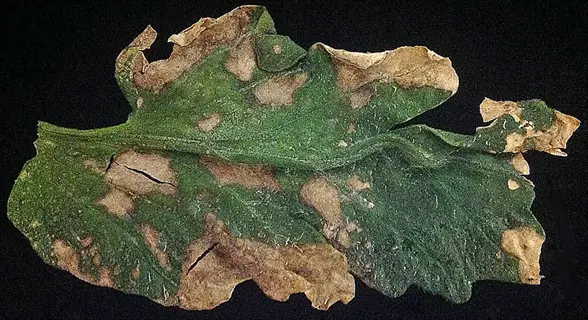
- Leaf spots: Small water-soaked or yellow-brown spots enlarge into dark, sometimes sunken lesions on tomato, bean, cucumber, and pepper foliage.
- Stem damage: Lesions on stems and stalks can girdle tissue, leading to wilting, dieback, and weak, collapsing plants.
- Spread pattern: Spots often appear first on lower leaves close to the soil where rain splash and irrigation reach them most.
- Spore sign: In humid weather the centers of older lesions may ooze pink to salmon spore masses that confirm the disease.
- Severity: Heavy infection reduces leaf area and weakens the whole plant, cutting yield well before harvest.
- Differential: Unlike even, edge-wide salt burn, anthracnose spots are usually scattered, sunken, and centered within the leaf.
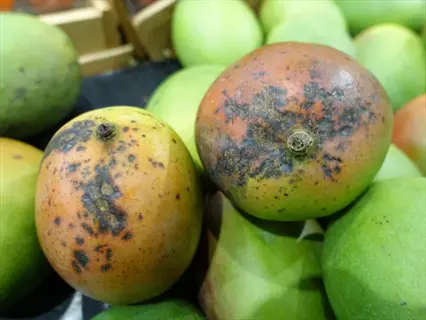
Fruit lesions
- Classic look: Round, dark, sunken spots appear on fruit such as mango, papaya, tomato, pepper, and strawberry as they ripen.
- Surface ooze: Lesion centers often develop concentric rings and a pink to orange spore mass in moist conditions.
- Hidden start: Fruit can be infected early yet look clean, because the fungus waits in a latent phase until the fruit ripens.
- Postharvest risk: Spots frequently expand after picking, which is why healthy-looking harvested fruit can rot during storage and shipping.
- Quality loss: Even small lesions make fruit unsellable, driving major postharvest losses in mango and papaya.
- Spread caution: Handling and packing wet, infected fruit alongside clean fruit moves spores onto sound produce.
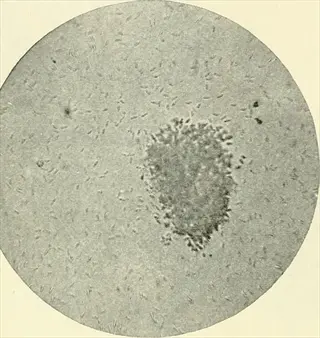
Spore signs up close
- Setae: Look for tiny black, hair-like bristles arranged in groups within the lesions, a structure called an acervulus.
- Spore color: In moist weather these structures release sticky orange to salmon-pink spore masses that smear when touched.
- Spread method: Because the spores are sticky, they move mainly by water splash, hands, and tools rather than drifting far on wind.
- Magnification help: A simple hand lens makes the setae and spore masses easy to see and confirms anthracnose over look-alikes.
- Where to check: Examine the centers of older, sunken lesions on leaves, stems, and fruit where these structures concentrate.
- Why it matters: Confirming the spore signs prevents wasted sprays on disorders like sunscald that anthracnose can resemble.
Before you reach for a spray, rule out the look-alikes. Salt burn scorches leaf edges in an even band, while anthracnose spots sit scattered and sunken inside the leaf. Sunscald leaves pale, papery patches on the side facing the sun, with no pink ooze. And powdery mildew coats the surface in white dust you can rub off, where anthracnose lesions are dark and sunken into the tissue.
When you are unsure, get close with a hand lens. Hunt for the orange to salmon spore masses in the center of an older spot. That sticky smear of spores is the one sign no other problem can fake. It tells you to stop guessing and start a real plan.
Plants and Crops at Risk
The list of plants affected by anthracnose is long, and it reaches far past the shade tree in your yard. This fungus hits trees, garden vegetables, and tropical fruit with the same dark, sunken spots. Knowing which group your plant falls into tells you how worried you should be.
Many anthracnose fungi are host-specific. The strain that infects your ash tree cannot jump to a nearby maple or oak. Each of those trees can still get anthracnose, but only from its own matching fungus. That narrow host range is why the disease on one plant rarely sweeps through everything you grow at once.
Severity swings a lot by host. On established anthracnose on trees, the damage is mostly cosmetic and the canopy fills back in. On tropical fruit the stakes climb fast. Unmanaged mango plantations can lose up to 100% of the crop, and papaya loses about 25% to 40% after harvest. Mango fields have reported roughly 39% losses in India and as high as 62.8% to 63.2% in Thailand.
Mango sits at the top of the high-risk anthracnose host plants. Every grown mango is at risk, and no type on the market beats every strain. Even the tougher ones stay among the susceptible plants. They still need clean tools, good air flow, and morning watering to stay ahead of the fungus.
Conditions That Trigger It
You can boil the conditions favoring anthracnose down to a few numbers you can watch. The one that matters most is leaf wetness. Once your leaves stay wet for 4 or more hours after rain or watering, spores get the time they need to germinate. Then they push into the leaf and the trouble starts.
Temperature sets the pace, and it splits by host. On tropical crops the fungus takes off when humidity climbs above 90%. It wants warm air too, around 22 to 32°C (72 to 90°F). Shade trees go the other way. Your trees catch it worst in a cool, wet spring near 50 to 68°F (10 to 20°C), when young leaves are soft and the canopy stays damp.
Overhead watering in the evening keeps leaves wet overnight, easily clearing the four-hour wetness window the fungus needs, so water at the base in the morning instead.
How anthracnose spreads surprises people who expect it to blow in on the wind. The spores are sticky, so they move by water splash, hands, and dirty tools far more than through the air. A hard rain or an overhead sprinkler kicks them off an old lesion and onto fresh growth, where the wet surface lets them settle in. Even on a dry day they can wait up to 48 hours without leaf wetness and still infect once the next shower hits.
Here is the chain that ties it together. The fungus overwinters in fallen leaves, twigs, and cankers. In the next mild, wet stretch it releases spores onto your new growth. Rain or watering wets the leaves, the spores germinate, and the dark sunken lesions show up days later. Break any link in that chain and you stop the disease. That is why the prevention steps ahead lean so hard on dry leaves and clean tools.
How to Prevent Anthracnose
Knowing how to prevent anthracnose matters more than any treatment you can buy. Sprays only protect healthy tissue. They never fix a leaf or fruit the fungus has already entered. So your daily habits carry the real workload all season long.
Start with the plant itself. Resistant varieties are the best first line of defense. Pick cultivars bred to shrug off the disease whenever your crop or tree offers them. From there, every move you make should aim at one goal. Keep the leaves dry, because the fungus needs wet foliage for about four hours to break in.
The lower leaves on my raised tomato beds came up freckled with dark splash spots one July. The evening sprinkler had been soaking the plants overnight, so I swapped it for a soaker hose on a sunrise timer. The next season the new growth came in clean, and I never reached for a single spray.
Morning watering with drip or a soaker hose gives the sun all day to dry the canopy before night. Good air circulation does the rest. Space your plants, thin crowded growth, and prune for airflow so humidity stays low and wet leaves dry fast. The steps below put the whole routine in order.
- Resistant varieties: Choose disease-resistant cultivars where they exist, since they are the recommended first line of defense against anthracnose.
- Morning watering: Water at the base in the morning with drip or soaker hoses so leaves dry fast and never stay wet for four hours.
- Air circulation: Space plants and prune for airflow so foliage dries faster and humidity around the canopy stays lower.
- Tool sanitation: Disinfect pruners and tools between cuts and plants so the sticky spores are not carried to healthy growth.
- Debris cleanup: Rake and remove infected fallen leaves and twigs, and do not compost them, to cut the overwintering spore supply.
- Pruning: On trees, prune out diseased twigs and cankers about 4 inches (10 centimeters) below the visibly affected area.
Field sanitation ties it all together. The spores are sticky, so they ride on your hands, your pruners, and old plant debris straight to clean leaves. Wipe down tools between plants. Bag up infected leaves and twigs, and keep them out of the compost pile. That waste would only feed next year's outbreak.
Treating and Controlling It
Most blogs hand you the same vague advice: spray a fungicide and hope. The honest part they leave out is that fungicides protect healthy tissue but never cure tissue that is already sick. Any good anthracnose treatment starts with that fact, so you spray before infection takes hold, not after the lesions show up.
So your first job is cleanup. Your second is to decide if a spray is worth it at all. The four options below run from no chemicals up to careful chemical control. Each one fits a different plant and a different level of risk.
Cultural control first
- Why first: Removing infected tissue, improving airflow, and keeping foliage dry stop new infections without any chemicals.
- On trees: Established shade trees rarely need more than cleanup, since they re-leaf by midsummer and outgrow spring damage.
- Limit: Cultural control prevents spread but cannot heal lesions already present, so it works best applied early and consistently.
- Best fit: This is the right primary approach for home gardens, ornamentals, and low-value plantings most of the time.
Protectant fungicides
- How they work: Products such as chlorothalonil, mancozeb, and copper coat healthy tissue and block spores before they infect.
- Timing: Apply before and during cool, wet weather and reapply at the shorter 7 to 10 day interval while conditions stay favorable.
- Key limit: They protect only healthy tissue and never cure existing infection, so spraying after lesions appear is largely wasted.
- Caution: Systemic fungicides are not recommended for edible plants, so check the label for the specific crop and interval.
Organic and biological control
- Options: Bacillus subtilis products, liquid copper, sulfur, and neem oil give organic growers protectant-style coverage.
- Strengths: Some biologicals are gentle on pollinators and fit edible gardens, supporting greener management programs.
- Limit: Like synthetics, these suppress new infection rather than cure tissue that is already infected.
- Best fit: Useful for organic vegetable and fruit programs when applied early and reapplied through wet, humid spells.
Resistance management
- The risk: Fungicide susceptibility in some Colletotrichum populations can decline with repeated use of one product.
- The fix: Rotate fungicides with different modes of action rather than relying on a single chemistry season after season.
- Pair it: Combine chemical sprays with resistant varieties and sanitation so chemicals are not doing all the work alone.
- Why it matters: Protecting the tools you have keeps treatment effective for the long term across repeat growing seasons.
Here is the simple rule for when chemical control earns its place. If you grow shade trees, skip the spray. Use fungicides only after a tree drops most of its leaves for several springs in a row. Healthy trees re-leaf by midsummer and shrug off the damage on their own.
Vegetables and fruit flip the math fast. A crop like mango or tomato can lose a whole harvest. So sprays of copper or chlorothalonil pay off once cool, wet weather sets in. Organic growers can use Bacillus subtilis, sulfur, or neem oil instead. These give the same protectant cover and fit an edible garden.
Whatever you spray, rotate your modes of action. That keeps the fungus from learning to shrug it off. Pair the chemical work with resistant varieties and clean tools too. Then your sprays do far less of the heavy lifting alone.
5 Common Myths
Anthracnose is a single disease caused by one specific fungus that behaves the same way on every plant.
It is a group of diseases caused by several fungi, mostly Colletotrichum species, with about 340 recognized species behaving differently by host.
Spraying a fungicide after you see lesions will cure the infection and bring the damaged tissue back to health.
Fungicides only protect healthy tissue from new infection; they cannot cure tissue that is already infected, so timing before wet weather is key.
If a shade tree gets anthracnose and drops its leaves in spring, the tree is dying and should be removed.
Established trees are rarely seriously harmed and usually produce a healthy second flush of leaves by midsummer without any treatment.
Anthracnose is mainly a cosmetic problem and never causes serious losses in real farms or gardens.
Colletotrichum species cause about 20 percent of global yield losses, with mango losses reaching up to 100 percent in unmanaged plantations.
The anthracnose fungus on one tree species will quickly jump to and infect every other tree nearby.
Many anthracnose fungi are host-specific; for example, the fungus infecting ash cannot infect maple or oak, which have their own pathogens.
Conclusion
Here is the spine of everything above. Anthracnose disease is not one sickness with one cure. It is a group of fungal diseases driven by wet weather and spread when water splashes spores from leaf to leaf. So the fix is never a single product. You treat it as a pattern of conditions, and you change those conditions before the lesions show up.
Keep the hardest truth front and center. A fungicide protects healthy tissue but cannot cure what is already infected. That one fact reshapes your whole plan. The real defense lives in resistant varieties. It lives in watering at dawn so leaves dry fast. It lives in good airflow, clean tools, and raking up the fallen debris where the fungus overwinters. Get those habits right and you lean on sprays far less.
If your worry is a big shade tree, you can relax a little. Established trees usually shrug off an attack. Most re-leaf by midsummer, so the damage tends to look bad but stays cosmetic. Save your urgency for high-value vegetable and fruit crops. That is where this plant disease turns costly fast, with up to 100% loss reported in unmanaged mango plantations.
Let your watch for prevention become a habit, not a panic. Scout your plants after rain and note when leaves stay wet for 4 hours or more, since that window is when infection takes hold. Acting in that gap beats reacting once spots appear. Colletotrichum is tied to roughly 20% of global yield losses each year. So this calm, ahead-of-trouble routine matters in your backyard and on the world's farms alike.
Glossary
- Acervulus
- A small, saucer-shaped fungal fruiting structure in anthracnose lesions that holds groups of black bristles and releases spores.
- Colletotrichum
- The fungal genus responsible for most anthracnose diseases, with about 340 recognized species attacking many different plants.
- Latent infection
- A hidden stage where the fungus stays dormant and symptomless inside healthy-looking tissue before lesions or fruit rot appear later.
- Leaf wetness
- The length of time leaf surfaces stay wet after rain or watering; four or more hours can trigger anthracnose infection.
- Postharvest disease
- A disease, such as fruit rot, that develops on produce after it has been picked, often during storage or shipping.
- Protectant fungicide
- A spray that coats healthy plant tissue to block new infection but cannot cure tissue that is already infected.
- Setae
- The tiny black, hair-like bristles found in anthracnose lesions that help confirm the disease under a hand lens.
- Systemic fungicide
- A fungicide absorbed into plant tissue that moves within the plant, generally not recommended for use on edible plants.
External Sources
Frequently Asked Questions
What causes anthracnose disease?
Anthracnose is caused by several fungi, most often species in the genus Colletotrichum, that spread by water splash in wet conditions.
Will anthracnose go away on its own?
Established trees usually outgrow it and re-leaf by midsummer, but infected tissue does not heal, and crops often need active management.
What is the best fungicide for anthracnose?
There is no single best fungicide; protectants like copper, chlorothalonil, and mancozeb work only when applied before infection.
When should you spray for anthracnose?
Spray protectively before and during cool, wet weather, reapplying at the shorter 7 to 10 day interval, not after symptoms appear.
How do you prevent anthracnose disease?
Choose resistant varieties, water at the base in the morning, improve air flow, sanitize tools, and remove infected debris.
Does neem oil get rid of anthracnose?
Neem oil can help suppress early fungal spread as a protectant, but it does not cure tissue that is already infected.
How long does anthracnose stay in soil and debris?
The fungus mainly overwinters in infected fallen leaves, twigs, and plant debris rather than living long in bare soil.
What time of year does anthracnose occur?
It appears most in cool, wet spring weather on trees, and in warm, humid periods on tropical fruit and vegetable crops.
Is anthracnose harmful to humans?
The fungi that cause plant anthracnose do not infect humans, though rotted fruit should not be eaten for general food safety.
How do you stop anthracnose from spreading?
Remove infected tissue, avoid wetting foliage, sanitize tools between cuts, and protect remaining healthy growth with a protectant.