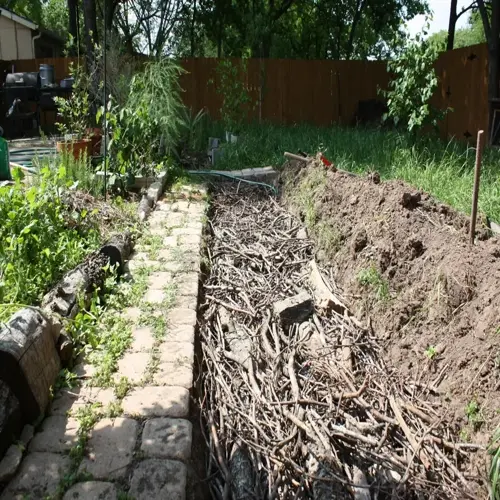

The best mulch that stays put is the heavy, coarse kind: coarse wood chips, bark nuggets, and stone. These hold their ground in hard rain and on slopes because the chunks are too heavy and too tangled to float off. Fine, light mulches do the opposite. They lift on a wave of runoff and slide downhill in minutes, so you end up spreading the same bed twice in one season.
A pale stripe of bare soil cut straight down the sloped back bed after a July storm in my zone 7 garden. The shredded mulch I had raked in that spring sat in a soggy pile at the bottom of the slope. I pulled it all out and spread bark nuggets instead, big knuckle-sized pieces. The next heavy rain ran right over them and the soil underneath stayed dark and covered.
The reason comes down to weight and shape. Water moving over your bed pushes on every piece it touches. A light particle like a cocoa hull or a loose straw stem weighs almost nothing wet, so it floats and rides the current off the bed. A heavy chunk sits low and the water slides past it. Coarse pieces also lock together at their rough edges, so the whole layer moves as one mat instead of scattering one bit at a time.
Wind plays the same game as water. If your bed sits in an open, gusty spot, fine and fluffy mulches blow off long before the first rain even arrives. You will find loose straw piled against the fence and cocoa hulls scattered across the lawn. The same heavy chunks that beat runoff also shrug off wind, so you do not have to pick one problem over the other. One coarse mulch handles both.
Here is how the common choices for mulch for slopes stack up by staying power.
Pine needles are the dark horse on a hillside. Each needle is light, but they catch on each other and knit into a springy layer that water flows under instead of through. I have seen pine straw hold a steep bank for years with almost no slippage. If you have pines nearby you can rake your own for free. Coarse wood chips and bark nuggets are the reliable middle ground for most beds, and the bigger the piece, the better it stays. When you shop, skip the bags labeled shredded or fine and reach for the ones that say nuggets or large grade.
Grab a handful before you buy. If the pieces are bigger than your thumb and feel heavy, they will stay put on a slope. If they crumble or feel papery, save them for a flat, sheltered bed.
For your worst spots, stone mulch is the permanent answer. Gravel and river rock weigh far too much to move in any storm, so they basically never wash out. The tradeoff is that stone adds no nutrients to your soil and gets hot in summer sun. Use it where erosion keeps winning, like a bare drainage channel or a steep strip you are tired of refilling every year. Once you set it, you can forget it.
On any slope, pick a coarse interlocking mulch and give the water something to slow it down. Set a low edge or a small terrace across the grade so runoff pools and drops its speed instead of racing straight downhill. Lay your mulch 3 to 4 inches deep so it forms a real mat that water has to work through. Where the grade is steep and erosion keeps winning, switch that section to stone and stop fighting it. Match the mulch to the slope and you will not be out there every spring raking it back up the hill.
Read the full article: 10 Types of Mulch for Every Garden