Shrub · Apocynaceae
Asiatic Jasmine
Trachelospermum asiaticum
Tough, glossy, and happy in sun or deep shade, Asiatic jasmine carpets the ground and asks for almost nothing.
Full sun
Every 7–14 days
USDA 7–11
6–24 in · 15–61 cm
Overview
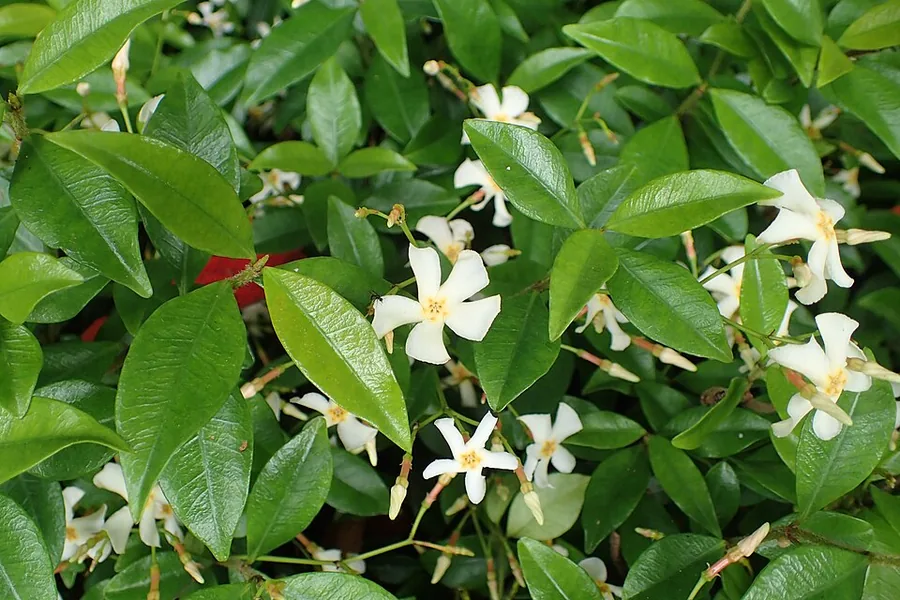
Asiatic jasmine is a low, evergreen groundcover prized for its dense mat of small, glossy leaves more than its flowers. It sits in the dogbane family and, name aside, is not a true jasmine at all. New growth frequently flushes a coppery bronze or red before it deepens to rich green, so the planting shifts color quietly across the year.
What wins most gardeners over is how little it demands. It takes full sun to deep shade, brushes off drought once established, and works in clay, loam, or sand. Hardy from zones 7 to 11, it pulls through down to about 10°F (-12°C) and powers on through heat up to 100°F (38°C), which is why it thrives under trees and along curbs where most plants give up.
The catch is sheer vigor. Those trailing stems root as they travel, so the same plant that blankets a bare slope will scale a trunk or run across a sidewalk if you let it loose. Hand it an edge to push against plus a yearly shearing, and it stays a clean, even carpet for decades.
Care
The short version: plant it almost anywhere from full sun to full shade, keep it watered through the first season, then mostly leave it be and shear it once a year in early spring to keep the mat dense and in bounds.
Light
Few groundcovers bend this easily to light. Asiatic jasmine grows in full sun all the way to full shade, though it stays thickest and colors up best with at least some sun. Heavy shade slows it and thins the mat a touch, yet it still holds firm.
Water
Keep the soil evenly moist through the first season while it roots in. After that it turns genuinely drought tolerant and rarely calls for extra water. Go light, since too much water is one of the triggers that tips it into aggressive, unruly growth.
Soil
It takes nearly any well-drained soil, clay, loam, or sand alike, across a generous pH band of 6.0 to 8.0. The one catch: strongly alkaline ground locks up iron and yellows the leaves, so aim for neutral to slightly acidic wherever you can.
Temperature
Hardy in zones 7 to 11, it powers through a wide swing from about 10°F to 100°F (-12°C to 38°C). That pairing of cold hardiness and heat tolerance is exactly what lets it carpet ground in climates that batter softer plants.
Humidity
Everyday outdoor humidity suits it fine, with no number to track. It takes humid Southern summers and drier spells right in stride.
Feeding
Feed it lightly, if at all. A small dose of balanced slow-release fertilizer in spring does the trick, and most established plantings need none. Overdo the fertilizer and all you get is faster, more unruly growth to cut back.
Pruning
The main task is a once-a-year mow or shear in early spring to renew the planting and keep it dense. Trim the edges here and there through the season to stop it creeping into lawns, beds, and walkways.
Repotting
Grown in the ground, it hardly ever needs repotting. In a container, bump it up only when roots circle the pot, push out the drainage holes, or water begins running straight through.
Size & spacing
It keeps low, just 6 to 24 inches (15 to 61 cm) tall, while each plant ranges wide, from 3 to 12 feet (91 cm to 3.7 m) across. Set plants 1.5 to 3 feet apart for groundcover and leave it room away from trunks and structures it might scale.
When to plant
Asiatic jasmine goes into the ground in spring, once the last frost is past and the soil starts warming. Plant it then and water it through that first season so it roots in, and it spends the next two years weaving into a solid evergreen carpet.
Northern hemisphere
Southern hemisphere
Typical months for a temperate climate: start earlier in warm zones, later where spring frosts linger.
- Plant: spring after last frost
- Harvest: late spring to early summer (blooms sparsely)
Hardiness
USDA hardiness zones: 7–11
Temperature: down to -18°C
Troubleshooting
This plant brings little trouble, and most hiccups are either a spreading habit that needs reining in or a soil issue you can put right. Match what you see below, then act fast before a small problem races across the planting.
Stems racing into the lawn and scaling nearby trees
This groundcover sprints, and every trailing stem roots wherever it lands on damp soil. Too much water, sun, or fertilizer kicks it into overdrive, sending stems up trunks and across walkways. Take charge: edge the bed, peel stems off shrubs and trees, and shear the whole planting once a year in early spring to reset it into a neat mat.
Fix:
- Trim and edge the perimeter regularly to keep it in bounds
- Pull or cut stems climbing trees and shrubs
- Mow or shear the whole planting once a year in early spring to renew it
- Reduce supplemental water and fertilizer to slow aggressive growth
Yellow leaves while the veins stay green
A leaf that yellows but keeps its green veins is signaling iron chlorosis, and alkaline soil tying up the iron is nearly always the culprit. Watch the newest growth, where it shows first. Reach for a chelated iron supplement to turn it around quickly, then work the soil pH down so it stays away for good.
Fix:
- Apply a chelated iron supplement
- Acidify or amend the soil to lower pH
Open gaps between plants through the first year
A fresh planting looks patchy and thin its whole first season, and that is exactly as expected. Asiatic jasmine pours the first year into building roots and needs about two growing seasons to knit together fully. Keep the soil evenly moist, set plants 1.5 to 3 feet apart to speed the fill, and let the second season power the spread.
Fix:
- Keep soil evenly moist while establishing
- Space plants closer (about 1.5 to 3 feet apart) for faster coverage
- Be patient; growth accelerates in the second season
Tiny bumps on the stems with sticky residue
Now and then scale insects set up on the stems and leaf undersides, leaving little bumps plus a sticky honeydew that invites sooty mold. Real pest trouble almost never strikes this plant. Knock the scale back with horticultural oil and snip out any stems that are heavily coated.
Fix:
- Treat with horticultural oil
- Prune out heavily infested stems
Toxicity
Welcome news for households with pets and children: Asiatic jasmine counts as non-toxic, and the related star jasmine holds a spot on the ASPCA non-toxic list. The one thing to keep in mind is that cut stems weep a milky latex that can irritate sensitive skin, so wear gloves when you prune.
Safe for
People · Cats · Dogs · Horses · Rabbits · Livestock · Birds
Cats None
Plant it freely around cats. The related star jasmine holds a spot on the ASPCA non-toxic list, and a curious nibble shouldn't trigger anything beyond a mild, passing stomach upset.
Dogs None
Dogs can roam the garden alongside it with no worry. No known toxin affects them, so a chewed stem might bring on a brief tummy grumble at most.
Horses Safe
Counts as safe around horses. No toxin lurks here, though as with any lush new foliage it pays to keep a horse from gorging on it.
Rabbits Safe
Carries no toxicity for rabbits. The leaves run tough and milky rather than tempting, so most rabbits skip it entirely.
Livestock Safe
Safe for cattle, goats, and sheep, with no poisoning on record. That bitter latex in the stems tends to steer grazing animals away on its own.
Birds Safe
Carries no toxic risk to birds. They can roost in the dense mat with no harm coming from the foliage.
People Safe
Safe to keep around children and adults. The cut stems do weep a milky latex that can irritate sensitive skin, so slip on gloves ahead of a big pruning job.
It is a member of the dogbane family (Apocynaceae) and exudes a milky latex sap when cut that may cause mild skin irritation in sensitive people; wear gloves when pruning. Despite the name it is not a true jasmine.
Varieties
Beyond the plain green form, a handful of selections bring color through variegated or brightly tinted new growth. These are the ones you'll meet most often.
'Snow-N-Summer' ('HOSNS')
A variegated pick whose new growth bursts open pink and white, then mellows to green and white as it matures.
'Variegatum'
Creamy white edges and marbling across green leaves hand this one its bright, two-tone punch.
'Bronze Beauty'
Picked for new foliage that flushes a deep bronze to reddish before greening up.
'Goshiki' / 'Ogon Nishiki'
New growth arrives in a blend of yellow, orange, and red to lay down a multicolored carpet.
'Elegant' / dwarf forms
These lower, tighter selections deliver a fine-textured dwarf groundcover wherever less height suits the spot.
How to propagate
Asiatic jasmine is a breeze to multiply, and it nearly does the work for you wherever a stem meets the ground.
LayeringEasy
Growing season · Several weeks to months
Layering tops the list for making more plants, since the trailing stems strike roots on their own wherever they meet moist soil. Pin a stem to the ground during the growing season and it grabs hold over the next several weeks to months, ready to clip free as a brand new plant.
Stem cuttingsModerate
Summer · Several weeks to a couple of months
Rooting semi-hardwood stem cuttings taken in summer works too, though it calls for a touch more attention than layering. Give them several weeks to a couple of months to root before you pot them on.
Myths
Asiatic jasmine is a true jasmine.
The name misleads: this is Trachelospermum asiaticum in the dogbane family, not a real jasmine, which lives in the genus Jasminum within the olive family. The common name is misleading, and the two plants share no close kinship at all.
Asiatic jasmine is the same as star jasmine and is grown for its flowers.
This is a separate plant from star or Confederate jasmine, keeping lower, denser, and smaller-leaved with far fewer blooms. It rarely flowers and is grown as a foliage groundcover, never for a floral display.