Ornamental · Apocynaceae
Blue Star
Amsonia tabernaemontana
Plant it in full sun and shear it after bloom, and Blue Star powers from spring flowers straight into glowing gold fall color.
Full sun
Every 7–14 days
USDA 3–9
2–3 ft · 0.6–0.9 m
Overview
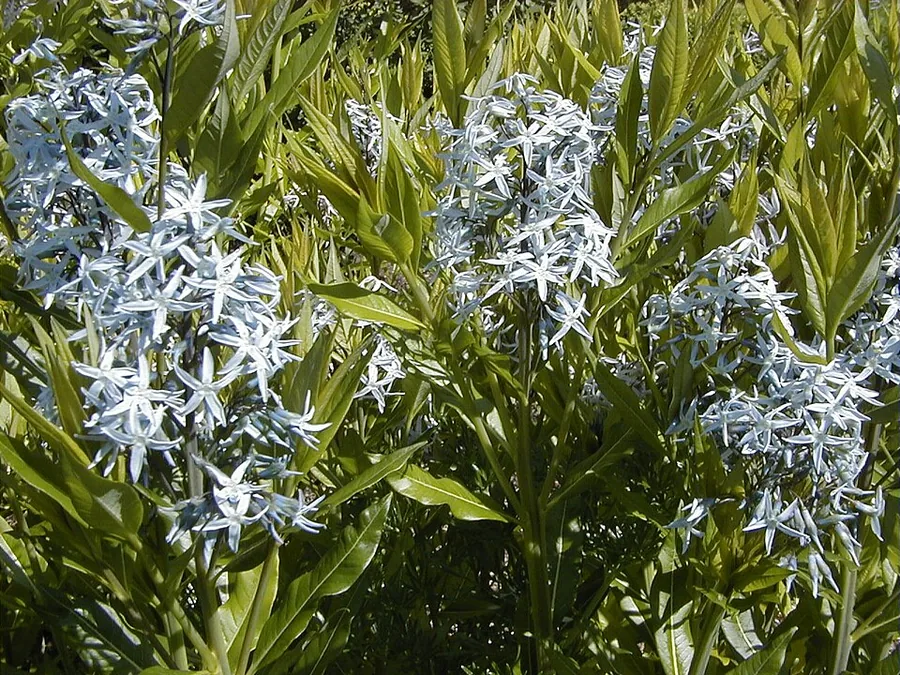
Blue Star pulls its weight from the moment it gets going. This tough native perennial builds a slow, shrubby clump of feathery green foliage that keeps its shape all season, then erupts in late spring with clusters of soft, steel-blue star-shaped flowers that stop people in their tracks. It comes from the dogbane family, and once those roots dig in it laughs off cold, heat, clay, and drought. Hardy from zone 3 to zone 9, it thrives just about anywhere you plant it.
And it keeps giving long after the flowers fade. Come autumn the narrow leaves catch fire in a clear golden yellow that sets a whole border alight, while the bitter, milky sap running through the stems sends deer and rabbits packing. Drop it in full sun and it springs up straight without a single stake, earning its keep as a backbone plant that gives back far more than it takes.
Care
The short version: full sun, average well-drained soil, and a bold shear the moment the flowers fade. It drinks little once established and barely wants feeding, so your one real move is cutting it back to keep it standing tall instead of flopping.
Light
Blue Star comes alive in full sun, where it bulks up dense and stands tall without a single stake. It will get by in partial shade or partial sun, but cut the light and the stems start to stretch, lean, and flop.
Water
Keep the soil evenly moist while the plant digs in, watering every 7 to 14 days. Once those roots take hold it shrugs off drought and even rides out the odd wet spell, so you can back right off the hose.
Soil
It charges ahead in just about any soil, loam, clay, or sand, as long as the water drains. Hand it a pH anywhere from 6.0 to 8.0 and it is good to go, and that covers most garden ground.
Temperature
Talk about tough: this perennial powers through winters down to -40°F (-40°C) and summer heat up to 100°F (38°C) without missing a beat. That muscle is exactly why it delivers from zone 3 all the way to zone 9.
Humidity
Plain outdoor air is all it asks, so forget chasing a humidity number. Good airflow is the thing to nail, because crowded, stuffy spots are what hand rust an opening on the leaves.
Feeding
Feeding barely registers here. A light topdressing of compost in spring does the trick, and piling on rich soil or fertilizer just turns the stems soft and floppy.
Pruning
The one move that pays off big is cutting the stems back by one-third to one-half the instant the flowers fade. That snaps the clump into a rounded, self-supporting shape, and deadheading on the spot keeps it from scattering seed across the garden.
Repotting
Established clumps almost never need lifting and bristle at being disturbed, so leave them to it. Dig and divide only when the center starts to die out or the flowering tails off, and that can be many years out.
Size & spacing
A mature plant shoots up to about 2 to 3 feet (61 to 91 cm) tall and spreads to match. Give each one roughly 2 to 3 feet (61 to 91 cm) of room so air rushes through and rust never gets a foothold.
When to plant
Blue Star roars back on its own every year, which makes it a joy to grow. Get new plants in the ground in spring after frost or in fall, watch the blue flowers burst open in late spring, then cut the whole clump back hard the moment the bloom wraps up.
Northern hemisphere
Southern hemisphere
Typical months for a temperate climate: start earlier in warm zones, later where spring frosts linger.
- Sow: Late winter to early spring; seed germinates readily but plants typically flower in their second year.
- Plant: Spring after frost, or fall.
- Harvest: Late spring (April to May), into early summer.
Hardiness
USDA hardiness zones: 3–9
Temperature: down to -40°C
Troubleshooting
Here is the best part: Blue Star throws almost no problems your way, and that is why growers keep reaching for it. Only two things ever really crop up, floppy stems and the odd patch of rust. Spot what matches below and you will knock out the fix in no time.
Stems that splay open and flop outward
When the stems splay and topple, flopping almost always traces back to too much shade or soil that is too rich, and skipping the post-bloom trim only makes it worse. Shear the stems by a third to a half the moment the flowers fade and the plant bounces back into a tight, self-supporting mound. Got a clump stuck in shade? Move it to a sunnier spot and watch it stand right back up.
Fix:
- Cut stems back by one-third to one-half after flowering to encourage a denser, self-supporting habit
- Relocate to a sunnier position if grown in shade
Orange, rusty bumps on the leaves
Powdery orange-to-brown spots on the leaf undersides flag rust, the one disease that ever bothers this plant. Strip off the marked foliage and bin it fast. Then open the clump up for more room and keep water off the leaves, since rust thrives in still, damp air.
Fix:
- Remove and dispose of affected foliage
- Improve air circulation and avoid overhead watering
Toxicity
Blue Star keeps things refreshingly low-risk in the garden. Its bitter, milky sap sends deer, rabbits, and most curious pets right back where they came from, and it never makes the ASPCA toxic list. The one thing to keep on your radar is that the latex from cut stems can irritate skin and eyes, so wash your hands after pruning.
Toxic to
Cats · Dogs · Horses · Livestock · Birds · People
Safe for
Rabbits
Cats Caution
No report is written up just for cats, but the bitter milky sap runs in the same family as other irritant plants. A curious cat that chews a leaf might drool or get a quick stomach upset, though the taste usually sends it off after one bite.
Dogs Mild
One extension source calls the milky sap slightly toxic to dogs, so a chewed stem can hand a dog mild mouth or stomach irritation. Good news: the bitter latex tends to stop most dogs before they swallow much.
Horses Caution
Nothing specific is on the books for horses, but the bitter sap and that dogbane background make it one to keep them clear of. Most horses give it a pass on their own anyway.
Livestock Caution
Grazing animals turn away from the bitter foliage, so trouble is unlikely. Still, keep the milky latex out of pasture where hungry stock have little else to eat.
Birds Caution
There is no record of harm to birds, and the foliage holds zero appeal for them. Watch only if a pet bird has a habit of nibbling houseplants and cut greenery.
People Caution
No part of this plant is meant to be eaten. The milky latex from cut stems can irritate skin or eyes, so wash your hands after pruning and keep small children from chewing the foliage.
Rabbits Safe
Rabbits steer way around this one. The bitter taste deters them so reliably that gardeners plant it right where rabbits cause trouble, and browsing damage barely happens.
The milky latex released when stems or leaves are cut or torn can be a mild skin or eye irritant; wash hands after pruning.
Helpline numbers

United States
ASPCA Animal Poison Control: (888) 426-4435 (fee applies)
Poison Control: (800) 222-1222



Canada
Poison Centres: 1-844-764-7669
Varieties
A handful of standout selections push the wild plant even further, mostly with richer flower color or knockout foliage. These are the ones that turn up at most nurseries.
Storm Cloud
Storm Cloud comes out swinging, with stems that emerge nearly black in spring against dark green leaves marked with bright silver veins.
Blue Ice
Blue Ice keeps things compact and delivers deeper, more violet-blue flowers than the species.
var. salicifolia
Reach for var. salicifolia and you get narrow, willow-like leaves only about a quarter inch wide.
How to propagate
Blue Star takes its sweet time spreading, so growers love to speed things up. Split the clumps, save seed, or root cuttings and you will have new plants going in no time.
DivisionEasy
Spring or fall while dormant · One growing season
The fastest win is to lift and split the clump while it is dormant in spring or fall, just keep at least one eye, or growth bud, on every piece. The divisions dig in and settle over a single growing season.
SeedEasy
Late winter to spring · Flowers usually in the second year
Sow seed from late winter into spring and it sprouts without a fight, though the young plants hold out until their second year to bloom. Snip off any seedheads you do not want, or the plant cheerfully sows itself around.
Stem cuttingsModerate
Late spring to early summer · Several weeks to root
Feeling bold? Take root or stem cuttings from non-flowering shoots in late spring or early summer. They take several weeks to root, which makes this the slower, trickier play next to division.
Myths
Blue Star is dangerously poisonous to people and pets and should be kept out of the garden.
Not so fast. Only one extension source flags the milky sap as slightly toxic to dogs, and the bitter taste turns most animals away before they ever take a bite. It is widely grown as a safe, low-maintenance native ornamental, and it does not appear on the ASPCA toxic plant list.