Houseplant · Arecaceae
Parlor Palm
Chamaedorea elegans
Give it low light and steady moisture, and the parlor palm thrives where fussier plants sulk.
Bright indirect
59–86°F · 15–30°C
USDA 10–12
2–7 ft · 0.6–2 m
Overview
The parlor palm won its name in Victorian sitting rooms, where it powered through dim corners and dry air that wiped out flashier plants. It joins the palm family and grows wild as an understory plant in the forests of Mexico and Guatemala, tuned to deep shade and soft, filtered light. That forest upbringing is the secret behind how well it takes to life indoors.
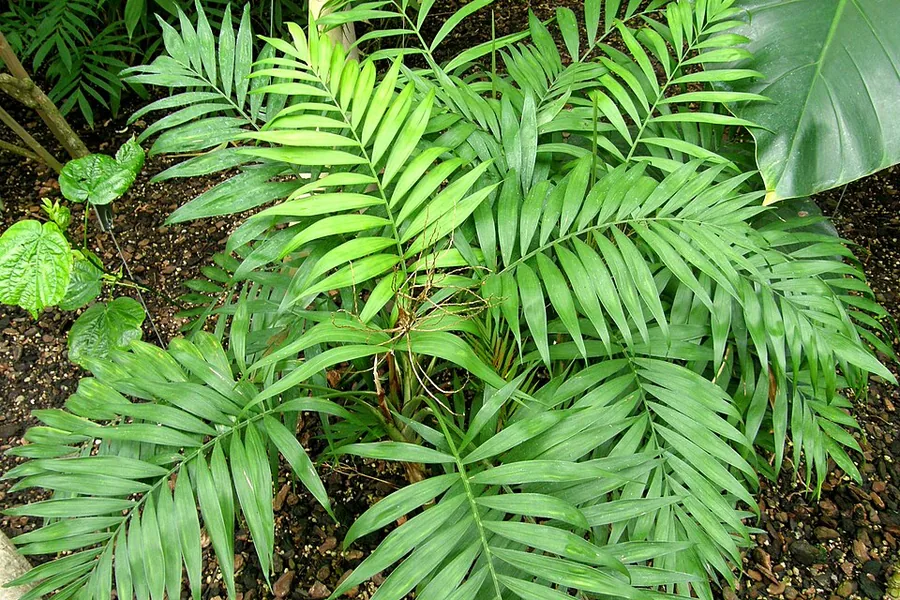
This one grows as a slow, compact palm, climbing to just 2 to 6 feet (60 to 200 cm) over many patient years. Each stem throws out a tuft of soft, arching fronds, and growers love to pack several seedlings into one pot so a young plant looks full straight away. Give it enough light and a mature plant can even fire up sprays of small yellow flowers in spring, which is a genuine thrill to catch.
Almost nothing on the shelf rewards you for so little effort. It shrugs off low light, average humidity, and the odd missed watering, and since it is non-toxic, it slots easily into homes with cats, dogs, or small children. Only two things throw it off its stride: soggy soil and bone-dry air, and both are quick to sort out.
Care
The short version: aim for bright indirect light but count on it cruising through low light, water when the surface dries and never leave it standing in water, hold it at ordinary room warmth, and treat it to a light feed in spring and summer only.
Light
Parlor palms hit their stride in bright, indirect light, but the real showstopper is how they push on through low light and shade where most plants throw in the towel. Steer them clear of direct sun, which scorches the soft fronds. Park one by a north or east window and it settles right in.
Water
Water it thoroughly once the soil surface dries, then tip out anything pooling in the saucer. Soggy soil and a poorly draining mix rot the roots faster than anything else, so lean slightly dry rather than wet. Forget a fixed schedule and let the soil call the shots.
Soil
Reach for a porous, humus-rich potting mix that drains freely. Loads of organic matter grip enough moisture without ever going waterlogged. Dial the pH in anywhere from 6.0 to 7.5 and it stays happy.
Temperature
Everyday room warmth keeps it thriving, anywhere from 59°F to 86°F (15°C to 30°C). Keep it well away from cold drafts and blasting heating vents. Frost is a dealbreaker, so it never handles that.
Humidity
Average household humidity gets the job done, so skip chasing a number. Still, dry air rolls out brown tips and spider mites, so a shot of extra moisture in winter pays off. A gravel-and-water tray or a quick misting nails it.
Feeding
Feed it only while it is actively growing in spring and summer, using a slow-release palm fertilizer two or three times across the season. Cut the feeding entirely in winter. Go light on it, because too much fertilizer stacks up salts that scorch the leaf tips.
Pruning
Pruning barely registers on the to-do list. Snip off a whole dead or damaged frond at its base, but never top a stem. Each stem grows from one point, so lopping the crown kills that stem instead of pushing it to branch.
Repotting
Repot only every few years, or once it clearly outgrows the pot, since it actually prefers to run a little pot-bound. Keep watch for roots circling the pot or breaking out the drainage holes, soil that dries fast, and stalled growth, your green light to size up.
Size & spacing
Bank on a mature height of 2 to 6 feet (60 to 200 cm) and a spread of 2 to 3 feet (60 to 90 cm), earned slowly over years. Grown in a pot, it skips garden spacing entirely and just wants elbow room for those arching fronds.
Troubleshooting
A parlor palm hardly ever throws you a curveball, and when it does, the foliage waves the flag first. Two signs top the list: browning tips and a dull, speckled look. Catch either one early and you turn it around fast.
Dull, speckled fronds with fine webbing sneaking in
Warm, dry air rolls out the welcome mat for spider mites, and they pile onto the undersides of the fronds where they hope to go unnoticed. Hunt them down: watch for the tiny mites, the fine webbing, and that speckled or bronzed cast spreading over the foliage. Fight back by wiping every frond with a damp cloth, misting often, and cranking the humidity up until the mites clear out.
Fix:
- Rinse or wipe foliage with a damp cloth and mist regularly
- Raise humidity to discourage mites
- Move plants outdoors in summer for natural predator control or treat as needed
Brown, crispy tips creeping in on the leaflets
Dry indoor air drives most cases of browning tips, and a buildup of fertilizer salts or soil that keeps bouncing between bone-dry and soaked piles on from there. Track the pattern: the very tip crisps and browns while the rest of the leaf stays green, and the oldest fronds always flag it first. Jump on it fast by lifting the humidity, easing off the feeding, flushing the pot to wash out the salts, and holding the soil evenly moist.
Fix:
- Raise humidity with a gravel-and-water saucer or room humidifier
- Reduce fertilizer rate and flush the pot with water to leach accumulated salts
- Maintain even soil moisture, watering thoroughly when the surface dries
Toxicity
Here is the part pet owners love: the parlor palm scores non-toxic across the board. The ASPCA lists it as safe for cats and dogs, and no known toxins put other animals or people at risk. The one small footnote is that the fruit pulp can irritate skin, so glove up if you ever get to process the seed.
Safe for
People · Cats · Dogs · Horses · Rabbits · Livestock · Birds
Cats None
Great news for cat households. The ASPCA lists the parlor palm as non-toxic to cats, so a curious nibble at a frond does no harm at all.
Dogs None
Dogs get the all-clear too. The plant carries no known toxins, though a dog that gulps down a big mouthful of any greenery might ride out a passing stomach upset.
Horses Safe
No toxic compounds turn up in the foliage, so a horse can graze on this palm without any danger.
Rabbits Safe
Rabbits can munch the fronds with zero risk, since the plant packs nothing poisonous to them.
Livestock Safe
Cattle, goats, and sheep run no poisoning risk near it, because the parlor palm simply is not a toxic plant.
Birds Safe
Pet birds do just fine around the fronds and the small black fruit, both of which carry no known toxin.
People Safe
People are in the clear too, since the plant is non-toxic. The only heads-up is the fruit pulp, which can irritate skin during seed processing, so glove up for that job.
Gloves are advised when handling Chamaedorea fruits during seed processing because the fruit pulp can contain skin irritants.
Varieties
The parlor palm sells almost entirely as the true species, skipping the wave of cultivar breeding that reshapes other houseplants. That leaves just one to learn, which keeps the whole thing refreshingly simple.
Chamaedorea elegans (species)
You get the classic compact, single-stemmed parlor palm, and growers pack several seedlings into one pot so the plant bursts out of the gate looking full and bushy.
How to propagate
Growing more parlor palms leans on patience far more than skill, and that makes the payoff satisfying. Raise fresh plants from seed or split an established clump, but brace for a slow ride, because neither one races along.
SeedDemanding
Sow fresh seed in warmth; germination is slow and erratic · Seed may not begin germinating for several months and can continue sporadically for over a year
Seed drives most parlor palm propagation, and it is a real test of patience. Sow fresh seed in warmth, then settle in for the long haul, since germination crawls along and can keep sprouting in bursts for over a year. Pull on gloves while you clean the fruit, because the pulp can irritate skin.
DivisionModerate
When repotting a multi-stemmed clump · Several weeks to re-establish after separating clumps of seedlings
Score a pot with several seedlings grown together and you can split that clump the next time you repot. The fresh divisions take a few weeks to bounce back and settle in. A single-stemmed plant is off the table for this, since each stem grows from one point and will not multiply.
Myths
Parlor palms are poisonous to cats and dogs.
Not so, and here is the reassuring truth: the ASPCA lists Chamaedorea elegans as non-toxic to both cats and dogs. A nibbling pet is in no danger from this palm, which is exactly why it keeps landing on pet-safe plant lists everywhere.
You can keep a leggy parlor palm short by cutting off the top of the stem.
Resist the urge, because each stem grows from a single point at its tip, so topping it will not spark any branching. Cut off the top and you just kill that stem. Chase a full look the smart way and start with a multi-seedling clump instead of shortening the height.