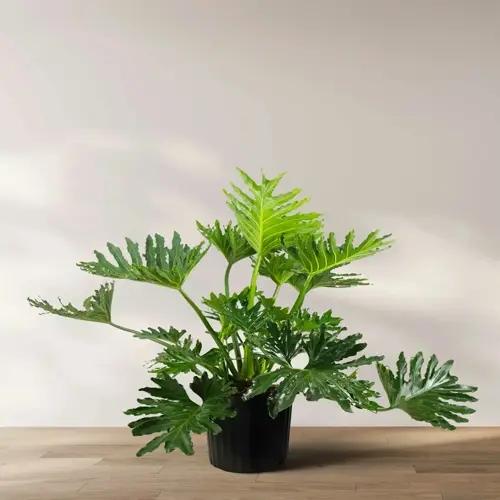

Yes, but it only survives there. Rhaphidophora tetrasperma low light means a plant that lives without dying, not one that thrives. Set one in a dim corner and it makes small, solid, slow leaves. Set the same plant near a bright window and it pushes out larger leaves with deep splits. The contrast is hard to miss once you see both side by side. One looks stalled. The other looks like it doubled in a season.
Your plant climbs the floor of tropical forests in the wild. It starts low on the ground and reaches up tree trunks toward the filtered sun above the canopy. That habit tells you what it wants in your home. Give it bright indirect light near a window where the sun never hits the leaves head-on. You want plenty of light on the leaves, but always softened by glass, a sheer curtain, or the angle of the sun. Get that right and your plant grows fast and full.
Direct sun and deep shade both cause problems for you, just different ones. NC State Extension notes that too much direct sun burns the leaves, leaving crispy brown patches that never heal. Once a leaf scorches, it stays scarred for the rest of its life. Too little light does the opposite. Your plant slows down, holds onto its old leaves longer, and barely adds new growth. You want the middle ground between those two extremes, and that middle is wider than you might think.
Low light costs you growth in three clear ways. Your plant grows much slower, so a vine that should gain a foot a season barely moves at all. It stretches and gets leggy, with long bare gaps between the leaves as the stem reaches toward your nearest window. And the splits fade out, since leaf fenestration light is what triggers those famous holes. A young plant in good light starts to split as it climbs and matures. Keep yours in the dark and it stays stuck on small, plain, solid leaves instead of the split look you bought this plant for in the first place.
There is a simple reason the splits depend on the light you give it. In the wild, the holes and slits let wind pass through the leaf and let light reach the leaves lower down the vine. Your plant only spends the energy to build that complex leaf shape when it has the light to spare. Starve it of light and it falls back to the cheapest leaf it can make, which is a small solid one. So the splits are not just about your plant getting older. They track how much light you give it.
So a dim room is not a death sentence, but it is a trade-off. You keep the plant alive and you lose the speed and the splits that make it special. Many people are fine with that, and a slow green vine in a quiet hallway still looks good against a wall. Just go in knowing what you give up before you commit that plant to a darker spot.
If a dim spot is all you have, you have two easy fixes. Add a small grow light on a timer for about 10 to 12 hours a day and place it a foot or so above your plant. That alone can bring back faster growth and new splits within a couple of months. Or move your plant to an east-facing window, where soft morning sun gives plenty of light without the burn risk of harsh afternoon rays. Either fix moves your plant from just surviving to actually growing.
Watch how the plant responds over the next month or two. New leaves that come in bigger and split mean the light is working and you can leave the setup alone. Long stretches of bare stem between small leaves mean it still wants more, so nudge it closer to the source. Adjust from there, and accept the slower, less split growth as the honest cost of keeping this climber in a darker room.
Read the full article: Rhaphidophora Tetrasperma Care Guide