
Introduction
What makes a plant a pothos? You have seen dozens of pothos varieties sold under that one name. Yet two of them can look nothing alike. They can grow at very different speeds too. I've seen the same plant wear three names at three shops in one town. This guide names the real species behind each plant. It also shows you where each one came from.
Almost every plant on the shelf is Epipremnum aureum. It is a vine in the Araceae family, and it comes from the Society Islands. The same plant sells as devil's ivy, golden pothos, or just pothos. The store name is up to the seller. But the group has more plants too. There is one more that you may meet, and it goes by the name Epipremnum pinnatum. You can also run into a third one, and that one is called Epipremnum amplissimum. A few Scindapsus look-alikes get mixed in and mislabeled, per NC State Extension.
Those Latin names may sound like a lot to you. The point is simple. Not every pothos is the same kind of plant, so they will not all act the same for you.
Think of pothos as a family with several branches, not one single plant. That is why two pots with the same label can climb, trail, and variegate in such different ways. Once you know the branch a plant sits on, its care and its quirks start to make sense fast.
This guide does one extra thing for you. It names the types of pothos and then tells you who bred each plant, backed by real sources. You will read where the names came from, tied to plant patents and university records. You will see how Pearls and Jade, Manjula, and Global Green joined classics like Golden and Marble Queen. You will also learn to tell a true pothos from its imposters.
What Makes a Pothos a Pothos
A true pothos is one plant wearing a lot of names. The scientific name is Epipremnum aureum, and you might see the same vine sold as devil's ivy, golden pothos, or taro vine. The plant on the shelf does not change. Only the label does, and that label shifts from store to store and region to region.
Pothos sits in the family Araceae, the arum family. It is native to the Society Islands. Botanists once filed it under the name Scindapsus aureus, so older books and tags still use that term. Left to climb or trail, the vine can stretch from 13 to 40 feet (4 to 12 meters). That is why one small pot can take over a whole shelf in time.
Here is the part that trips up shoppers. Many plants sold as pothos are not Epipremnum at all. The satin pothos is really a Scindapsus, a separate genus that just looks the part. The two stay split for a clear reason. Each chamber in a Scindapsus seed pod holds just one ovule. The true pothos packs in several seeds per chamber. That small gap in the flower is enough for botanists to keep them apart.
You do not need to memorize every pothos species to shop with confidence. Learn the one word that matters most. Most plants labeled pothos belong to Epipremnum, so when a tag points you somewhere else, you know you are looking at a look-alike. That same habit clears up the old pothos vs philodendron mix-up. Philodendrons are a different group with their own leaf shapes and growth.
Pothos is very easy to grow. It prefers bright, indirect light and survives for long periods in low light.
Classic Pothos Varieties
My golden pothos sat in a north-facing kitchen window for months and grew long, sad vines with pale, washed-out leaves. The stems stretched between leaves with big gaps and almost no gold to speak of. I slid the pot a few feet over to a brighter indirect spot near the counter. Within weeks the new leaves came in fuller, and the gold was back.
That move is the whole story with classic pothos. These are the most widely sold and budget-friendly types, so they are where you should start. They cost little and grow fast, which makes them forgiving while you learn what each one wants from you.
All of them prefer bright indirect light and will survive low light for a long time. The catch is that dim light fades their color and can erase variegation. The greener types like jade pothos and golden pothos hold their look in low light far better than the white ones. So the light in your room should guide which classic you pick.
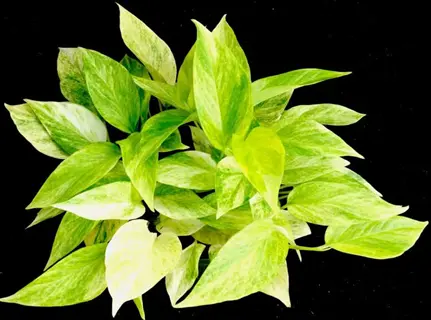
Golden Pothos
- Species: Epipremnum aureum, the most widely grown and recognizable pothos worldwide.
- Look: Heart-shaped green leaves marbled with irregular splashes of creamy gold.
- Light: Tolerates low light better than most, though brighter indirect light deepens the gold.
- Habit: A vigorous trailing or climbing vine that fills hanging baskets quickly.
- Best for: Beginners who want a forgiving, fast-growing first pothos.
- Note: Often the plant people picture when they hear the name devil's ivy.
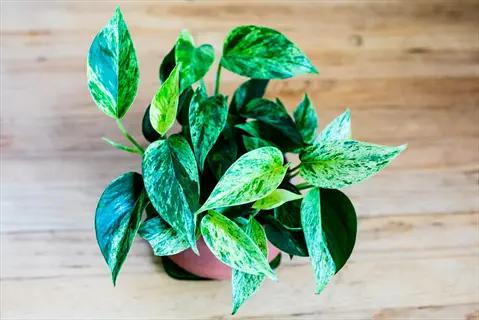
Marble Queen Pothos
- Species: Epipremnum aureum, with heavier variegation than Golden pothos.
- Look: Leaves are nearly half white, streaked and speckled with green in a marbled pattern.
- Light: Needs brighter indirect light than Golden because white tissue has no chlorophyll.
- Habit: Grows more slowly than Golden, since less green means less energy production.
- Best for: Growers who want bold variegation and can give it a bright spot.
- Note: Marble Queen is the parent plant several patented cultivars were selected from.

Neon Pothos
- Species: Epipremnum aureum prized for color rather than variegation.
- Look: Solid, glowing chartreuse to lime leaves with no marbling.
- Light: Brighter light keeps the neon tone vivid, while shade turns leaves a duller green.
- Habit: A fast trailing vine that brightens dim corners with its electric color.
- Best for: Anyone wanting a pop of color without a variegation pattern.
- Note: New growth emerges brightest and matures to a slightly deeper shade.
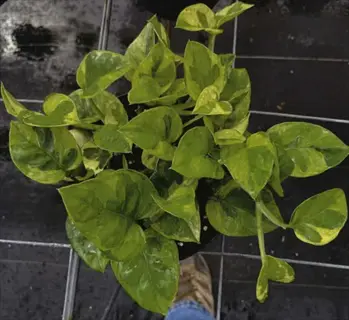
Jade Pothos
- Species: Epipremnum aureum, essentially the plain green form.
- Look: Uniform deep green, heart-shaped leaves with no variegation at all.
- Light: Among the most shade-tolerant pothos because it is fully green.
- Habit: Steady, reliable trailing growth that rarely struggles.
- Best for: Low-light rooms and offices where variegated types would fade.
- Note: Often confused with reverted Golden pothos that has lost its gold.

N'Joy Pothos
- Species: Epipremnum aureum, a compact variegated cultivar.
- Look: Smaller leaves with crisp, clearly defined patches of white and green.
- Light: Wants bright indirect light to keep its sharp white sections healthy.
- Habit: More compact and slower than Golden, suiting smaller spaces.
- Best for: Growers who like tidy, distinct variegation over marbled blends.
- Note: Frequently compared with Pearls and Jade, which has more speckling.
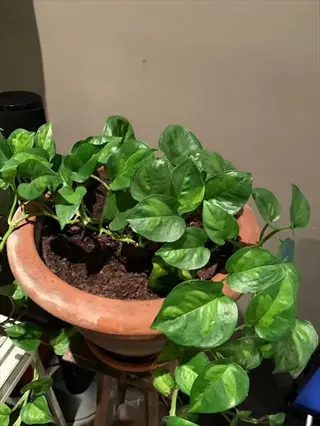
Global Green Pothos
- Species: Epipremnum aureum, a newer green-on-green cultivar.
- Look: Two-tone leaves with darker green centers and lighter green edges.
- Light: Handles lower light reasonably well because there is little white tissue.
- Habit: Moderate trailing growth with a subtle, refined appearance.
- Best for: People who want variegation that reads as elegant rather than flashy.
- Note: A modern introduction that has quickly become a sought-after favorite.
Use light to decide. If your space stays dim, lean toward jade or golden pothos and skip the heavy whites. If you have a bright window, a variegated pothos like marble queen pothos will reward you with bold color. And if you just want a splash of brightness, neon pothos glows in chartreuse with no pattern at all.
Patented and Premium Cultivars
Some patented pothos carry a real paper trail. The cultivar code, the patent number, and the breeder are all on record. So the plant in your pot has a backstory most houseplants never get.
Here is why this matters. Pothos rarely flowers indoors, and you cannot cross two plants to make a new one the way you would with roses or tomatoes. So breeders skip hybridizing and instead force tiny genetic changes, then watch for a stray branch that looks different. That single odd branch becomes the next named variety.
The two stories below could not be more different. Pearls and Jade pothos started in a lab where scientists blasted cuttings with gamma radiation. Manjula pothos showed up by pure luck on a greenhouse bench. Both ended up with a US plant patent. Two routes, same finish line.
Pearls and Jade
- Origin: Selected from a group of Marble Queen plants at the UF/IFAS center in Apopka, Florida.
- Method: Created by exposing Marble Queen cuttings to gamma radiation from a Cobalt-60 source, then selecting a single branch mutation about a year later.
- Patent: Protected by US Plant Patent 21,217, with rights held by the University of Florida.
- Look: Smaller leaves, about 7 to 8 cm (2.8 to 3.1 in) long, with white, gray, and green in irregular patches and streaks.
- Note: Variegation appears on both the top and underside of the leaves.
Manjula
- Origin: Spotted in 2010 as a naturally occurring branch mutation among more than 1,000 plants at a greenhouse near Mumbai, India.
- Species: Botanically an Epipremnum pinnatum selection, named after its discoverer.
- Patent: Protected by US Plant Patent 27,117, filed in 2014 and granted in 2016.
- Look: Broad, wavy-edged leaves with a bright marbled and blotched pattern in green and yellow-green.
- Note: Compact growth with short internodes gives it a fuller, bushier appearance.
Jessenia
- Origin: A Costa Farms introduction selected for its distinctive green-on-green coloring.
- Look: Heart-shaped leaves marbled in two shades of green rather than white.
- Light: Tolerates lower light than white-variegated types because it keeps more chlorophyll.
- Habit: Slower growing, with a refined look that suits collectors.
- Note: Often compared with Global Green for its subtle two-tone effect.
Global Green
- Origin: A modern patented-era cultivar that quickly became collectible.
- Look: Dark green leaf centers framed by softer, lighter green margins.
- Light: Handles moderate light well thanks to its largely green leaves.
- Habit: Steady trailing growth with a clean, layered appearance.
- Note: Its green-on-green pattern makes it a favorite for understated displays.
'UFM12' originated by exposing cuttings of Epipremnum aureum cultivar 'Marble Queen', not patented, to gamma-ray radiation from a Cobalt 60 source.
That University of Florida pothos breeding program is the reason Pearls and Jade exists at all. The team ran a deliberate mutation effort because normal breeding was off the table. The shrunken leaves, just 7 to 8 cm (2.8 to 3.1 in) long against the 12 cm (4.7 in) of parent Marble Queen, came straight out of that work.
Jessenia and Global Green fill out the premium tier with green-on-green color instead of white. Jessenia pothos keeps more of its green, so it copes with lower light than the white-flecked types do. Pay extra for one of these named plants and you get two things. You get a documented origin, and you get a look no plain golden pothos can match.
Blue and Large-Leaf Pothos
My cebu blue pothos pushed out its first split, silvery leaf only after I gave it a moss pole. For two years it trailed flat across the kitchen window shelf, staying small and plain, with arrow-shaped leaves no bigger than my thumb. I had almost written it off. Then I let it climb, and within one season the new leaves came in larger, more silver, with clean natural slits down each edge.
That shift points to something most variety lists skip in a single line. These blue and large-leaf plants are not all Epipremnum aureum, the species behind the golden type. Cebu Blue and baltic blue pothos are both Epipremnum pinnatum. The silver streak pothos is a third species, Epipremnum amplissimum. That split in parentage is why you see longer, less heart-shaped leaves on these plants.
These climbing, blue-toned plants have driven a lot of collector interest, and for good reason. They break the mold most people expect, so you get a pothos that looks like nothing else on the shelf. The table below sorts out what sets each one apart.
Cebu Blue
- Species: Epipremnum pinnatum, distinct from the common Epipremnum aureum group.
- Look: Narrow, arrow-shaped leaves with a silvery blue-green sheen.
- Habit: Stays small and flat when trailing, but changes a lot when climbing.
- Mature form: Develops larger leaves with natural splits, called fenestrations, on a support.
- Best for: Growers ready to give a pothos a moss pole or totem to climb.
Baltic Blue
- Species: Epipremnum pinnatum, related to Cebu Blue but with deeper color.
- Look: Darker blue-green leaves that fenestrate earlier and more readily.
- Habit: A vigorous climber that shows its mature, split-leaf form sooner.
- Light: Bright indirect light encourages faster, larger leaf development.
- Best for: People who want the fenestrated look without a long wait.
Silver Streak (Amplifolia)
- Species: Epipremnum amplissimum, a third species in the pothos group.
- Look: Long, slender, lance-shaped leaves brushed with silvery streaks.
- Habit: An upright-leaning climber that looks unlike typical trailing pothos.
- Light: Prefers bright indirect light to keep its silvery markings crisp.
- Best for: Collectors wanting an unusual, narrow-leaved pothos.
Albo and Highly Variegated Types
- Group: Collector cultivars such as Albo, Harlequin, and Skeleton Key.
- Look: Bold white sections or unusual leaf shapes that command high prices.
- Light: Need bright indirect light because large white areas have no chlorophyll.
- Care: Grow more slowly and can revert, so stable conditions matter.
- Best for: Experienced growers comfortable with a more demanding plant.
Your pinnatum plants need two things: patience and a support to climb. A mature fenestrated pothos vine grows those natural leaf splits once it climbs. So a young plant on a shelf can look like a whole different species from an old one on a pole. Baltic Blue tends to split sooner. Cebu Blue makes you wait a bit longer for the payoff.
Give any of these bright indirect light and a pole to climb, and you unlock their grown-up form. Skip the support, and even an old plant often stays small and flat. You never get to see what the species can really do.
Pothos Look-Alikes Compared
Half the pothos look-alikes on a shelf wear the wrong name tag. Two plants can show you the same white and green leaves yet belong to different species, and color alone will not tell them apart. Your fastest pothos identification comes from reading four clues at once.
Check leaf size, variegation pattern, edge texture, and species together, not one at a time. Leaf size is the quickest tell. Pearls and Jade leaves run about 7 to 8 cm (2.8 to 3.1 in), while a Marble Queen leaf reaches about 12 cm (4.7 in) on the same kind of vine. The table below lines up the plants people mix up the most.
Variegation style often breaks a tie when two plants look close to you. Picture three patterns side by side. Speckled dots like Pearls and Jade, blocky patches like N'Joy, and broad brushstroke marbling like Marble Queen. Name the pattern first and you will land on the variety.
The genus mix-up costs you the most. Satin pothos wears the pothos name on its tag. But it is a Scindapsus pictus, a separate plant with velvety leaves and silver dots. A heartleaf philodendron also sits beside true pothos in many shops, and its smooth, thin leaves trip up new buyers. A Scindapsus sometimes sells at a pothos price, so flip the tag and read the scientific name before you pay.
When shopping, check the plant tag for a scientific name; a Scindapsus label means it is a satin pothos look-alike, not a true Epipremnum pothos.
Simple Pothos Care Basics
Good pothos care is simpler than most variety lists let on, and the same short routine works across every type you grow. Pothos earns its beginner reputation for a reason, which is part of why it spread around the world as devil's ivy. Get the light and water right, and the plant mostly takes care of itself.
Start with the light. Pothos light requirements are easy to meet, since the plant prefers bright, indirect light but survives long stretches in low light. There is one catch you should know. Low light makes variegated cultivars lose their pattern, so a Marble Queen that turns plain green is telling you it wants a brighter spot. A fading pattern is almost always a light problem, not a disease, and moving the pot is the fix.
The lower leaves on my Marble Queen yellowed first, then the stems near the soil went soft and mushy to the touch. The pot had been sitting in a saucer of water on a bookshelf for weeks. Once I let the top of the mix dry out before each watering, the soft stems firmed up and the plant pushed out new leaves within a month.
That mess points straight at the real risk with pothos watering, which is too much, not too little. Use a well-drained mix, let the top dry between drinks, then water it well. Overwatering pothos brings on root rot and blackened leaf margins far faster than a few dry days ever will. Empty the saucer every time so the roots never sit in standing water.
The routine below works for any pothos on your shelf. A plain golden pothos and a pricey cultivar both want the same care. Watch the light to keep your pattern strong. Pothos variegation reverting is the gripe people raise most, and it is the easiest one to fix.
Place pothos in bright, indirect light; it survives low light, but variegated types fade and grow leggy without enough brightness.
Let the top of a well-drained mix dry out, then water thoroughly, because soggy soil leads to root rot far faster than dryness.
Empty any saucer after watering so the pot never sits in standing water, which causes blackened leaf margins and soft stems.
Trim leggy vines to keep growth full, and root the cuttings in water to make more plants from the same variety.
All parts of pothos are toxic due to calcium oxalate crystals, which can irritate the mouth and skin of people, cats, dogs, and horses, so keep it out of reach and wash hands after pruning.
5 Common Myths
All plants sold as pothos are the same species, so the care and identification rules are identical across every variety.
Pothos covers several species plus Scindapsus look-alikes, so leaf size, variegation, and even genus can differ between them.
A pothos on your desk will noticeably clean and purify the air in a normal, well-ventilated room throughout the day.
Air-cleaning data came from a tiny sealed chamber, not real rooms; in ventilated homes the benefit is mostly aesthetic and psychological.
Variegated pothos need the same dim conditions as plain green pothos and will keep their patterns anywhere indoors.
Variegated pothos need brighter indirect light, because in low light many cultivars lose their variegation and revert to green.
Pothos is completely safe to keep around curious pets and small children since it is just a common houseplant.
All pothos parts contain calcium oxalate crystals and are toxic to humans, cats, dogs, and horses, causing mouth and skin irritation.
Every named pothos is just a nickname growers invented, with no real history or science behind the newer ones.
Several modern cultivars are patented plants, with documented origins in university breeding and mutation programs recorded in extension publications.
Conclusion
The big idea from the start still holds. Pothos is not one plant. It is a family with several branches. Naming the species is what turns a guessing game into real ID. So once you know if you own a true pothos like Epipremnum aureum, the rest of the picture clicks into place.
That family tree shows why two plants on one shelf can act so differently. The classic types of pothos sit next to newer ones with a paper trail. Cultivars like Pearls and Jade and Manjula are patented plants. They were born in plant labs or found by chance, not made up. That backstory makes each plant feel less like a mystery.
Two facts should stay with you. First, every part of a pothos is toxic. The cause is calcium oxalate crystals, so keep all of these plants away from pets and kids. Second, your best choice is to match the plant to your light. Green types do well in low light. But variegated pothos need bright indirect light to hold their pattern and stay from fading to plain green.
So look at any pothos you own with fresh eyes. Check the leaf size and the pattern against the chart from earlier. Now you can give it a name. The list of new pothos varieties keeps growing. But good pothos care built on species and light keeps your plants healthy. That stays true no matter which new one shows up next.
Glossary
- Calcium oxalate crystals
- Tiny sharp crystals found throughout pothos that irritate the mouth, skin, and digestive tract, making the plant toxic.
- Cultivar
- A plant variety produced and named by growers through selection or breeding rather than occurring naturally in the wild.
- Epipremnum aureum
- The scientific name for the most common pothos species, which includes Golden, Marble Queen, and Neon pothos.
- Fenestration
- The natural holes or splits that form in mature pothos leaves, mainly on climbing pinnatum types like Cebu Blue.
- Mutation induction
- A breeding method that uses treatments such as radiation to trigger genetic changes, used to create new pothos cultivars.
- Plant patent
- A legal protection giving the holder exclusive rights to propagate and sell a specific named plant cultivar for a set period.
- Scindapsus pictus
- A separate plant genus sold as satin or silver pothos, which is a look-alike rather than a true Epipremnum pothos.
- Variegation
- The patches of white, cream, or different-colored tissue on leaves, caused by areas that contain little or no green chlorophyll.
External Sources
Frequently Asked Questions
How many types of pothos are there?
There is no single official count because pothos covers several species and many named cultivars.
- Common classic cultivars such as Golden, Marble Queen, and Neon
- Patented premium cultivars such as Pearls and Jade and Manjula
- Pinnatum and amplissimum species such as Cebu Blue and Silver Streak
- Scindapsus look-alikes often sold as Satin pothos
What is the rarest pothos variety?
Highly variegated and unstable cultivars such as Albo, Harlequin, and Skeleton Key are among the hardest to find.
What is the easiest pothos to grow?
Golden pothos is widely considered the easiest because it tolerates low light and irregular watering.
Which pothos variety is best for low light?
Greener cultivars like Golden, Jade, and Global Green handle low light better than heavily variegated types.
What plant is mistaken for pothos?
Satin pothos (a Scindapsus) and heartleaf philodendron are the most common pothos look-alikes.
Are pothos toxic to cats and dogs?
Yes, pothos is toxic to cats and dogs because of calcium oxalate crystals in all parts of the plant.
Is it okay to touch pothos?
Brief handling is usually fine, but the sap can cause skin irritation, so wash your hands after pruning.
Why is pothos called the devil's ivy?
It earned the name because it is nearly impossible to kill and stays green even in poor conditions.
Why is it illegal to propagate some patented pothos?
Patented cultivars are legally protected, so propagating them for sale without a license can infringe the plant patent.
Can pothos live in a bathroom?
Yes, pothos can do well in a bathroom if it gets enough indirect light, since it enjoys the humidity.