
Introduction
Watch a maranta plant as the sun goes down and you will see its leaves rise and fold together, like two hands closing in prayer. By morning they open flat again to soak up the light. That nightly show is why most people fall for this plant, and it is also where almost every care guide goes quiet. They tell you the leaves move. They never tell you why, and they never point to a real source.
This guide does both. The plant tag will read Maranta leuconeura. You probably know it as the prayer plant. It comes from Brazil, where it grows low and wide on the warm forest floor. It is part of the arrowroot family. It stays small too. Most plants top out at just 6 inches to 1 foot tall. That size makes it a great indoor plant for a shelf, a desk, or a spot near your window.
The looks alone earn its keep. The leaves carry bold fishbone veins in green, cream, and deep red, so the plant looks painted even when it sits still. Pet owners get a bonus here. The ASPCA lists the prayer plant as non-toxic to dogs, cats, and horses, which is rare for a houseplant this striking. You can place it within reach of a curious cat and sleep fine.
You get real prayer plant care here, not a thin 300-word card. Every claim leans on a trusted source. We pull from plant experts, a botanical garden, and a science study. You will learn light, water, humidity, and soil in plain terms. You will see why the leaves really move at night. And you will fix the brown tips and curling leaves that trip up new owners, often before they spread.
Complete Maranta Care Guide
Good maranta plant care comes down to copying one thing. You want the warm, damp floor of a Brazilian rainforest. Get the light, water, and air close to that and your plant rewards you. The leaves fold up like hands each night. The grid below gives you the whole care profile in one place.
My Fascinator Tricolor sat in a bright window for a year and sulked. Its red veins faded and the edges turned crisp. So I moved the same 4-inch nursery pot to a low shelf in my north-facing bathroom. Within weeks it pushed out fresh leaves. It started praying again every night, and the shower steam did what no fertilizer had.
Maranta leuconeura stays small, so it fits almost anywhere. It grows 6 inches to 1 foot (15 to 30 centimeters) tall. It spreads 6 inches to 2 feet (15 to 60 centimeters) wide as the clump fills out. That low, trailing shape suits a shelf, a hanging pot, or the front edge of a plant group.
Match the rainforest, not the windowsill. Steady warmth, humidity above 50%, and bright indirect light prevent most maranta problems before they start.
Solid prayer plant care rests on a few firm numbers. The Missouri Botanical Garden and NC State Extension both call for bright indirect light with no direct sun. Strong rays bleach the leaf color you bought the plant for. Keep it warm, above 60 degrees Fahrenheit (16 degrees Celsius). That matches its home in USDA zones 11 to 12. Plant it in a well-draining, peat-based mix with a soil pH of 6.0 to 7.0.
Most people get one thing wrong, and that is prayer plant humidity. This plant wants the air above 50%, far damper than a normal room. A steamy bathroom or a pebble tray fixes that fast. One last bit of good news. The ASPCA lists maranta as non-toxic to dogs, cats, and horses. A pet that chews a lot of the fibrous leaves may still get a mild upset stomach.
Light, Temperature, Placement
Getting prayer plant light right is the one thing that makes or breaks those bold leaf patterns. Your maranta wants bright indirect light, which is the soft glow you find near a window. It is not the harsh beam that falls straight onto the leaves and washes them out.
Picture the difference this way. Bright indirect light is the warm brightness you can read by a few feet back from the glass. Direct sun is the hot stripe of light that lands right on the foliage. NC State Extension and the Missouri Botanical Garden both warn that too much direct sun bleaches the leaf colors. The good news is that this plant also handles low light better than most patterned tropicals, so it works on a shelf or in a room without strong sun.
The best spot for prayer plant growth sits a few feet back from an east or north window. That gentle morning light feeds the plant without scorching it. A south or west window can work too, but only behind a sheer curtain that softens the glare. A bright bathroom often beats a sunny sill, since it pairs steady light with the damp air this plant loves.
Prayer plant temperature needs are simple once you know the numbers. Keep your maranta between 65 and 75°F (18 to 24°C), which matches its warm Brazilian rainforest roots. Never let it dip below 60°F (16°C), or you will see stalled growth and damaged leaves. Outdoors it is hardy only in USDA zones 11 to 12, so nearly everyone grows it as an indoor houseplant. The chart below breaks down each piece so you can dial in the right home for your plant.
Bright Indirect Light
- What it means: Place the plant where it sees plenty of daylight but no direct beam landing on the leaves, such as a few feet back from a bright window.
- Why it matters: Direct sun bleaches the bold patterns and can scorch the foliage, while bright indirect light keeps the colors saturated and the veins crisp.
- Best aspect: East or north-facing windows are the safest, and a sheer curtain softens a brighter south or west exposure into usable indirect light.
Low To Medium Light Tolerance
- Flexibility: Marantas tolerate lower light better than many patterned tropicals, which is why they suit interior shelves and rooms without strong sun.
- Trade-off: In dim spots growth slows and leaf patterns can fade slightly, so aim for the brightest indirect spot you can offer without direct sun.
- Placement idea: A bright bathroom combines gentle light with the higher humidity the plant craves, making it one of the better rooms in many homes.
Warmth And Temperature
- Ideal range: Keep the plant between 65 and 75 degrees Fahrenheit (18 and 24 degrees Celsius), which mirrors its warm Brazilian rainforest origins.
- Hard floor: Avoid letting temperatures dip below 60 degrees Fahrenheit (16 degrees Celsius), as cold causes stalled growth and damaged leaves.
- Avoid drafts: Keep the plant away from cold windows, heating vents, and air conditioning blasts, all of which dry and chill the foliage quickly.
Outdoor Hardiness
- Zone limit: The plant is winter hardy outdoors only in USDA zones 11 to 12, so almost everyone grows it as an indoor houseplant.
- Seasonal moves: It can summer outdoors in deep shade in warm climates, but bring it in well before nights cool toward 60 degrees Fahrenheit (16 degrees Celsius).
- Indoor default: For most readers the realistic plan is a stable indoor spot year round rather than chasing outdoor placement.
Watering and Humidity
Most care guides treat soggy soil as the one threat to your maranta plant and leave it there. The real routine has two halves, and you need both. Get the watering rhythm right, then keep the air around the leaves damp enough to match the tropics this plant came from.
When you sort out how to water prayer plant soil, it comes down to a simple touch test, not a fixed calendar. Press a finger into the top inch of soil and water only when it feels dry. In summer that often lands near once a week, but the soil tells you more than any schedule does.
Press a finger into the soil and water only when the top inch (2.5 centimeters) feels dry, which is often about weekly in summer.
Reach for filtered, distilled, or rainwater rather than tap water, since fluoride and chlorine build up and burn the leaf tips brown.
Soak the soil until water runs from the drainage holes, then let the excess drain fully so the roots never sit in standing water.
Reduce watering from autumn through late winter while growth slows, letting the soil dry a little more between drinks to prevent root rot.
Keep the soil evenly moist through spring and summer, then pull back hard once growth slows in autumn. This is the single best move against root rot, since cool roots sitting in wet soil rot fast. NC State Extension lays out the same seasonal swing.
Keep potting soil evenly moist throughout the growing season, but hold back on watering to allow the soil to dry out in the winter months.
Water quality matters more than people expect. Fluoride and chlorine in tap water build up in the soil and burn the leaf tips brown over time. Switch to filtered water, distilled water, or rainwater, and clean foliage follows. If tap is all you have, let it sit out overnight so some chlorine escapes first.
An earlier prayer plant of mine sat on a dry sunny windowsill and crisped brown at every leaf edge within a month. I moved this one to my north-facing bathroom, where shower steam keeps the air thick. New leaves came in whole and stayed that way, and I never once reached for a mister.
That bathroom hit on what this plant truly needs, which is prayer plant humidity above 50%, held steady. Misting gives a brief boost that fades in an hour. A pebble tray of water under the pot, a cluster of plants grouped close, or a small humidifier all raise the moisture and keep it there. Steady beats frequent every time.
Soil, Feeding, Repotting
My 'Fascinator Tricolor' sat stalled and pot-bound on a bathroom shelf for most of a year. I moved it up just one pot size into a peat-and-perlite blend, and it pushed out new leaves within weeks. The plant came in dense store-bought soil that stayed wet too long and choked the roots. A snug pot and an airy mix turned it around fast.
Good prayer plant soil starts with a peat-based potting mix that drains well. Loosen it with perlite and a handful of coconut coir so water runs through instead of pooling around the roots. Aim for a slightly acidic to neutral pH 6.0 to 7.0, which matches the rainforest floor this plant came from.
Pot size matters more than most people think. Pick a pot only a little bigger than the root ball, because an oversized pot holds extra wet soil that invites root rot. When you handle repotting prayer plant roots, do it about every two years in spring and go up just one size. Make sure the pot has drainage holes and never leave it sitting in a saucer of water.
Feeding keeps the color rich through the warm months. Use a balanced prayer plant fertilizer once a month during the growing season, then stop from autumn through late winter while growth slows. A well-draining mix plus monthly food gives you steady new leaves without the soggy soil that causes most problems. The checklist below sums up the whole routine.
- Soil mix: Use a well-draining, peat-based potting mix and loosen it with perlite and coconut coir so water moves through instead of pooling.
- Soil pH: Aim for a slightly acidic to neutral range of pH 6.0 to 7.0, which suits the plant's rainforest roots.
- Pot size: Choose a pot only slightly larger than the root ball, since a snug pot avoids the excess wet soil that causes root rot.
- Drainage: Make sure the pot has drainage holes and never let the plant sit in a saucer of standing water after watering.
- Feeding: Fertilize monthly during the growing season with a balanced houseplant feed, then stop from autumn through late winter while growth slows.
- Repot timing: Repot about every two years in spring, lifting the plant into the next size up only when roots fill the current pot.
Why Prayer Leaves Move
So why do prayer plant leaves fold up tight every evening? The praying-hands look has a real cause, and it comes down to a tidy bit of plant science. Once you know it, the nightly show makes a lot more sense.
The movement has a name. Botanists call it nyctinasty, the daily rise and fall of leaves in step with day and night. It is not the plant reacting to a light switch. It runs on a built-in circadian rhythm, the same kind of internal clock that tells you when to sleep.
Scientists proved this clock is real by watching related plants in constant light. The leaves kept rising and falling on schedule with no day or night to cue them. As one peer-reviewed study put it, the circadian clock controls this rhythm rather than the light itself. That clock keeps a free-running cycle of about 26 hours and holds steady across normal room temperatures.
The folding happens at a tiny joint at the base of each leaf called the pulvinus. Think of it as a hinge filled with water. The plant pumps potassium ions into one side, water follows, that side swells, and the leaf lifts. Release the pressure and the leaf drops back down flat.
Here is the part that should ease your mind. Seeing your prayer plant at night with its leaves folded up like hands is a sign of a happy plant, not a stressed one. A maranta that folds and unfolds on a steady daily clock is doing exactly what a healthy plant should do.
Morning
As daylight returns the leaves lower and spread flat to catch the soft indirect light the plant uses to grow.
Midday
The leaves stay open and horizontal, displaying the fishbone veins and bold patterns at their most striking.
Evening
As light fades the pulvinus at each leaf base shifts turgor pressure and the leaves begin to rise.
Night
The leaves fold upward like praying hands, a movement an internal circadian clock keeps running even in constant conditions.
We report that plantlets of the liverwort Marchantia polymorpha show analogous rhythmic movements of thallus lobes, and that the circadian clock controls this rhythm, with auxin a likely output pathway affecting these movements.
Varieties, Pet Safety, Buying
Most guides name three prayer plant varieties and move on. The real help is telling them apart on a crowded shelf. Each one is a form of Maranta leuconeura. The species name means white-veined, and that fits the pale lines you see across the leaves.
Two of these forms earned the Royal Horticultural Society Award of Garden Merit. The red-veined var. erythroneura is the classic herringbone plant, named for the fishbone pattern down each leaf. The rabbit's foot form, var. kerchoveana, has paired dark spots that fade as the leaf ages. Here are the four you will see most often.
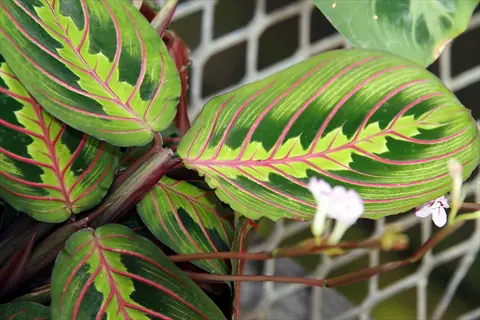
Fascinator Tricolor (Red Prayer Plant)
- Look: Deep green leaves marked with bright red veins and feathery yellow-green central blotches, the most dramatic and widely sold variety.
- Also called: Often sold as the red prayer plant or as var. erythroneura, the herringbone plant, for its bold vein pattern.
- Award: This red-veined herringbone form holds the Royal Horticultural Society Award of Garden Merit for reliable garden performance.
- Size: Like all marantas it stays low at 6 inches to 1 foot (15 to 30 centimeters) tall and spreads outward over time.
- Care note: The vivid color fades in too little light, so give it the brightest indirect spot you can without direct sun.
- Best for: Growers who want the showiest foliage and the most obvious nightly praying movement.
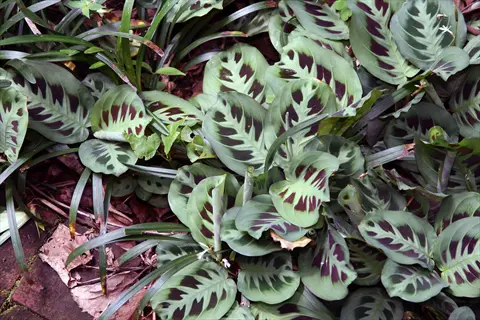
Kerchoveana (Rabbit's Foot)
- Look: Soft green leaves with paired dark blotches along the midrib that look like animal tracks, fading as the leaf matures.
- Also called: Known as rabbit's foot or rabbit tracks, and listed botanically as var. kerchoveana.
- Award: This classic form also holds the Royal Horticultural Society Award of Garden Merit.
- Undersides: The leaf undersides are light green, a quick way to tell it from the red-backed herringbone variety.
- Size: It keeps the same low, spreading habit of 6 inches to 1 foot (15 to 30 centimeters) tall typical of the species.
- Best for: Beginners who want a forgiving, classic prayer plant with charming markings.
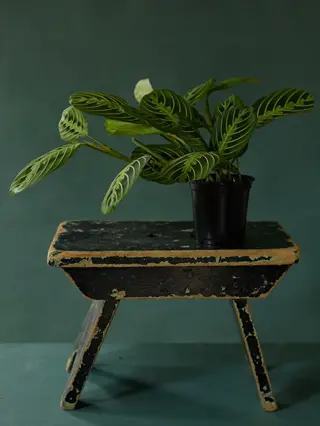
Lemon Lime
- Look: Bright chartreuse and yellow-green veining on a green leaf, giving a fresh, glowing appearance that lights up shaded shelves.
- Also called: Sold simply as Lemon or Lemon Lime, prized for its luminous coloring.
- Contrast: The neon veining stands out more than the red varieties in lower light, making it a good pick for dimmer rooms.
- Size: It shares the compact 6 inches to 1 foot (15 to 30 centimeters) tall, spreading form of the genus.
- Care note: Keep humidity above 50% to stop the fine veined edges from browning.
- Best for: Growers wanting a brighter, more modern look among prayer plants.
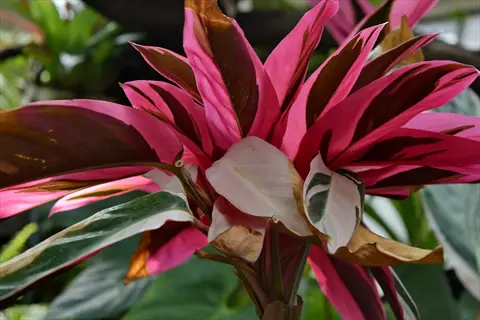
Silver Band
- Look: A silvery band runs down the center of each leaf against darker green, a subtle, elegant variation on the classic pattern.
- Also called: Marketed as Silver Band for its distinctive central stripe.
- Contrast: The muted silver tone suits growers who prefer a calmer look than the vivid red or lime types.
- Size: It grows in the same low, clumping habit of 6 inches to 1 foot (15 to 30 centimeters) tall as the rest of the genus.
- Care note: Like all marantas it wants bright indirect light and steady moisture to keep the band crisp.
- Best for: Collectors looking to round out a maranta grouping with a softer color.
The genus is named for Bartolomeo Maranta, a botanist from the 1500s. So the name carries a bit of plant history. Maranta is not the only prayer plant, though. Calathea, Stromanthe, and Ctenanthe all share that name. All four sit in the Marantaceae family, the arrowroot family.
That shared family brings good news for you. None of these prayer plants make the toxic list. Maybe you have searched whether prayer plant toxic to cats is a real worry. The answer should put you at ease. The ASPCA lists maranta as non-toxic to dogs, cats, and horses. That makes it one of the easier pet-safe plants to keep near your animals.
The ASPCA lists prayer plants as non-toxic to dogs, cats, and horses. Non-toxic does not mean zero risk, though, since eating a large amount of any plant can cause mild stomach upset.
Fixing Common Problems
Most prayer plant problems trace back to just a few causes, and the leaves tell you which one. Your plant has no serious diseases to worry about. When something looks off, your fix is usually a small change to water, light, or air.
Start by reading the symptom. Prayer plant brown tips point to dry air or to the fluoride and chlorine in tap water. Prayer plant leaves curling point the other way, toward thirsty soil or too much direct sun. Match the sign to the cause first, then act.
Watch out for two bigger threats. Soggy, poorly drained soil leads to root rot, which turns stems mushy and your soil sour. Dry indoor air invites spider mites, the tiny pests that leave fine webbing and speckled leaves. The table below pairs each sign with its likely cause and the fix that works for you.
Pests are easy to beat if you catch them early. Wipe your leaves down with a damp cloth, then treat with insecticidal soap or neem oil every few days until the bugs clear. Both are gentle enough for you to use on the thin maranta leaves without harming your plant.
One last sign throws people off. A plant that stops praying and quits folding its leaves at night is rarely sick. It is reacting to a change in light or watering, so adjust those and the nightly fold comes back.
5 Common Myths
Maranta plants need to sit in bright direct sunlight on a windowsill to keep their bold leaf patterns and colors.
Direct sun actually bleaches the leaf colors. Marantas want bright indirect light and can even tolerate low to medium light.
Misting a prayer plant several times a day is the best and only way to give it the high humidity it needs.
Misting only raises humidity briefly. A pebble tray, grouping plants, or a humidifier gives the steady high humidity marantas need.
Because marantas love moisture, the soil should be kept constantly wet and soggy all year for the plant to thrive.
Soggy soil causes root rot, the top failure mode. Keep soil evenly moist in summer and let it dry more in winter.
The leaves folding up at night means the prayer plant is stressed, unhappy, or not getting enough light during the day.
Nightly folding is normal nyctinasty driven by an internal circadian clock. A plant that folds and unfolds is actually healthy.
Prayer plants are dangerous to keep around cats and dogs because most tropical houseplants are toxic to pets.
The ASPCA lists maranta as non-toxic to dogs, cats, and horses, though large amounts of any plant may cause mild stomach upset.
Conclusion
Good prayer plant care comes down to copying a patch of the Brazilian rainforest floor. Give your maranta plant bright indirect light with no harsh sun, since direct rays bleach the patterns out of the leaves. Keep the soil moist but never soggy, and only reach for the watering can once the top inch feels dry.
The other two pillars are just as simple. Push the humidity above 50% with a pebble tray or a humidifier nearby, and keep the room above 60°F (16°C) all year. A prayer plant rewards steady habits far more than constant fussing, so pick a routine and stick with it.
Here is the part worth holding onto. That nightly folding and unfolding is a real circadian rhythm. It runs on an internal clock inside the plant, not on a simple reaction to the lights going off. I moved one pot onto a pebble tray near a bright east window, and within a week the leaves stood up straight every evening like clockwork. So when your maranta lifts its leaves to pray each night and lays them flat each morning, it is telling you it feels at home and healthy.
It helps that this is a pet-safe, non-toxic choice if you share your home with dogs, cats, or horses, per the ASPCA. Match its warm, humid, shaded conditions and your plant does the rest. When you want the specifics on watering schedules, potting up, and how long these plants live, head down to the FAQs below.
Glossary
- Bright indirect light
- Plenty of daylight near a window but with no direct sunbeam landing on the leaves.
- Circadian rhythm
- An internal biological clock that repeats roughly every 24 hours and keeps running even without light cues.
- Maranta leuconeura
- The botanical name for the prayer plant, a small tropical houseplant grown for its patterned leaves.
- Marantaceae
- The arrowroot plant family that includes the maranta and other prayer plants.
- Nyctinasty
- The natural movement of plant leaves that open during the day and fold up at night.
- Pulvinus
- A small motor organ at the base of a leaf that swells and shrinks to raise or lower the leaf.
- Rhizomatous
- Describes a plant that spreads by underground stems called rhizomes, sending up new shoots as it grows.
- USDA zones
- A map of climate regions used to show where a plant can survive winter outdoors.
External Sources
Frequently Asked Questions
How do you care for a Maranta plant?
Give a maranta bright indirect light, keep the soil evenly moist, raise humidity above 50 percent, and keep it warm above 60 degrees Fahrenheit (16 degrees Celsius).
How often should I water a Maranta?
Water when the top inch (2.5 centimeters) of soil feels dry, often about once a week in summer, and reduce watering in winter.
Can I water a Maranta with tap water?
Tap water can cause brown leaf tips because of fluoride and chlorine, so filtered, distilled, or rainwater is safer for marantas.
Do Maranta plants like to be misted?
Marantas love humidity, but misting gives only a brief boost, so a pebble tray or humidifier works much better.
What are the most common problems with Maranta plants?
The most common maranta problems are brown tips, curling leaves, yellowing, faded color, root rot, and occasional spider mites.
How can you tell if a prayer plant is happy?
A happy prayer plant folds its leaves upward at night, holds bright unblemished color, and pushes out new growth steadily.
Are prayer plants hard to keep alive?
Prayer plants are moderately fussy mainly about humidity and water quality, but they become easy once those two needs are met.
Do prayer plants like big pots?
Prayer plants prefer a snug pot only slightly larger than the root ball, since oversized pots hold too much wet soil.
What is the lifespan of a prayer plant?
A well-cared-for prayer plant can live many years indoors, and dividing it during repotting keeps the plant going indefinitely.
Is a Maranta a good plant for a bedroom?
Yes, a maranta suits bedrooms well because it tolerates lower light, is non-toxic to pets, and folds its leaves at night.