Tree · Fagaceae
Chestnut
Castanea sativa
Plant it in acidic soil with sharp drainage and a partner for pollen, and this eager tree pays back a generous haul of nuts ready to roast.
Full sun
Every 7–21 days
USDA 4–8
49–98 ft · 15–30 m
Overview
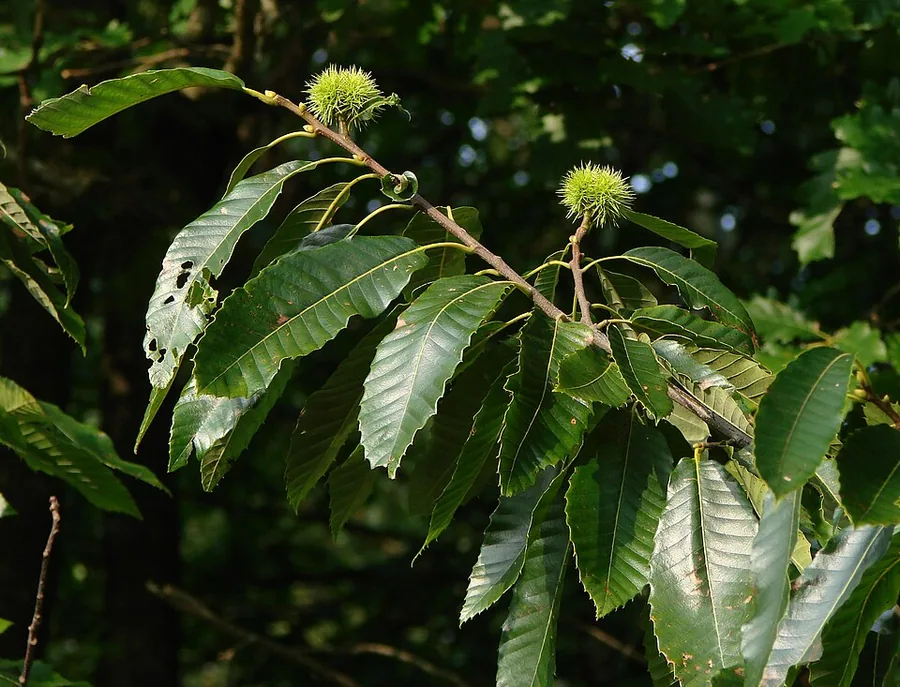
The sweet chestnut earns its place as a long-lived nut and shade tree from the beech family, a tree people have grown for the harvest for thousands of years. It powers up into a broad, deep-rooted giant of 15 to 30 m, far too much for a tight yard but a thrill to grow where the ground opens up. Best of all, it drops the very nuts that get roasted over coals all winter long.
Get one thing locked in before anything else. The horse chestnut, the conker tree, springs from a totally unrelated family and only fakes a resemblance at a glance. Only the true chestnut from the genus Castanea hands you nuts you can actually eat. The horse chestnut's nuts are toxic, so they stay far from the kitchen.
Dial in the ground and a chestnut takes off. It craves acidic, well-drained soil and full sun, and it stalls out on heavy, wet, or limey sites. Plant a second chestnut close by for cross-pollination and watch a few empty burs flip into a crop worth gathering by the basketful.
Care
The short version: full sun and deep, acidic, well-drained soil, steady summer water as the nuts fill, and a second chestnut nearby to fire up real fruit set.
Light
Drop it in full sun and the flowering and nut set go into high gear. It will get by in partial sun or light shade, but a shaded chestnut stretches leggy and crops way less, so hand it the brightest spot you have.
Water
Hit young trees with a deep soak through their first few seasons to lock the roots in place. A mature chestnut shakes off dry spells, yet it still wants steady moisture all summer to pack out the nuts. Keep it clear of waterlogged ground, which opens the door to root rot.
Soil
This tree rises or falls on its soil, full stop. Hand it deep, well-drained sandy loam on the acidic side, a pH of 5.0 to 6.5, and it thrives. Heavy, wet, or alkaline ground drags it into chlorosis and slow decline, so get this part right.
Temperature
Talk about tough. The chestnut shrugs off winter cold down to about -22°F (-30°C) and pushes through summer heat up to 95°F (35°C), which lands it squarely in USDA zones 4 through 8.
Humidity
Skip the fretting here. Ordinary outdoor air around 40% to 70% humidity covers it completely, so there is nothing to dial in. The site and the soil drainage carry far more weight for its health.
Feeding
Feed it in early spring as growth fires back up, using a balanced complete fertilizer. On naturally acidic sites, hold the lime, since shoving the pH past the preferred range only fights the tree.
Pruning
Grab the pruners in late winter while the tree sits dormant. Train a young chestnut to a single central leader, clear out dead, crossing, or damaged wood, and slice off any branch carrying a sunken bark canker right away to choke off the blight.
Repotting
No repotting grind here, since this is a landscape tree, not a pot dweller. Just move a nursery sapling to its final site while young and dormant, before the roots start circling the pot.
Size & spacing
Brace for a big one, roughly 49 to 98 feet (15 to 30 m) tall with a spread of 33 to 49 feet (10 to 15 m). Carve out that much open room and keep it well clear of buildings and power lines.
When to plant
Lean into the seasons and the chestnut keeps pace. Push dormant saplings or stratified nuts into the ground in spring once the hard frosts clear out, or sow nuts in fall and let winter chill them for you. The catkins burst open in early summer, and by September and October the burs crack to drop their ripe nuts.
Northern hemisphere
Southern hemisphere
Typical months for a temperate climate: start earlier in warm zones, later where spring frosts linger.
- Plant: Plant dormant saplings or stratified nuts in spring after the last hard frost, or set out nuts in fall for natural cold stratification.
- Harvest: Catkins bloom in early summer (June to July); nuts ripen and drop inside spiny burs in September to October.
Hardiness
USDA hardiness zones: 4–8
Temperature: down to -34°C
Troubleshooting
Almost every chestnut snag tracks back to one of three things: the wrong site, a missing pollen partner, or the blight that has chased this species for ages. Learn to read the bark, the burs, and the leaves and you will pin down the cause fast. Match the signs below and jump on it early, before a setback hardens into a dead tree.
Bark cankers spreading, upper branches dying, shoots breaking out low
Those sunken orange-brown patches on the bark spell chestnut blight, the fungal disease that wiped the American chestnut out of eastern forests. It breaks in through wounds in the bark and throws a girdling canker that kills everything above it, while the roots keep firing up new shoots below. Slice the cankered limbs out well below the lesion, and where it keeps storming back, replant with blight-resistant Chinese chestnut or resistant hybrids.
Fix:
- Prune out and destroy cankered limbs well below the lesion
- Replace highly susceptible American or European trees with blight-resistant Chinese chestnut or resistant hybrids
Flowers everywhere, yet burs turning out flat and seedless
A chestnut that blooms hard yet barely sets a nut is almost always missing its pollen partner. Chestnuts run largely self-incompatible, so a lone tree pollinates itself poorly and the burs come up flat or empty. Plant a second, genetically different chestnut within about 30 m and watch the nut set roar back.
Fix:
- Plant a second, genetically different chestnut within about 30 m to supply cross-pollen
Leaves going pale, shoots stalling, vigor draining away
When the leaves wash out pale and the shoots stay thin, the soil is usually the culprit. Chestnuts can't stand alkaline or soggy ground, and either one starves the roots and triggers chlorosis. Drive the soil toward pH 5.0 to 6.5 with elemental sulfur, fix the drainage, or shift the tree to a deeper, better-drained acidic site.
Fix:
- Acidify soil toward pH 5.0 to 6.5 with elemental sulfur
- Improve drainage or relocate to a better-drained, acidic site
Toxicity
Here is the good part for a house full of pets and kids: the true sweet chestnut is non-toxic, and people have happily eaten its roasted nuts for ages. The only things to keep tabs on are the spiny bur and the whole hard nut, since either can choke a pet or jab a hand. Steer well clear of the toxic look-alike horse chestnut, whose nuts must never land on a plate.
Safe for
People · Cats · Dogs · Horses · Rabbits · Livestock · Birds
Cats None
The true sweet chestnut is non-toxic to cats, so a nibble won't poison one. The real risk is a whole nut bolted in a rush, which can choke a cat or leave its stomach churning.
Dogs None
Dogs can romp around the sweet chestnut with zero poisoning worry. Just watch for a gulped whole nut, since the size and hard shell can jam the throat or set off a mild upset stomach.
Horses None
Sweet chestnut sits firmly on the safe list for horses and sparks no toxic reaction. Just don't let one bolt the spiny burs, which can prick the mouth.
Rabbits None
A rabbit faces no poisoning from the true chestnut. The dense, starchy nut is just heavy food for a small gut, so it stays a stray bite, not a meal.
Livestock None
Cattle, sheep, and goats can graze near a sweet chestnut safely, and fallen nuts have long pulled duty as feed. Trouble shows up only from a sharp bur underfoot or in the mouth, never from a toxin.
Birds None
Chickens, jays, and other birds tuck into chestnuts with no harm, and wild birds even help fling the crop far and wide. Offer the nuts broken into manageable pieces so nothing goes down whole.
People Safe
Roasted, boiled, or milled into flour, sweet chestnuts make wholesome eating for people. The one catch is the look-alike horse chestnut, or conker, whose nuts are toxic and must never stand in for them.
Wear gloves when collecting the spiny burs, and keep whole shelled nuts away from pets since they can be a choking or mild GI-upset risk if gulped.
Varieties
Several chestnut species and hybrids pop up across orchards and yards, each bringing its own nut size, leaf detail, and knack for shrugging off blight. These are the ones worth getting to know on sight.
Castanea sativa (Sweet / European chestnut)
The classic Mediterranean nut tree, prized for its big, sweet nuts and easy to call by its long, lance-shaped leaves with toothed edges.
Castanea dentata (American chestnut)
Once a towering ruler of eastern US forests, knocked out as a canopy giant by chestnut blight, and marked by its coarsely toothed, hairless leaves.
Castanea mollissima (Chinese chestnut)
A go-to for nut production thanks to its blight resistance, and quick to spot by the soft hairs on its twigs and leaf undersides.
'Dunstan' hybrid chestnut
A punchy cross of American and Chinese parents, bred to fuse strong blight resistance with good nut quality.
Companions
A chestnut's best neighbor is another chestnut, since one tree needs a partner to set nuts, and its worst is the grass crowding its trunk.
Plant near
A second, different chestnut cultivar: Supplies cross-pollen for nut set because chestnuts are largely self-incompatible.
Keep apart
Turfgrass or sod against the trunk: Competes with young chestnuts for water and nutrients; keep a mulched, grass-free zone around the base.
How to propagate
Kick off a chestnut from its own nut or graft a known cultivar, and the route you take drives both how soon it bears and whether it follows the parent tree.
SeedModerate
Sow fresh nuts in fall, or cold-stratify moist nuts for about 2 to 3 months and sow in spring. · 5 to 7+ years to first nut crop from seed
Most chestnuts spring straight from the nut, but the nut is recalcitrant and dies if it dries out, so sow it fresh in fall or keep it moist and cold-stratified for 2 to 3 months before a spring sowing. A seedling won't match its parent, and it takes 5 to 7 or more years to push out its first crop.
GraftingDemanding
Graft in late winter to spring onto compatible seedling rootstock. · Grafted trees typically bear in 3 to 5 years
Grafting is the move for copying a named cultivar true to type and fusing blight resistance with good nut quality. Work onto compatible seedling rootstock in late winter or spring, and look for nuts in 3 to 5 years, though graft unions do sometimes fail.
Myths
Both the sweet chestnut and the horse chestnut grow on one tree, and their nuts alike make good eating.
Not a chance, since the two are not even close relatives. The edible sweet chestnut sits in Castanea within the family Fagaceae, while the horse chestnut, or buckeye, is Aesculus, and its nuts pack aesculin and saponins that are toxic to pets and people. Never eat a horse chestnut or conker in place of the real thing.
The American chestnut has vanished completely.
Castanea dentata is functionally extinct only as a mature canopy tree, knocked down by blight before it can shoot up tall. Surviving root systems still sprout year after year, and breeding programs keep cranking out blight-resistant hybrids to bring the tree back.
Just one chestnut tree will hand you a heaping crop of nuts.
One tree on its own sets poorly because chestnuts are largely self-incompatible. You need two genetically different trees close enough to trade pollen before the burs will fill out properly.