Tree · Rosaceae
Almond
Prunus dulcis
Hand it full sun, deep well-drained soil, and a frost-free bloom, and the almond pays you back with years of nut harvests.
Full sun
Every 7–14 days
180–240 days
USDA 7–9
Overview
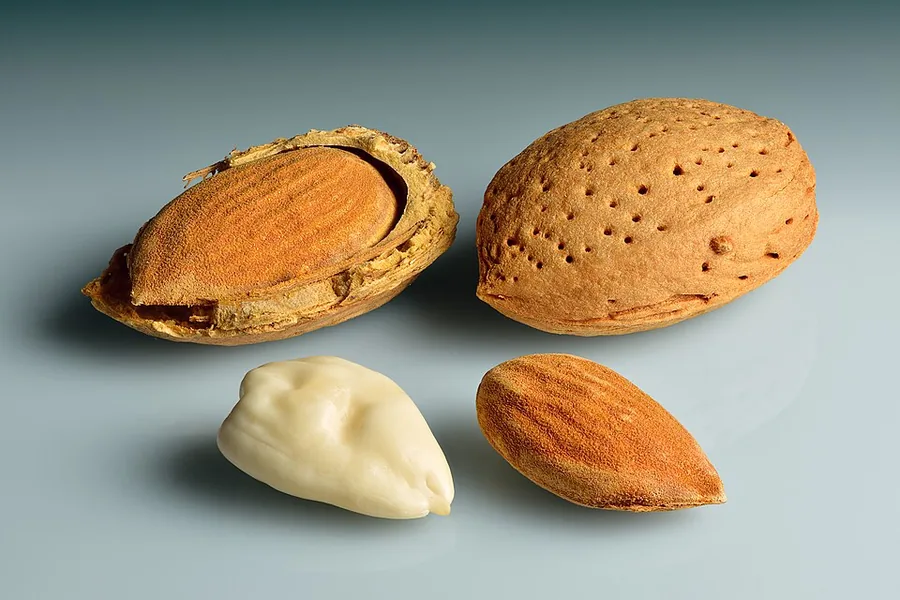
The almond is a deciduous tree in the rose family and a close cousin of the peach and apricot, grown for the seed inside its stone instead of any fleshy fruit. It comes out of western Asia and the eastern Mediterranean and has thrived in dry, sunny climates for ages. Crack one open and what you eat is the kernel of a drupe, not a true nut at all.
This is a tree built for warm, Mediterranean-style gardens, hardy clear through USDA zones 7 to 9. It bursts into bloom earlier than almost anything else in the orchard, often by February or March, and that fast start is its weak spot. A late frost can wipe the flowers and the whole season's crop in one night, so locking in a frost-free bloom matters more than just about anything else.
Almonds reward a grower who plans ahead, which is what pushes them to the demanding end of the scale. Most named varieties cannot set nuts solo and need a second tree blooming at the same time to pollinate them. Hand an almond deep, well-drained soil, full sun, and steady summer water, and a young tree starts cranking out nuts within a few years and keeps producing for decades.
Care
The short version: full sun and deep, well-drained sandy loam, with regular deep watering through spring and summer to fill the nuts out. Prune to an open vase in winter, plant a pollinizer partner, and guard the early bloom from frost.
Light
Almonds crave full sun, ideally an open, south-facing spot that soaks up light all day long. They will put up with a little partial sun, but shade quietly drains both the tree's vigor and the nut crop.
Water
Water deeply on a steady schedule through spring and summer, roughly every 7 to 14 days, to pack the nuts out. The tree shrugs off drought once established, but it hates wet feet, so steer clear of waterlogged ground that invites root and crown rot.
Soil
Plant an almond in deep, well-drained sandy loam and it really takes off. It fights heavy or poorly drained ground, so set your sights on a pH between 6.0 and 7.5 on loose, free-draining soil.
Temperature
Almonds power through a wide span of weather, from about 5°F to 104°F (-15°C to 40°C). The real threat is not winter cold but a frost during the very early bloom, which can knock out the flowers.
Humidity
This tree thrives on dry air, somewhere around 30% to 50% humidity, which is why Mediterranean climates suit it perfectly. Damp, humid air during bloom only fuels brown rot and other fungal diseases.
Feeding
Feed through the growing season, from early spring into summer, with a nitrogen-based orchard fertilizer that brings potassium along too. Split the applications across the season and let a leaf or tissue test set the amount.
Pruning
Prune in the dormant season, in winter, shaping the tree into an open-center vase form. Cut out dead, crossing, and weak wood, and thin the canopy so light pours onto the fruiting wood inside.
Repotting
Almonds are not really container trees, and field-grown trees never get repotted. If you do kick one off in a pot, don't hold it too long, or the roots circle and the tree stalls and dies back once planted out.
Size & spacing
An almond grows into a full-sized tree, hitting 10 to 30 feet (3 to 9 m) tall and spreading about as wide. Hand it plenty of open room so the canopy fans out and air rips freely through it.
When to plant
Almonds run fast and early. Plant bare-root trees in late winter to early spring while they are still dormant, gear up for a February or March bloom that frost can threaten, and bring the nuts in from late summer into fall once the hulls crack open.
Northern hemisphere
Southern hemisphere
Typical months for a temperate climate: start earlier in warm zones, later where spring frosts linger.
- Plant: Late winter to early spring as dormant bare-root, grafted nursery trees
- Harvest: Blooms very early (Feb-Mar) and is frost-prone; nuts harvested Aug-Oct when hulls split
Hardiness
USDA hardiness zones: 7–9
Temperature: down to -18°C
Troubleshooting
Most almond trouble lands on the nuts at hull split or on the blossoms through that early bloom. Spot the signs at the right stage and a fungicide or a quick clean-up pays off big, but miss the window and the crop is gone. Match what you see below, then move while the timing still works for you.
Kernels riddled with tunnels and webbing at harvest
Track this damage straight back to the navel orangeworm, the pest that tops every almond grower's watch list. The larvae drive into the nuts the second the hulls split, and they get their head start from the old mummy nuts hanging on from last year. Strip those mummies out over winter to break the cycle, then treat at hull split and hit it again 2 to 3 weeks later if pressure climbs.
Fix:
- Treat at the start of hull split and again 2-3 weeks later in moderate-to-high pressure orchards
- Harvest promptly once hulls split to limit exposure
Blossoms browning and dropping after a cold snap
Almonds throw their flowers open ahead of nearly every fruit tree, so a late freeze catches them wide open and kills the pistils, which darken brown or black inside and leave the crop thin. Fight back on two fronts at once: run wind machines or irrigation on the dicey nights, plant where cold air drains downhill, and lean toward later-blooming varieties on frosty ground.
Fix:
- Use frost protection (wind machines or irrigation) during high-risk nights
- Avoid the earliest-blooming cultivars in frost-prone sites
Shoots and leaves crashing right at hull split
When a shoot drops out of nowhere at hull split, point the finger at hull rot, a duo of fungi that pile in as the hulls crack and pump out toxins that kill the spur or shoot right beside them. Hit it with a fungicide at hull split, and pull back on late-season nitrogen and water so the hulls dry off fast and starve the fungus out.
Fix:
- Apply an effective fungicide (DMI or QoI) at hull split
- Reduce late-season nitrogen and water to speed hull drying
Browning blossoms and oozing twig cankers at bloom
A wet stretch during flowering hands brown rot blossom blight an open invitation into the blooms, which brown out, hang onto the spur, and trail gummy little cankers down the twigs. Land a fungicide on the flower stage, around pink bud and full bloom, and snip out every blighted spur and mummy you spot to shut it down.
Fix:
- Apply a bloom fungicide at the appropriate flower stage (e.g., pink bud and full bloom)
- Remove blighted spurs and mummies
Toxicity
Stay sharp with this tree around animals. The leaves, bark, green hulls, and the kernels of bitter almond all carry amygdalin, which releases cyanide, and the stone fruit's high fat and whole nuts stack on choking and pancreatitis risk for pets. The sweet almonds people eat are safe, but keep livestock, horses, and pets clear of the foliage and prunings.
Toxic to
Cats · Dogs · Horses · Rabbits · Livestock · Birds · People
Cats Mild
Let a cat get into a few sweet almonds and you will usually see vomiting, loose stool, and a sour stomach. The bigger worry is the bitter kernels and the leaves, which can fire off cyanide signs like drooling, blown pupils, and strained breathing.
Dogs Mild
Dogs gulp nuts down whole, so brace for vomiting and diarrhea, a flare of pancreatitis from all that fat, or even a choke or a blockage. Bitter almonds and any green plant parts crank the danger up into cyanide range.
Horses Toxic
The cyanide locked in wilted leaves and bark hits a horse fast, driving rapid breathing, a staggering walk, bright red gums, and collapse. Keep horses well clear of prunings and fallen branches.
Rabbits Toxic
A rabbit's tiny frame leaves almost no room for the amygdalin in almond leaves and twigs, so even one nibble can turn dangerous fast. Keep the foliage completely off the menu.
Livestock Toxic
Cattle, goats, and sheep that graze the leaves or gnaw the bark can load up on enough cyanide for a sudden, severe poisoning. Fence the trees off and rake any dropped prunings out of the pasture.
Birds Toxic
Cyanide hits birds acutely, so the green hulls, foliage, and bitter kernels stay strictly off limits for backyard poultry and pet birds alike.
People Caution
Sweet almonds off the shelf carry only a trace of cyanide and are perfectly safe to eat. Bitter almonds play a whole different game, packing amygdalin enough to be genuinely poisonous raw, which is exactly why they never reach the shelf for raw eating.
Sweet (culinary) almonds sold in the U.S. are low in cyanide and edible; bitter almonds and the tree's foliage, bark, and green hulls are the cyanogenic hazard. Keep pets from chewing foliage, twigs, or fallen green hulls.
Helpline numbers

United States
ASPCA Animal Poison Control: (888) 426-4435 (fee applies)
Poison Control: (800) 222-1222



Canada
Poison Centres: 1-844-764-7669
Varieties
Almond varieties get sorted by bloom timing and shell as much as flavor, since most need a partner to set nuts. Here are the ones worth knowing by name.
Nonpareil
California's headline cultivar, loved for thin, smooth shells that crack open with barely a squeeze, though it sets zero nuts without a cross-pollinizer close by.
Carmel
A soft-shell variety that flowers right in sync with Nonpareil, which is exactly why growers pair the two so often for pollination.
Monterey
A late-blooming hard-shell cultivar dropped in to stretch the bloom window and keep an orchard's pollination firing.
All-in-One
A self-fertile semi-dwarf, the clear winner for a home garden with room for just one almond tree.
Mission (Texas)
A hard-shelled, late-blooming variety that ducks much of the spring frost, so it pulls its weight where the cold drags on.
Companions
Plant near
Pollinizer almond varieties (e.g., Nonpareil with Carmel/Monterey): Most cultivars are self-incompatible and need a different, overlapping-bloom variety nearby for bee cross-pollination and nut set.
Flowering bee-forage cover crops (clover, mustard): Support honey bee and native pollinator activity during the critical early bloom window.
Keep apart
Peach and other Prunus stone fruits planted close by: Share pests and diseases such as brown rot, peach twig borer, and navel orangeworm, increasing pressure on the almonds.
How to propagate
You won't grow a named almond from its own seed, since it refuses to come true. Trees get propagated by grafting onto chosen rootstock, with seed saved for raising those rootstocks.
GraftingModerate
T-budding in late summer or bench/whip grafting onto rootstock in late winter · 3-4 years to first meaningful nut crop
A named almond never comes true from its own seed, so growers bud or graft it onto a peach, almond, or hybrid rootstock picked to suit the soil and the vigor they are after. T-bud it in late summer, or bench-graft onto rootstock through the late winter dormancy, and you are off. From there the young tree takes 3 to 4 years before it pumps out a crop worth the name.
SeedModerate
Stratify seed over winter and sow in spring · 1 season to seedling, several years to bear
Going the seed route means chilling it over winter and sowing in spring, which lands you a seedling in a single season but tacks on several years before it bears. The twist is that seedlings don't match the parent, so they mostly end up as rootstock rather than a shortcut to copy a named variety.
Myths
An almond is a true nut.
The almond you crunch is the seed tucked inside the stone of a drupe, the very same fruit build you find in a peach or apricot. It is a seed, not a true nut at all.
Every almond is equally safe to eat.
Sweet almonds grown for food hold just a trace of cyanide and earn their spot on the table. Bitter almonds flip the script, loaded with amygdalin that releases cyanide, which is why they are never sold for raw eating in the U.S.