Houseplant · Cactaceae
Christmas Cactus
Schlumbergera × buckleyi
Hand it bright, indirect light and cool fall nights, and this old-favorite houseplant bursts into flower right on cue for the holidays.
Bright indirect
55–81°F · 13–27°C
USDA 10–12
6–12 in · 15–30 cm
Overview
The Christmas cactus throws a curveball: it is a forest cactus, not a desert one. Out in the wild it scrambles up the trees of the Brazilian rainforest, riding the branches with its roots stuffed into pockets of leaf litter, which is exactly why it craves steadier moisture than the spiny cacti everyone pictures. Bring it indoors and it stays small while living for decades, and these are the plants that get handed down from one gardener to the next.
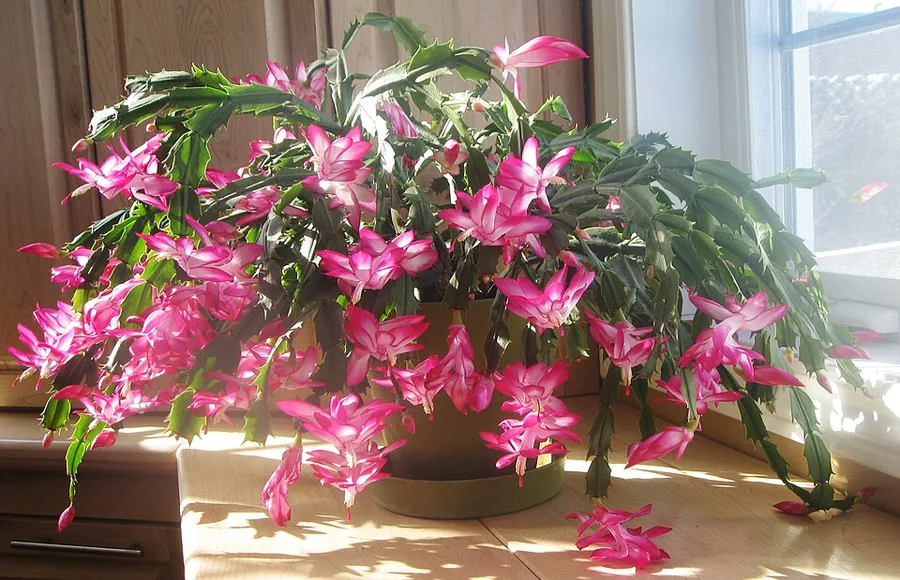
The real payoff is the timing of its flowers. As the days shrink and the nights cool off in fall, the plant grabs the cue, sets buds, and erupts into arching, tubular blooms in pink, red, white, or coral right around the holidays. Those flat, jointed segments build a soft, cascading shape that practically begs for a hanging basket or the lip of a shelf.
Crack the one trick about light and cool nights and the rest comes easy. Park it in bright, indirect light, water when the top of the mix dries, and quit fussing over it. A plant left a touch pot-bound and undisturbed is the one that rewards you with the biggest flush of flowers.
Care
The short version: bright, indirect light, water once the top of the mix dries, and a run of cool nights with long, unbroken darkness in fall to fire off the buds.
Light
Hand it bright, indirect light for most of the year and it thrives. It scrapes by in medium light or light shade too, but harsh direct summer sun scorches the segments and stains them red, so dodge that. An east window, or a shaded west one, sets it up perfectly.
Water
Water once the top half of the mix dries out, then soak it well. This is a forest cactus, so it drinks more than a desert cactus but never sits in soggy soil. The moment buds show, keep the mix evenly moist, since a dry snap right then knocks the buds straight off.
Soil
Pot it into a well-drained, organic-rich potting mix, the cactus or succulent kind loosened with a handful of extra grit. A pH between 5.5 and 7.0 hits the mark. Drainage rules everything here, because standing water at the roots is what takes these plants down.
Temperature
Everyday room warmth between 55°F and 81°F (13°C to 27°C) keeps it cruising year-round. Fall flips the script, when cool nights around 55°F to 60°F (13°C to 16°C) kick off the blooming.
Humidity
Average household humidity has it covered, so skip chasing a number. As a rainforest plant it loves a little extra moisture in the air, and grouping it with other plants or setting it on a pebble tray handles that with zero hassle.
Feeding
Feed it monthly through spring and summer while it's pushing growth, using a balanced houseplant fertilizer at half strength. Cut it off by late summer to steer it toward fall flowering, then swap to a low-nitrogen, high-phosphorus feed as bloom season closes in.
Pruning
Once it flowers in spring, pinch or twist off a few end segments to drive branching and bulk it out bushier. Those trimmed pieces are pure bonus, since they root fast into brand-new plants.
Repotting
Only repot every 3 to 4 years, and don't jump the gun. This cactus flowers best left slightly pot-bound, so an oversized pot hands you more leaves and fewer blooms. Roots shooting from the drainage holes, or soil that dries almost instantly, flag that it's finally time.
Size & spacing
A grown plant stays compact at 6 to 12 inches (15 to 30 cm) tall yet fans out 12 to 24 inches (30 to 61 cm) wide as the jointed stems arch and trail. That tumbling habit makes it a slam-dunk for a hanging basket or a high shelf.
Troubleshooting
Almost every Christmas cactus hiccup traces back to water, light, or the conditions it needs to flower, and the plant broadcasts the problem loud and clear. Dropped buds, soft stems, or color creeping into the segments all point you straight at the cause. Match your symptom below and act fast, before a small slip swallows the whole season.
Mushy, slumping stems over soggy soil
A plant that flops while its soil sits wet is shouting root rot, driven by overwatering or a dense mix that traps water. Jump on it: slide the plant out and squeeze the roots, and if they come up brown and soft instead of firm and white, you have your answer. Dry it out, snip away the rotted roots, repot into fresh, fast-draining mix, and dump every saucer so the pot never stews in standing water.
Fix:
- Allow the plant to dry out
- Repot into a fresh, fast-draining mix and trim away rotted roots
- Empty saucers so the pot never stands in water
Buds yellow and drop right before the show
Bud drop stings, but it almost always tracks back to one abrupt change after the buds set, like a cold draft, a warm vent, or a watering that slipped your mind. Lock the plant into a single steady spot and keep the soil evenly moist while it carries buds. Resist the urge to move it or even spin it, because this plant flat-out hates being shuffled around just as it gears up to flower.
Fix:
- Keep the plant in a stable spot away from heat vents and cold drafts
- Keep the growing medium evenly moist once buds appear
- Avoid moving or rotating the plant while in bud
Picture of health, yet not a single flower
A plant that won't bloom has almost always coasted through fall too warm and too brightly lit to take the hint. Flip the switch by handing it cool nights around 55°F to 65°F (13°C to 18°C) plus 12 or more hours of solid, unbroken darkness every night for roughly 6 weeks. Guard that dark window fiercely, because even one lamp clicking on can shut the flowers down before they start.
Fix:
- Provide cool nights of about 55 to 65°F
- Give 12 or more hours of continuous darkness each night for roughly 6 weeks starting in fall
- Avoid interrupting the dark period with artificial light
Segments flashing yellow or red
Segments that flush yellow or red have taken a sunburn from too much direct light, and summer is the usual culprit. Pull the plant back into bright, indirect light and throw it some shade through the fiercest weeks. Good news: the color tends to bounce back once that harsh sun stops blasting the leaves.
Fix:
- Move the plant to bright, indirect light
- Provide light shade during hot summer months
Toxicity
Pet owners can breathe easy, because the Christmas cactus is safe. The ASPCA lists it as non-toxic to cats and dogs, and it carries no poison that threatens other animals or people. Chew through a stack of the fibrous stems and a pet might get a quick, mild stomach upset, but that is the whole story.
Safe for
People · Cats · Dogs · Horses · Rabbits · Livestock · Birds
Cats None
Great news for cat people, since this plant packs no toxin at all. A cat that goes to town on the fibrous stems might earn a quick bout of vomiting or a loose stool, and nothing worse.
Dogs None
Dogs are in the clear here, with zero poison in the plant. If one tears into the stems and gulps a big mouthful, expect a short bout of stomach upset that clears up fast and on its own.
Horses None
Horses have nothing to fear from this plant, and a small indoor grower like this stays well clear of them anyway.
Rabbits None
A rabbit can graze the segments without any worry. Pile on too much, like with any fibrous green, and the gut might loosen for a day, but there is no danger in it.
Livestock None
No toxin here troubles goats, sheep, or cattle, and as a houseplant it almost never crosses paths with farm animals to begin with.
Birds None
Pet birds face zero poisoning risk from the stems or flowers, so a cheeky peck is nothing to sweat over.
People None
People are perfectly safe around it, young kids included. Nobody grows it to eat, so skip the taste test, but a curious nibble won't cause any harm.
Varieties
Three holiday cacti crowd in under the same name, and cracking which is which comes down to segment shape and when they flower. Here are the ones you'll bump into.
Thanksgiving cactus (Schlumbergera truncata)
Spot it by the pointed, claw-like teeth running along its segment edges and a bloom that lands near Thanksgiving, and it turns out most plants sold as Christmas cactus are really this one.
True Christmas cactus (Schlumbergera × buckleyi)
This one flaunts rounded, scalloped segment margins and a drooping habit, and it pushes its flowers out closer to Christmas than its earlier cousin.
Easter cactus (Rhipsalidopsis / Hatiora gaertneri)
It jumps to a whole separate genus, sporting rounded segments edged in tiny bristles and flowers that hold off until spring.
How to propagate
Hardly any houseplant multiplies this easily. Twist off a piece of stem and it roots almost by itself, which is exactly why these plants keep getting passed from gardener to gardener.
Stem cuttingsEasy
Late spring to early summer after flowering (about May to June) · Roots form in about 2 to 8 weeks
Grab cuttings in late spring to early summer right after flowering wraps, around May to June. Twist off a piece of 2 to 5 joined segments, let the cut end callus for a day, then push it into a moist, well-draining mix. The segments root like champs in about 2 to 8 weeks, and slapping a humidity cover over them really kicks things into gear.
Myths
The three holiday cacti are one plant, so segment shape and bloom time don't matter.
Not so fast, because they really are different plants, and segment shape plus flowering time give them away every time. Thanksgiving cactus rocks pointed, claw-like teeth and blooms in late November, true Christmas cactus carries rounded, scalloped margins and opens nearer Christmas, and Easter cactus is its own genus that holds out for spring. Most plants sold as Christmas cactus are actually Thanksgiving cactus.