Tree · Pinaceae
Douglas Fir
Pseudotsuga menziesii
Hand it room, moist soil, and a stretch of years, and the Douglas fir shoots up into one of the tallest trees in the forest.
Full sun
Every 7–14 days
USDA 4–6
39–79 ft · 12–24 m
Overview
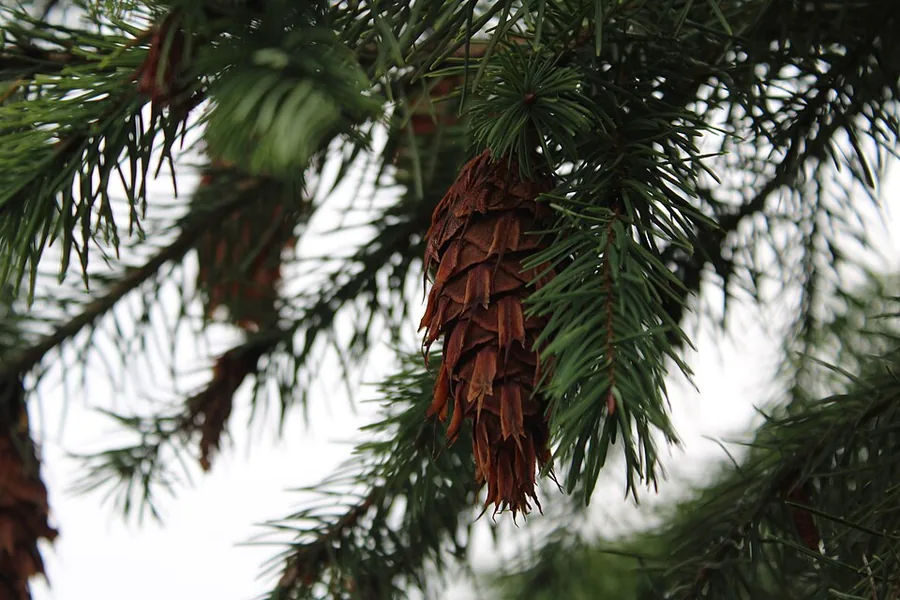
The Douglas fir stands among the giants of western North America, a fast-growing conifer that blasts past 80 feet (24 m) in a yard and climbs far higher in the wild. The name plays a trick, because this is no true fir but its own kind of evergreen, easy to call out by the soft flat needles and the hanging cones whose papery bracts jut out like little mouse tails. It headlines the Pacific Northwest as the classic Christmas tree and drives a huge slice of the timber trade.
Two main forms turn up in gardens, and picking the right one sets the whole project up to win. The coast type races up tall and fast and loves the damp, mild weather west of the mountains, while the Rocky Mountain blue form runs smaller, bluer, and far tougher in the cold, holding strong down to zone 4. Matching the form to your climate counts for more here than with nearly any other tree, because the wrong seed source spends its life battling disease.
This one rewards space and patience rather than a quick screen, and the payoff is worth the wait. It craves deep, moist, well-drained ground and full sun, and it pushes back hard against drought, compaction, and soggy roots. Plant it well clear of the house, turn it loose, and watch it grow into a landmark tree that outlives the person who set it in the soil.
Care
The short version: full sun, deep and steadily moist acidic-to-neutral soil that drains well, and plenty of open room, since this tree can shoot up to 40 to 80 feet in the yard.
Light
Pour full sun onto a Douglas fir and it answers with the fullest, densest growth around. It will put up with a little partial shade, especially while young, but a tree stuck in heavy shade stretches thin and leggy.
Water
This tree is intolerant of drought, so keep the soil deep and steadily moist while never letting it waterlog. Water young trees on a steady beat until they establish, every 7 to 14 days depending on the weather, and never leave a long dry spell hanging.
Soil
Drop it into deep, moist, rich loam that drains fast and runs acidic to neutral, anywhere from pH 4.5 to 7.2. It flat-out rejects poorly drained or compacted ground, where root rot moves in quick.
Temperature
Douglas fir takes a beating from the weather and keeps going, handling anything from -29°F to 90°F (-34°C to 32°C) depending on the form you plant. The Rocky Mountain type powers through the harshest cold, down to zone 4.
Humidity
Outdoor humidity is whatever the climate dishes out, so leave it be. Air circulation matters far more than moisture in the air, since crowded, stagnant pockets are exactly what let needle cast dig in.
Feeding
Feed in spring with a balanced fertilizer or one built for conifers and evergreens. The goal is not to force growth but to keep the tree unstressed, which makes it far less likely to catch needle cast.
Pruning
Pruning barely enters the picture. Pull only the dead, damaged, or diseased branches and leave the natural shape running free, unless you are shearing a Christmas tree.
Repotting
This is a forest tree, not a pot dweller, so repotting rarely comes up past the nursery stage. Keep tabs on a potted young one for roots circling the pot, growth that stalls, or soil that dries out very fast, all signs it wants the open ground or a bigger container.
Size & spacing
A Douglas fir grows big and does it fast, reaching 40 to 80 feet (12 to 24 m) tall with a spread of 12 to 20 feet (3.7 to 6 m). Plant it well clear of buildings, power lines, and septic lines, and turn it loose with the open space a landmark tree needs.
When to plant
Douglas fir plays a long game rather than a one-season sprint. Chill the seed through late winter, push young trees out into spring once the hard frosts clear, and skip waiting on flowers, since this conifer fires off cones instead, ripening them from late summer into fall.
Northern hemisphere
Southern hemisphere
Typical months for a temperate climate: start earlier in warm zones, later where spring frosts linger.
- Sow: Late winter after cold-moist stratification of seed for about 1-2 months.
- Plant: Spring, after the last hard frost, while trees are small and easy to transplant.
- Harvest: Non-flowering conifer; cones mature late summer to fall. No ornamental bloom.
Hardiness
USDA hardiness zones: 4–6
Temperature: down to -34°C
Troubleshooting
Most Douglas fir trouble breaks out either in the needles or down at the roots. The needle problems often trace straight back to the wrong seed source in a wet climate, while the real heavy hitters lurk underground. Match what you see below and jump on it early, since a stressed tree falls to disease far faster than a vigorous one.
Pale, thinning crown with dieback and a tree losing ground
A whole crown going pale and thin with branches dying back almost always points down to the roots. Armillaria root rot packs thick white fungal fans between the bark and wood at the root crown and runs black shoestring-like strands through the soil, while Phytophthora root rot rots roots dark wherever the ground stays wet or compacted. No spray rescues an infected tree, so dig into the real fixes: sharpen the drainage, quit planting too deep, and pull badly hit trees before replanting the spot with something tougher.
Fix:
- Improve drainage and avoid overwatering or planting too deeply
- Remove and destroy severely infected trees including small roots
- Replant the site with more resistant species
Older needles brown and drop, leaving twigs with only fresh growth
Older needles browning and dropping while only the fresh tips cling on usually means needle cast, a fungus that goes after the oldest needles first. Track down which one by flipping the needles over: Swiss needle cast lines them with rows of tiny black dots, and Rhabdocline splashes reddish-brown blotches across second-year needles. Open up crowded trees to get air moving, keep the roots watered, and reach for Pacific Coast seed sources in wet climates, since they shrug off the disease far better than Rocky Mountain stock.
Fix:
- Improve air circulation by thinning crowded trees and increasing spacing
- Keep trees adequately watered and properly fertilized to reduce stress
- Apply a labeled fungicide at budbreak and as new needles expand where infection pressure is high
- Remove and dispose of heavily infected fallen needles
Needles stripped from branches, hitting the top of the tree first
Bristly caterpillars chewing their way down from the top flag the Douglas-fir tussock moth or western spruce budworm, and in outbreak years either one can strip a tree clean. Get ahead of them by scouting the bark for egg masses before the spring hatch. Spray Btk while the larvae are still small, and in plenty of years the natural enemies and a native wilt virus crash the outbreak themselves within a season or two.
Fix:
- Monitor for egg masses before spring hatch
- Apply Bacillus thuringiensis (Btk) or a labeled insecticide while larvae are young
- Allow natural enemies and the naturally occurring wilt virus to collapse outbreaks over a season or two
Woolly white tufts on needles that twist and yellow
Spot woolly white tufts on the needles and you have met the Cooley spruce gall adelgid, a sap feeder that kinks Douglas-fir needles instead of throwing the cone-shaped galls it builds on spruce. Light infestations call for nothing at all, since natural predators charge in and handle them. Knock back heavier ones with a dormant horticultural oil before budbreak, and steer new plantings clear of spruce, the bug's alternate host.
Fix:
- Tolerate light infestations; natural enemies often suppress populations
- Spray dormant-season horticultural oil or treat before budbreak
- Soil-applied imidacloprid can control populations on high-value trees
Toxicity
Great news for households with pets and kids: Douglas fir is not toxic. That is exactly why it has headlined Christmas living rooms across much of the country for generations. A pet that chews the fallen needles might pick up a mildly upset stomach, but no poison comes into it.
Safe for
People · Cats · Dogs · Horses · Rabbits · Livestock · Birds
Cats Safe
Cats land firmly on the safe list here. A cat that grabs a needle or two might drool a bit or spit it back, but the tree packs no real toxin.
Dogs Safe
Dogs run no risk of poisoning from this tree. Gnawing the sharp needles can hand a dog a mild stomach gripe, so still nudge them off any fallen branch.
Horses Safe
Horses graze around a Douglas fir without a worry. It dodges the mare-abortion problem that hits some pines, and its needles carry no listed toxicity.
Rabbits Safe
Rabbits stay perfectly safe near this tree, and wild ones actually go after the bark and twigs as winter browse.
Livestock Safe
Cattle, sheep, and goats browse Douglas fir with zero trouble. Unlike ponderosa pine, its needles never get tied to lost pregnancies in grazing stock.
Birds Safe
Birds thrive around it, ducking into the dense branches for cover and picking the seeds out of the cones.
People Safe
People stay safe around it too, and the young spring tips even brew up into a bright citrusy tea, though those stiff mature needles belong well out of small hands.
Eating needles can cause mild mouth/stomach irritation with possible vomiting, drooling, or diarrhea, and large quantities of sharp needles could rarely cause GI blockage.
Varieties
Most Douglas firs on the bench are just the straight species, but a handful of named forms are worth chasing down when you have a particular spot or climate in mind.
var. glauca / 'Glauca' (Rocky Mountain blue Douglas-fir)
This smaller, blue-green Rocky Mountain form powers through hard cold down to zone 4 and beats the coast type for toughness, even if it climbs more slowly and picks up needle cast more readily where the air stays wet.
'Fastigiata'
A narrow, columnar pick that shoots straight up instead of out, slotting neatly into tight corners the wide-open species would never fit.
'Pendula'
A weeping form whose branches spill and tumble downward, grown as a striking ornamental specimen for that shape alone.
How to propagate
Douglas fir grows from seed for ordinary trees and from grafting for the named cultivars, and neither route races by. Both ask a couple of years before they hand you something ready to plant out.
SeedModerate
Sow in spring after 1-2 months of cold-moist stratification. · 1-2 years to a transplantable seedling
Seed is the go-to way to raise the straight species, and it pays off. Hand the seed 1 to 2 months of cold, moist stratification through winter, sow it in spring, and bank on 1 to 2 years before a seedling stands big enough to move. Young trees lift and transplant with ease while still small, so get them planted before the taproot drives deep.
GraftingDemanding
Late winter onto seedling rootstock. · 1-2 years
Grafting is the high-skill route, saved for the named cultivars like the weeping and columnar forms that refuse to come true from seed. Tackle the work in late winter onto a seedling rootstock, and even a graft that takes still needs 1 to 2 years to build into a tree you can trust.
Myths
Douglas fir is a true fir, like the firs in the genus Abies.
It is no true fir at all. That hyphen in Douglas-fir gives the whole game away, since the tree stakes out its own genus, Pseudotsuga, a name that means false hemlock. True firs stand their cones upright and let them shatter on the branch, but Douglas-fir cones swing downward and drop whole, with papery three-pointed bracts shooting out between the scales like little mouse tails.
Sources
- USDA Forest Service, Silvics of North America
- USDA Forest Service FEIS
- USDA Forest Service FEIS
- NC State Extension Gardener Plant Toolbox
- Pacific Northwest Pest Management Handbooks (OSU/WSU/UI Extension)
- Pacific Northwest Pest Management Handbooks (OSU/WSU/UI Extension)
- Colorado State University Extension
- Pacific Northwest Pest Management Handbooks (OSU/WSU/UI Extension)
- UC Statewide IPM Program (UC ANR)
- ASPCA
- Pet Poison Helpline
- Oregon State University Extension
- USDA NRCS Plant Fact Sheet