Tree · Cactaceae
Saguaro
Carnegiea gigantea
Hand it blazing sun, sharp drainage, and years of patience, and watch a saguaro rise into a true desert giant.
Full sun
Every 14–30 days
USDA 9–11
33–59 ft · 10–18 m
Overview
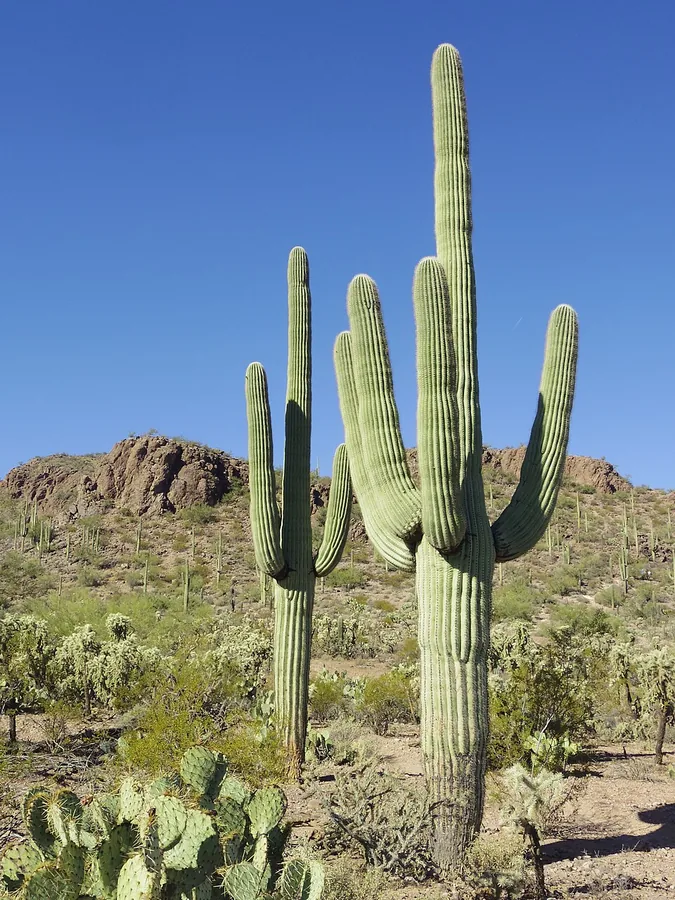
Meet the showstopper of the Sonoran Desert, the cactus that instantly says American Southwest. A saguaro climbs as a single ribbed column that may throw out those iconic arms, easily rising past head height. It grew up in country that goes months without rain, so it moves at its own slow, deliberate pace, and half the fun is watching that pace unfold.
Get ready to think in centuries, because this plant plays a long game. A saguaro can spend 50 to 75 years working up to its very first arm, and some never branch at all. When rain finally lands, the pleated stem swells like an accordion and banks the water for the dry stretch ahead. Late spring sparks white flowers that open under the stars, and then come the red fruits that desert peoples have gathered and eaten for generations.
Growing one is wonderfully simple once the setting clicks. Plant it in hot, dry, frost-free ground with soil that drains in a heartbeat, and the saguaro practically runs itself from there. Just remember it is protected in the wild, so kick things off with a nursery-grown plant and grow it proudly from there.
Care
The short version: pour on the sun, plant it in gritty fast-draining soil, and water with a light touch. Let the soil dry out completely between drinks, keep it nearly dry all winter, and shield it from a hard frost.
Light
Pour on the full sun, start to finish. This is an open-desert plant that soaks up every ray of direct light it can grab, so a blazing, wide-open spot makes it soar. Young plants enjoy a bit of afternoon shade while they toughen up, then they charge into the sun.
Water
Water it deep and seldom, waiting until the soil has dried out completely during warm growth. That lands at roughly every 14 to 30 days in the growing season, and come winter it wants to sit nearly dry. Once established, it thrives on natural rainfall and the water it banks inside its own stem, so a dry-side hand keeps it happiest.
Soil
Set it up in gritty, sharply draining mineral soil, and pile on the rock and sand for good measure. A pH from 6.0 to 8.0 works a treat. The single thing that trips it up is soil that clings to water around the roots, so drainage is the whole game.
Temperature
This plant laughs off blistering heat, right up to about 113°F (45°C). Cold is the real test. It can ride out a quick dip to around 23°F (-5°C), but a hard or drawn-out freeze bruises the tissue and can invite rot, so a warm, sheltered spot keeps it powering along.
Humidity
Dry air is where a saguaro really takes off, ideally around 10% to 30%. Damp, muggy conditions drag it down and crank up the rot risk, so skip the steamy corners and let it bask in open, arid air.
Feeding
Feeding barely registers on the to-do list. A dilute, low-nitrogen cactus fertilizer across spring and summer does the whole job. Go light, because a nitrogen overload only pushes soft, floppy growth the plant cannot hold up.
Pruning
The best move here is to let it grow untouched. Skip routine pruning and cut only an arm that is clearly damaged or diseased. On a big mature plant, call in a professional, since those arms are seriously heavy and the spines mean business.
Repotting
Only young potted plants ask for repotting, about every 2 to 4 years while they stay small. Once a saguaro settles into the landscape, it plants its flag and stays put for the long haul.
Size & spacing
Clear the decks, because this giant gets big. A mature saguaro rockets to 33 to 59 feet (10 to 18 m) tall and flings its arms 2 to 11.5 feet (60 cm to 3.5 m) wide. Hand it a permanent, wide-open spot from day one, because it will stand tall there for generations.
When to plant
The saguaro thrives on heat and shuts down at a hard freeze, so timing sets you up to win. Sow seed through the warm run of late spring and summer, and move young plants outdoors the moment the last frost clears. Late spring fires off white flowers, and red fruit rolls in through early summer.
Northern hemisphere
Southern hemisphere
Typical months for a temperate climate: start earlier in warm zones, later where spring frosts linger.
- Sow: Late spring into summer when soil is warm (21-27°C)
- Plant: Spring after all danger of frost has passed
- Harvest: Late spring to early summer (May-June); white night-opening flowers, followed by red edible fruit
Hardiness
USDA hardiness zones: 9–11
Temperature: down to -7°C
Troubleshooting
Nearly every saguaro hiccup traces to one of two things: too much water or a sharp cold snap. Zero in on the stem and the base, where rot and frost damage show up first. Spot your symptom below and jump on it early, before it works its way through the plant.
Dark, soft, foul lesions weeping down the trunk or arms
This is bacterial necrosis, and it kicks off when Erwinia cacticida sneaks in through a wound or frost crack and rots the plant from the inside. Grab a sterilized blade and carve the bad flesh back to solid green tissue, then let the wound dry and callus in open air. On a big plant, loop in an arborist before the first cut, and moving fast gives your saguaro a real shot.
Fix:
- Cut out infected tissue back to firm healthy green flesh using sterilized tools
- Allow the wound to dry and callus in open dry air
- Consult an arborist or extension specialist before treating large plants
A soft, discolored base with the plant tipping or leaning
This is root and basal rot, kicked off by overwatering or soil that just will not drain. The base goes soft instead of firm, and the whole plant can start to lean or topple. Cut off the water right away, let the soil dry out completely, and if drainage is the villain, shift it into a gritty mineral mix so it can rally.
Fix:
- Stop watering and allow the soil to dry completely
- Improve drainage or replant in gritty fast-draining mineral mix
- Cut away rotted tissue where accessible and let it callus
Yellow or black bands near the tips after a cold snap
This is frost damage, striking the growing tips and the most exposed surfaces right after a hard freeze. Resist the urge to start cutting. Let warm weather show the full picture, then whisk away only the tissue that is clearly dead or rotting, and give the rest a chance to bounce back.
Fix:
- Do not cut immediately; wait until warm weather to assess the extent of damage
- Remove only clearly dead or rotting tissue once freeze risk has passed
Toxicity
Here is the freeing part: the saguaro packs no poison, and its ripe fruit is genuinely good to eat, so a curious nibble does no harm. The thing to respect is physical. Those long, rigid spines drive deep into skin, and a grown plant tips the scales at several tons, so pull on thick gloves, grab the right tools, and keep kids and pets from brushing against it.
Safe for
People · Cats · Dogs · Horses · Rabbits · Livestock · Birds
Cats None
Nothing in the flesh is poisonous, so a nosy cat that grabs a taste stays perfectly fine. The spines are the real story here, since they can drive deep into a paw or face and often need a vet to pull free, so keep a cat's wandering routes clear of the plant.
Dogs None
A dog that chomps the plant runs into zero chemical trouble. A jabbed nose or a spine stuck in the mouth is the genuine risk, so steer an eager dog well clear of those long needles.
Horses None
A saguaro holds nothing that could poison a horse. Even a glancing bump against the rigid spines can leave nasty puncture wounds, though, so park the plant far from the paddock.
Rabbits None
A rabbit meets no toxin at all in the tissue. Those stiff spines can hurt a small animal fast, so fence bunnies away from any low arms and everyone stays happy.
Livestock None
Cattle, goats, and sheep shrug off any poison worry with a saguaro. The spines are the whole hazard, ready to wound mouths and legs if animals crowd in, so give the plant some room.
Birds None
Birds come through untouched, and heaps of desert species nest right inside a saguaro. The spines barely slow them down.
People None
The plant is not poisonous, and its ripe red fruit has been gathered and eaten for ages. The sharp spines are the one real catch, so gear up with thick gloves and proper tools whenever you handle it.
The danger is physical, not chemical: large rigid spines can puncture skin and cause painful wounds, and mature plants are extremely heavy.
Varieties
This one keeps it refreshingly simple. The saguaro shows up as one main form, plus a single rare curiosity that collectors chase down, and those two are the names to know.
Typical columnar form
The everyday form shoots up as one tall trunk, later branching into those signature arms and powering up to full tree size as it ages.
Crested (cristate) Saguaro
This rare crested standout comes from a mutation that fans the growing tip into a broad flattened crest instead of the usual rounded column.
How to propagate
Starting a saguaro from seed is a genuine kick, and the payoff builds over time. The seed pops up fast, and then the real adventure begins as the seedling climbs along at its own unhurried pace.
SeedModerate
Warm season, late spring through summer · Germinates in 1-3 weeks but takes several years to reach a transplantable size
Saguaros spring from seed, sown fresh onto a gritty mix and kept warm and lightly moist through the warm season from late spring into summer. Germination fires off fast, usually within 1 to 3 weeks, and then patience takes over, because the seedling needs several years of slow growth before it is big enough to transplant.
Myths
It is flat-out illegal to own or grow a saguaro.
Not so, because you can grow, sell, and plant one freely. Arizona law only reins in taking, harvesting, or destroying native plants out in the wild, which leaves home-grown and nursery-raised saguaros completely aboveboard. Plant one with total confidence.
Count a saguaro's arms and you have got its exact age.
Arm counts scatter far too widely to nail down age. Loads of saguaros need 50 to 75 years to push out a first arm, and some never branch at all, so the arm tally reveals next to nothing about a plant's age. Great story, shaky science.