Ornamental · Fabaceae
Alfalfa
Medicago sativa
Sort the soil and pH first, then watch this deep-rooted legume keep yielding cut after cut for years.
Full sun
Every 7–14 days
60–70 days
USDA 3–9
Overview
Alfalfa pulls real weight as a forage crop, a deep-rooted perennial legume that growers mow several times a season for hay. It rides in the pea family, and like every cousin there it grabs its own nitrogen straight from the air through Rhizobium bacteria packed into root nodules. The taproot plunges deep, which is exactly why a settled stand laughs off drought and bounces back season after season.
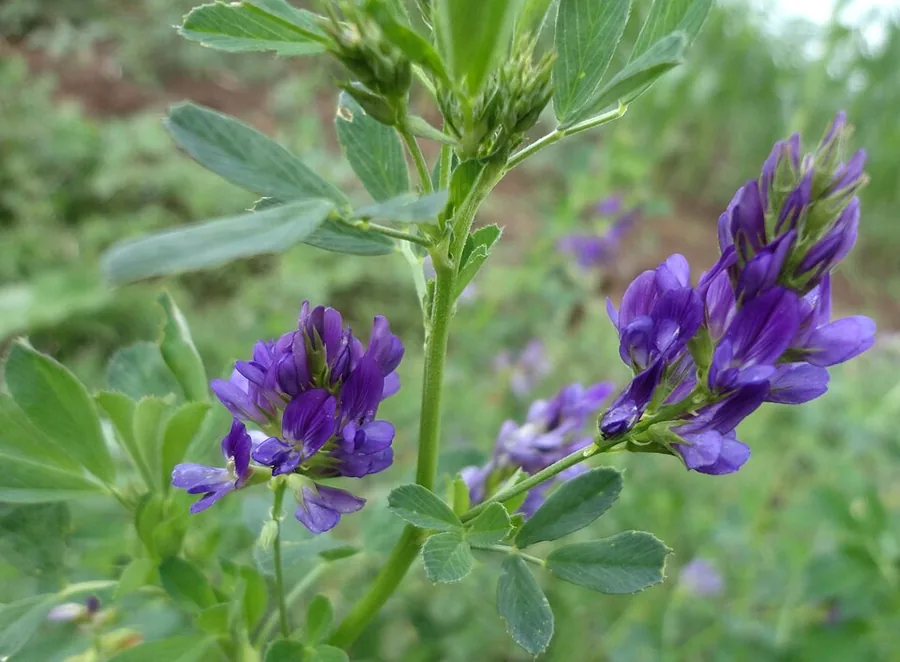
Where this crop turns choosy is the dirt beneath it. It demands deep, well-drained, near-neutral soil and goes grumpy on sour, soggy, or thin sites. Nail the pH and drainage before seeding and the planting pays back for years; miss them and the stand goes patchy quick. Come summer it lifts purple to blue-violet pea flowers, though most growers cut for forage well ahead of full bloom.
It also keeps a long grudge against itself. A tired stand sours the ground against its own seedlings, a quirk called autotoxicity, so dropping fresh seed straight back into a worn field flops. Slot alfalfa into a rotation instead, and the follow-up crop cashes in on the nitrogen left waiting in the soil.
Care
The short version: give it full sun and deep, well-drained, near-neutral ground at a pH of 6.5 to 7.5. Inoculate the seed, water deep but rarely once roots dig in, and keep cutting on a steady schedule all season.
Light
Alfalfa runs on full sun with no patience for shade at all. Open ground soaking up all-day sun is what powers the strong regrowth that springs up between cuttings.
Water
Once it settles in, the deep taproot turns alfalfa very drought tolerant, so soak it deep only every 7 to 14 days instead of dribbling water on often. It draws roughly 10 to 12 inches of moisture across a season yet buckles under flooding or waterlogged ground, so drainage counts every bit as much as the water you add.
Soil
Hand it deep, well-drained, fertile loam and hold the pH between 6.5 and 7.5. It struggles on acidic, very alkaline, wet, or shallow soils, and that pickiness about the seedbed stands as the single biggest driver of whether a stand makes it.
Temperature
This crop holds up at both extremes, riding out a span from roughly -20°F to 95°F (-29°C to 35°C) through its hardiness zones. That cold grit is what carries winter-hardy types through northern winters so they push back up each spring.
Humidity
Plain outdoor humidity won't trouble a field crop like this one. What carries far more weight is air movement and drainage, because damp, stagnant air is what calls in the root rots and white mold.
Feeding
As a legume, this crop fixes its own nitrogen by way of Rhizobium nodules the second the seed gets inoculated, so leave the nitrogen out of the picture. Deliver phosphorus, potassium, and lime guided by a soil test to hold pH near neutral, at both establishment and post-cutting.
Pruning
Cutting is the entire payoff here. Pull the first harvest off a direct-seeded stand about 60 days after seeding, then keep mowing on a steady schedule through the season for hay or forage.
Repotting
none
Size & spacing
A grown stand reaches about 24 to 35 inches (60 to 90 cm) tall with plants fanning 12 to 24 inches (30 to 60 cm) wide. Since it goes in broadcast or drilled as a field crop rather than spaced out like a garden plant, you steer it as a thick stand, not as single plants.
When to plant
Skip the transplant tray: this one goes in by direct seeding. Drill it into a packed seedbed in spring or circle back in late summer, claim a first cut about 60 days later, and keep mowing through the warm stretch as the purple blooms rise and fade.
Northern hemisphere
Southern hemisphere
Typical months for a temperate climate: start earlier in warm zones, later where spring frosts linger.
- Sow: Not typical; direct sown in field
- Plant: Spring (April-May) or late summer (late July-early September) into a firm, well-drained seedbed at neutral pH
- Harvest: Purple to blue-violet pea flowers in summer (May-October depending on latitude); cut for hay or forage multiple times per season
Hardiness
USDA hardiness zones: 3–9
Temperature: down to -40°C
Troubleshooting
Nearly every alfalfa headache brews down in the seedbed, where sour soil and leftover stand chemistry do their work long before a single symptom surfaces. The rest lands up top as bugs move in. Spot what matches your stand below and jump on it while there's still a crop to save.
A stand that comes up patchy or fails to dig in
This crop stays choosy about its dirt, and a failing stand nearly always traces to ground that runs too sour or too wet. Across acid soil the Rhizobia that feed the plant go idle, while pooled water rots roots and pries crowns loose over winter. Lime the field toward neutral well before any seed drops, aim for a deep, sharply draining spot, and inoculate the seed so roots build their nodules the right way.
Fix:
- Lime acidic soils to pH 6.5-7.0 at least six months before seeding if pH is below 6.2
- Select deep, well-drained fields and avoid hilltops, eroded ground, and low spots where water pools
- Inoculate seed with the correct Rhizobium and ensure good seed-to-soil contact in a firm seedbed
Reseed an old field and it shoots up thin and runty
Blame autotoxicity, and it trips up plenty of growers. An older alfalfa stand pumps out compounds that choke its own seedlings before they can germinate and run, so a fresh seeding dropped right back into the worn field sprouts sparse, way under the 25 plants per square foot you're after. Swing to corn or a grass for at least a year before alfalfa comes back, and let that rotation crop mop up the residual nitrogen.
Fix:
- Do not reseed alfalfa directly back into an old alfalfa stand
- Rotate to a non-alfalfa crop such as corn or a grass for at least one year before returning to alfalfa
- Use the residual nitrogen from the old stand for the rotation crop
Plants flopping pale with crowns rotting away
A handful of diseases sneak in as a gradual fade of the planting, and wet ground feeds the meanest among them. Phytophthora and Aphanomyces root rots rust out roots across soggy fields, bacterial wilt drags plants into a stunted, yellow-green slump, and Sclerotinia wraps crowns in white cottony fuzz. Plant resistant cultivars, tighten the drainage, and swing off this crop to grind down the inoculum lodged in the dirt.
Fix:
- Plant disease-resistant cultivars (bacterial wilt, Phytophthora, Aphanomyces resistant)
- Improve drainage and avoid wet, low fields
- Rotate away from alfalfa to reduce soilborne inoculum
Chewed-up, yellowing leaves while the planting thins fast
Three bugs rack up most of the damage. Alfalfa weevil larvae chew and skeletonize fresh growth, potato leafhopper scorches the leaf edges yellow with the burn the books tag as hopperburn, and aphids stack on. Sweep-net the field to nail down what's really out there, treat once counts top the economic threshold, and cut early or set in leafhopper-resistant cultivars to stay one jump ahead.
Fix:
- Scout regularly and treat at established economic thresholds
- Use early or timely cutting to disrupt pest cycles
- Plant potato-leafhopper-resistant and pest-resistant cultivars where available
Toxicity
This crop pulls a clean bill on every front and keeps clear of all the ASPCA toxic-plant rosters. People munch it as sprouts and supplements, and it nourishes cats, dogs, rabbits, horses, and poultry with no harm at all. The lone item to track sits with grazing cattle and sheep, where a lush patch can kick off bloat, so manage the grazing and keep raising the crop.
Safe for
People · Cats · Dogs · Horses · Rabbits · Livestock · Birds
Cats None
Alfalfa poses no threat to cats and it never lands on the ASPCA poison lists. A curious bite does no more than a chew of ordinary grass would.
Dogs None
Dogs can hang around alfalfa with nothing to fret over. Dried alfalfa even shows up as an ingredient in some pet foods, so there's nothing here to fence them off from.
Horses Safe
Horses tuck into alfalfa as a rich hay and take it in stride. It ranks among the more nutritious forages you can put in front of them.
Rabbits Safe
Alfalfa anchors many rabbit diets and lands as a favorite treat. Young rabbits especially flourish on it.
Livestock Mild
Cattle and sheep can crop this forage safely, though one true snag deserves a flag. A lush, pure patch may set off frothy bloat that puffs the left flank, while fresh shoots seldom trip photosensitization. Cap the legume near a third of the grazing, offer hay ahead of turnout, and skip shoving empty-bellied stock onto a thick patch.
Birds Safe
Birds can eat alfalfa without any harm, and poultry snap it up readily as a green feed.
People Safe
People dig into this crop as well, usually shaped into sprouts or a dried supplement. It carries no toxins that would tip it into unsafe territory.
Not poisonous to cats, dogs, or people. The only real caveats are with grazing ruminant livestock: lush alfalfa can cause frothy bloat in cattle and sheep grazed heavily, fresh alfalfa can rarely cause photosensitization, and alfalfa contains phytoestrogens. Limit legume to about 30 percent or less of pasture, feed hay before turnout, and avoid turning hungry animals onto lush stands.
Varieties
Pick alfalfa apart mainly by how hard it shuts down come fall and which diseases it shrugs off. Lock down these differences before the seed order goes in.
Fall-dormant (winter-hardy northern) types, FD 2-4
A low fall-dormancy rating makes these slow down early and ride out hard winters, which is exactly the trait you chase in cold northern ground.
Non-dormant (southern) types, FD 8-9
A high fall-dormancy rating drives these to keep growing late into the season for warm southern regions, trading away winter hardiness to do it.
'Alfagraze'
Bred to soak up the punishment of grazing, this cultivar set the bar that grazing-tolerance trials hold every challenger up against.
Disease-resistant modern cultivars
These fresher lines pile resistance onto bacterial wilt, Phytophthora and Aphanomyces root rots, Fusarium wilt, anthracnose, and the potato leafhopper.
Companions
Plant near
Grasses (orchardgrass, timothy): Grass-alfalfa mixtures reduce frothy bloat risk in grazing ruminants and improve stand productivity.
Corn or other rotation crops following alfalfa: Rotating to a non-alfalfa crop for a year uses alfalfa's residual nitrogen and avoids autotoxicity when returning to alfalfa.
Keep apart
New alfalfa seeded into an existing alfalfa stand: Autotoxicity from the established alfalfa inhibits germination and growth of the new alfalfa seedlings.
How to propagate
You raise alfalfa from seed dropped straight into the field, and the real craft sits less in the sowing than in nailing the seedbed, the inoculant, and the rotation.
SeedModerate
Spring (April-May) or late summer (late July-early September) · About 60 days to first harvest; full stand establishes over the seeding year
This crop drills straight into open ground, never coddled under glass, going down either across spring around April to May or through late summer from late July into early September. Dust each seed with the matched Rhizobium so the roots can pull nitrogen from the air, then settle them a quarter to half an inch deep, dropping a hair lower in sandy spots, onto a packed, sharply draining, near-neutral bed. That first cut lifts off near 60 days along, while the planting thickens out across the remainder of its first year. One unbending rule pins everything down: keep alfalfa from circling right back onto a worn alfalfa patch, or autotoxicity guts the young planting.
Myths
Plenty of people figure alfalfa is poisonous and risky to feed to animals or people.
This crop stands as safe, nourishing forage handed to livestock and rabbits, swallowed as a supplement by folks, and folded into a few pet diets, and its name stays off every ASPCA toxic-plant roster. The lone real catch lands as frothy bloat among cattle and sheep pushed onto a lush patch, joined by uncommon photosensitization and a touch of phytoestrogen. Not one bit of that renders it poisonous for pets or people.
Sources
- USDA Forest Service FEIS
- University of Minnesota Extension
- University of Minnesota Extension
- University of Wisconsin-Madison Extension (Team Forage)
- University of Kentucky
- UC ANR Statewide IPM Program
- UC ANR Statewide IPM Program
- Penn State Extension
- ASPCA
- University of Kentucky
- USDA SARE
- University of Kentucky Master Grazer