Ornamental · Fabaceae
Crimson Clover
Trifolium incarnatum
Sow it come fall and crimson clover repays you with fixed nitrogen and a sweep of brilliant red bloom.
Full sun
Every 5–10 days
150–210 days
USDA 6–9
Overview
Crimson clover is a quick cool-season legume you grow for what it does as much as how it looks, and it delivers on both. Belonging to the pea family, it draws nitrogen from the air and banks it in its roots, the reason gardeners and farmers sow it as a cover crop and green manure. It rockets up, crowds out weeds, and feeds bees as it goes.
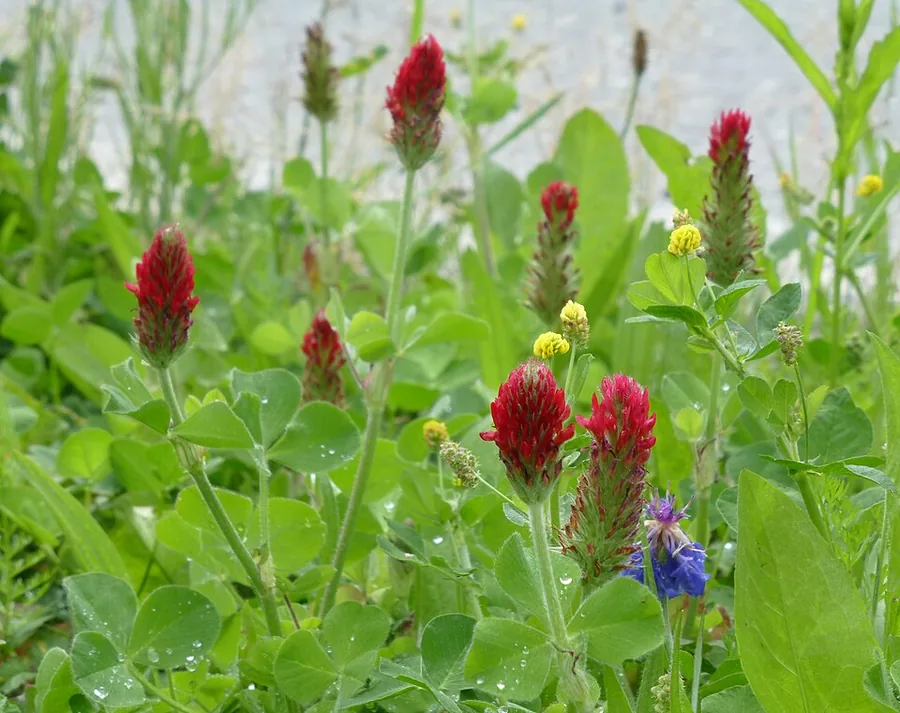
Count on it as an annual, and a short-lived one at that. Sown in late summer or fall, it builds a low rosette ahead of winter, then shoots up in spring to fly brilliant crimson-red conical flower heads before setting seed and dying off. That pace is exactly the point: cover and fertility arrive in one season, and then you turn it under for whatever crop comes next.
The payoff lands at the handoff. Cut it down at or just before bloom and it pours out a burst of nitrogen right as a hungry follow-on crop like corn reaches for it. Let it linger too long and it drops hard seed, turning into a volunteer weed in next year's bed.
Care
The short version: full sun and well-drained soil, inoculated seed direct-sown about 1/4 inch deep into a firm, moist bed, watered through establishment and then handed mostly to the rain, and terminated at or before early bloom.
Light
Crimson clover craves full sun for the boldest growth and bloom, though it gets by in partial sun. Pile on too much shade and it turns thin and floppy and fixes less nitrogen, so hand it an open, sunny spot.
Water
Hold the seedbed moist through germination and establishment, then water only in dry spells, because a settled stand runs mostly on rain. The single thing it refuses is wet feet, so steer clear of soggy or waterlogged ground.
Soil
Set it into well-drained loam or sandy loam of moderate fertility. It flounders on heavy clay or waterlogged ground, and it leans toward a near-neutral pH between 6.0 and 7.0.
Temperature
This cool-season grower takes a wide swing, running from about 10°F to 84°F (-12°C to 29°C), yet it holds less cold-hardiness than other clovers. Hard freezes in cold zones can thin or wipe out an overwintering stand.
Humidity
Plain outdoor humidity suits it just fine, so chase no particular number. Air movement and drainage carry more weight, since cool, wet, crowded conditions are what open the door to crown and root rots.
Feeding
Being a nitrogen-fixing legume, it asks for no nitrogen fertilizer; instead, coat the seed with the right Rhizobium so the plants make their own. Bring in phosphorus or potassium only when a soil test flags a real shortfall.
Pruning
Pruning in the usual sense never enters the picture. The work is termination: mow, till, roll, or let it winterkill at or before early bloom, ahead of hard-seed set, then work it in as green manure or leave it as surface mulch.
Repotting
none
Size & spacing
A stand reaches about 12 to 35 inches (30 to 90 cm) tall, with single plants spreading roughly 6 to 12 inches (15 to 30 cm). You broadcast or drill it as a dense stand rather than planting it out as spaced individuals.
When to plant
Crimson clover lives by the cool season. Drop it in late summer to fall, about 6 to 8 weeks before your first frost, so it builds a crown to ride out winter in mild zones; up in colder country, sow it in early spring instead. Bloom arrives the next spring, and you terminate right at or just before it.
Northern hemisphere
Southern hemisphere
Typical months for a temperate climate: start earlier in warm zones, later where spring frosts linger.
- Sow: Not applicable; crimson clover is direct-sown in the field, not started indoors.
- Plant: Sow in late summer to fall, about 6 to 8 weeks before the average first frost, to overwinter in mild zones (roughly USDA 6-9); in colder areas sow in early spring.
- Harvest: Showy brilliant crimson-red elongated conical flower heads appear in spring (about April to May). Terminate at or before early bloom for maximum nitrogen and to prevent reseeding.
Hardiness
USDA hardiness zones: 6–9
Temperature: down to -23°C
Troubleshooting
Nearly every crimson clover snag comes back to how the stand went in or when it came down. Catch the early tells in the stand and the roots and you can patch a thin spot or stop a weedy reseed before it sets you back. Match what you spot below, then move while it still pays off.
A patchy stand that comes up thin and pale
When plants struggle and run pale, the culprit is nearly always seed that skipped its Rhizobium inoculant, leaving no root nodules to fix nitrogen. Add dry soil or loose seed-to-soil contact and the stand thins even more. Lift a handful of seedlings a few weeks after they break ground, hunt for pink, working nodules, and overseed the gaps with fresh inoculated seed pressed into a firm, damp bed.
Fix:
- Use fresh pre-inoculated seed or treat seed with the proper Rhizobium inoculant before sowing
- Sow about 1/4 inch deep into a firm, moist seedbed with good seed-to-soil contact
- Sow 6 to 8 weeks before first frost into adequate moisture, or reseed thin areas
The stand fades or dies back through winter
This clover carries less cold-hardiness than its cousins and can winterkill where freezes bite deep, particularly below about zone 6. Sow it too late and the crowns stay too small to pull through. Roll any winterkilled residue into the soil as mulch or green manure, and in chilly spots grow it as a spring-sown annual or reach for tougher releases like AU Robin or AU Sunrise.
Fix:
- Treat winterkilled residue as mulch or green manure and follow with a spring crop
- In cold areas grow it as a spring-sown annual instead of overwintering it
- Choose hardier improved types such as AU Robin or AU Sunrise
Stray seedlings pop up in your next planting
Allow the stand to flower and drop hard seed, and crimson clover turns weedy, sprouting wherever you plant next. Timing settles it. Mow, till, or roll the stand down at or before early bloom, ahead of any viable seed, and pull or turn under whatever has already gone to seed.
Fix:
- Mow, till, or roll to terminate at or before early bloom, before viable seed forms
- Remove or incorporate any plants that have already set seed
Wilting, gnawed roots, or sticky leaves from pests and rots
More than one troublemaker can show up together. Clover root curculio larvae gnaw at roots and nodules, crown and root rots or Sclerotinia move into wet fall plantings, and aphids and thrips crowd the leaves and flower heads. Scout the roots for chewing and rot, scan the foliage for insects, then build your defense on well-drained ground and crop rotation, because a cover crop does not have to be spotless.
Fix:
- Plant on well-drained soil and avoid waterlogged sites
- Rotate away from legumes to break pest and disease cycles
- Tolerate minor feeding, since a cover crop need not be pest-free
Toxicity
Here is the welcome part: crimson clover is not poisonous to pets, people, or wildlife. It is a legume forage that animals graze safely. The one genuine caveat falls on grazing ruminants, where lush stands can bring on bloat under sloppy management, a grazing matter rather than a poisoning.
Safe for
People · Cats · Dogs · Horses · Rabbits · Livestock · Birds
Cats None
You will not find crimson clover on the ASPCA toxic-plant lists, so a cat that snacks on a leaf has nothing to fear. A large bite of any unfamiliar green can still rattle a touchy stomach for a day.
Dogs None
Dogs can hang around it and sample it safely. The most a dog that wolfs down a big helping might show is a bout of loose stool that settles on its own.
Horses Safe
Crimson clover is fine, safe forage for horses. The clover that gives horses grief is the related alsike, not this one, so you have nothing to fret over here.
Rabbits Safe
Rabbits can graze crimson clover with no trouble, and it makes a tasty fresh green. Bring any new forage in slowly so their gut keeps pace.
Livestock Mild
Cattle and sheep tuck into crimson clover and do well on it, with one caveat: grazing lush, fast-growing stands hard can set off pasture bloat. Keep the grazing in check and the risk stays slim.
Birds Safe
Seeds and young growth are safe for birds, and chickens will gladly work over a stand. Nothing on the plant threatens them.
People Safe
Crimson clover poses no poisoning risk to people. Cooks have long put the flowers and sprouts to use, though a few people react to clover pollen as a mild allergen.
Safe around pets and people. Like other clovers and legumes, lush crimson clover can cause bloat in ruminant livestock (cattle and sheep) if grazed heavily, but it is not poisonous to pets or people. Note that some related Trifolium species (for example alsike clover) can cause photosensitization or liver problems in horses, and clover pollen can be a mild allergen.
Varieties
Most crimson clover on the shelf is common seed, but a handful of named types reward a closer look, chiefly for cold hardiness and steady reseeding.
Dixie
A southern favorite valued for dependable hard-seed reseeding that brings the stand right back in mild-winter regions.
AU Robin
An improved, tougher release that flowers and matures sooner than standard types, a genuine edge where winters run close to the limit.
AU Sunrise
A second early-maturing, hardier cultivar bred to bloom sooner and adapt across more ground.
Kentucky Pride
A naturalized reseeding pick that thrives in the upper South and the transition zone where warm and cool climates meet.
Companions
Plant near
cereal rye: Grass-legume cover crop mix; the rye adds biomass and scavenges nitrogen while the clover fixes nitrogen and suppresses weeds.
oats: Oats provide quick fall cover and a nurse crop while crimson clover establishes and fixes nitrogen.
corn: Crimson clover green manure releases fixed nitrogen for a following heavy feeder such as corn.
How to propagate
Crimson clover comes up one way and one way only, from seed dropped right into the ground. The trick lies in the inoculant, not the sowing.
SeedEasy
Late summer to fall (6-8 weeks before first frost) to overwinter, or early spring in cold areas · Germinates in about 1-2 weeks; establishes a stand within several weeks of sowing
Crimson clover starts from seed alone, dropped right into the ground. Direct-sow about 1/4 inch deep into a firm, moist seedbed and reach for pre-inoculated seed, or coat it with Rhizobium inoculant, so the plants raise nitrogen-fixing nodules. Seed sprouts in roughly one to two weeks and fills in a stand over the following weeks, timed for late summer to fall to overwinter or early spring in cold areas.
Myths
Any clover will do the same job, so crimson clover is interchangeable with white or red clover.
Crimson clover is a quick, eye-catching annual that fixes nitrogen, yet it holds less winter-hardiness and lives shorter than perennial white or red clover. Sow it chiefly as a fast fall or spring cover crop and green manure, then cut it down before seed set. Count on it as a single-season workhorse, not a long-lived pasture clover.