Tree · Platanaceae
American Sycamore
Platanus occidentalis
Hand it room and moist ground, and the American sycamore shoots up into one of the East's largest shade trees.
Full sun
Every 7–14 days
USDA 4–9
75–100 ft · 22.9–30.5 m
Overview
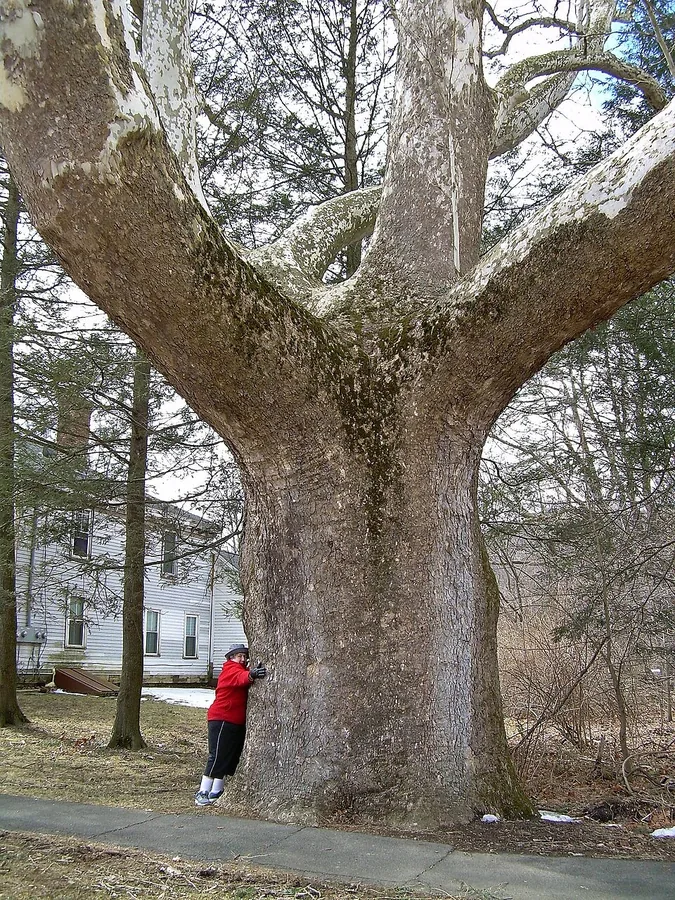
The American sycamore grows big. A native of the eastern United States, it stands among the largest hardwoods on the continent, races skyward fast, and tops out at 75 to 100 feet with a crown spreading just as far. Spot it by the bark, which peels in jigsaw flakes and leaves the upper trunk a smooth, pale, almost ghostly white.
Save this tree for open ground, not a tight lot. It craves deep, moist, rich soil and laughs off wet sites, clay, sand, compaction, even a passing flood. The catch is the mess it makes: big leaves, peeling bark, twigs, and round buttonball seed heads keep dropping all year, while the muscular surface roots heave pavement and press in on a foundation.
Plant it with room to spread and it gives back plenty for little fuss. The one thing to keep an eye on is anthracnose, a spring fungus that browns the new leaves through cool, wet spells, though the tree leafs out fresh and shakes off lasting harm.
Care
The short version: full sun and deep, moist, rich soil, plus wide-open room for a tree that clears 75 feet. Water young trees through every drought, prune in dormancy, and rake up the leaf litter to hold anthracnose down.
Light
Sycamores crave full sun and bolt fastest out in the open, though they'll accept a little partial shade. Crowding and deep shade just hand powdery mildew an opening, so give the tree room and light.
Water
Born to stream banks and bottomland, this tree wants deep, moist ground and even takes wet feet and brief floods in stride. Dry soil cuts its life short, so young and establishing trees need watering through any drought. A settled tree on a good site mostly looks after itself.
Soil
Few trees fuss less about soil. It flourishes in deep, moist, rich earth yet handles clay, loam, sand, compaction, and high pH without a grumble. The one thing it won't stand is ground baked bone dry.
Temperature
Hardy across USDA zones 4 through 9, the sycamore rolls with a wide weather swing, from roughly -29°F to 100°F (-34°C to 38°C). The real cold-weather hazard isn't the tree but a cool, wet spring that fuels anthracnose on the new leaves.
Humidity
Outdoors the air carries whatever moisture the weather delivers, and the sycamore takes it all. Airflow counts for more than humidity here, because a crowded, shaded canopy is what lets powdery mildew and anthracnose dig in.
Feeding
A tree on good soil rarely needs feeding. Where the ground runs poor, a balanced tree fertilizer in spring keeps a young or struggling sycamore vigorous, and vigor is its sharpest shield against disease.
Pruning
Prune in dormancy, clearing out dead, crossing, or anthracnose-infected twigs. Haul the infected leaves and twigs off and destroy them instead of leaving them under the tree, where the fungus would only reinfect next spring's flush.
Repotting
A sycamore belongs in the ground, not a pot, so it's rarely repotted. If you're keeping a young one in a nursery container, bump it up before the roots circle or escape the bottom and before top growth stalls.
Size & spacing
Plan for a giant: this tree runs 75 to 100 feet tall, or 23 to 30 m, with a spread to match. Set it well clear of pavement, foundations, and small lots, because the strong surface roots and outright size leave no room for second thoughts.
When to plant
The American sycamore goes in while it sleeps. Set it out in spring or fall during dormancy, catch the inconspicuous flowers in April, and look for the round buttonball seed heads to ripen and scatter from fall right through the next spring.
Northern hemisphere
Southern hemisphere
Typical months for a temperate climate: start earlier in warm zones, later where spring frosts linger.
- Plant: Spring or fall while dormant
- Harvest: Inconspicuous flowers in April; round buttonball seed heads mature and disperse fall through spring
Hardiness
USDA hardiness zones: 4–9
Temperature: down to -34°C
Troubleshooting
Nearly every sycamore gripe lands on the leaves, and on an established tree most of it reads as eyesore rather than emergency. Pin down the symptom below before you treat, because a fungus cure does nothing against an insect. Catch the early signs and you can step in while it still counts.
Crisping leaf edges climbing worse with each passing year
Scorch that creeps back and widens season after season usually means bacterial leaf scorch, a xylem disease moved by sap-feeding insects and pinned down by a lab test. Drought on a tree that craves moist ground throws a similar burn, so cross that off the list first. No cure exists once the bacterium settles in, yet pruning the worst limbs, watering through dry stretches, and keeping the tree strong stretches its life by years.
Fix:
- Prune infected branches
- Provide irrigation during drought
- Maintain vigor; antibiotic injections may suppress symptoms
Young spring shoots blackening the moment they emerge
Blame sycamore anthracnose, a fungus that springs to life in cool, wet weather and kills fresh shoots about as quickly as they open. Trouble peaks when leaf-out temperatures stay below 55°F (13°C) for roughly two weeks, and each round of twig killing builds a witches'-broom of stubby growth. Rake and destroy the fallen leaves and infected twigs, cut out the dead wood, then water and feed the tree well so it pushes a clean second flush.
Fix:
- Rake up and destroy fallen leaves and infected twigs
- Prune out blighted twigs and dead wood
- Maintain vigor with proper watering and fertilization
- Apply a labeled fungicide (chlorothalonil, thiophanate-methyl, or copper) on small trees if springs are wet
Powdery white patches spreading over leaves and stems
That floury coating points to powdery mildew, a fungus that lands on crowded, shaded growth and warps the leaves until they drop ahead of schedule. It alarms more than it harms and seldom troubles a grown tree. Thin the canopy to move air through it, keep growth strong, and turn to sulfur or horticultural oil only when a young tree takes a heavy hit.
Fix:
- Improve air circulation
- Maintain plant vigor
- Apply myclobutanil, propiconazole, sulfur, or horticultural oil if severe
Yellow flecking and bronze mottling on the leaf tops
Flip a speckled leaf and the sycamore lace bug turns up, a small lacy-winged insect feeding on the underside that drops dark spots and pale flecks across the top. The look startles, but it rarely sets back a healthy tree. Let predators take the lead, rinse light numbers off with a jet of water, and move up to insecticidal soap only when an outbreak runs hot.
Fix:
- Encourage natural predators
- Wash off light infestations with a water spray
- Use insecticidal soap or imidacloprid when necessary
Toxicity
Pet households can relax: the American sycamore is non-toxic to cats, dogs, and horses, and nothing about it will poison wildlife or livestock. The single catch is mechanical, not chemical. The fine hairs shed from spring leaves and buttonballs can irritate eyes, skin, and lungs, so cover up when you rake or prune at leaf-out.
Safe for
People · Cats · Dogs · Horses · Rabbits · Livestock · Birds
Cats None
The ASPCA rates this tree non-toxic to cats, so a curious nibble carries no poison. You can skip any special caution here.
Dogs None
A dog can mouth the leaves or bat a fallen seed ball around with zero poisoning risk. Any light stomach upset from gulping plant bits clears up on its own.
Horses None
Horses stay safe around this tree, which the ASPCA clears for them too. Grazing nearby brings no toxic worry.
Rabbits Safe
Neither the leaves nor the bark hold anything that poisons rabbits. As with any fresh green, work it in slowly so their gut stays steady.
Livestock Safe
Cattle, goats, and sheep can browse the foliage with no harm, since the tree carries no toxic principles.
Birds Safe
Birds perch, nest, and pick at the seed heads without danger. Those buttonballs make a familiar winter meal and pose no threat.
People Safe
Nothing about the tree poisons you to eat or handle. The lone nuisance is mechanical: the fine hairs shed from emerging spring leaves and buttonballs can scratch at eyes, skin, and lungs, so put on eye protection and a dust mask when raking or pruning at leaf-out.
Not poisonous, but the fine hairs (trichomes) shed from emerging leaves and from the buttonball seed heads can mechanically irritate the eyes, skin, and respiratory tract of people during spring leaf-out; wear eye protection and a dust mask when raking or pruning at that time.
Varieties
True American sycamore stands as one species, but its anthracnose woes steered nurseries toward the London planetree and its tougher picks. These are the names that turn up most.
London planetree (Platanus × acerifolia / × hispanica)
Cross American sycamore with Oriental plane and you get a tree that throws off sycamore anthracnose far better than the native, which explains why cities plant it everywhere.
'Bloodgood'
Extension sources flag this London planetree selection for its standout resistance to anthracnose.
'Liberty'
A second London planetree cultivar, reported to hold off both anthracnose and powdery mildew.
How to propagate
Raise a sycamore from seed or from a cutting, and one route runs far smoother than the other.
SeedEasy
Sow in fall after seed balls disperse · Seedlings can grow 36 to 48 inches the first year under good light
Seed is the easy path, and it rewards almost no effort. Sow in fall once the buttonballs crack open, skip any pretreatment, and lay the seed right on the surface, because it needs direct light to germinate at all. Give it that light and a seedling can rocket up 3 to 4 feet (90 to 120 cm) its first year.
Stem cuttingsModerate
Hardwood cuttings in late winter/dormancy; softwood during active growth · Several weeks to root, then one or more seasons to establish
Cuttings root too, but only off the right wood. Take hardwood in late winter while the tree sleeps, or softwood during active growth, and always cut from young, fast-growing stems, since wood from a mature tree won't strike by ordinary means. Count on several weeks for roots and a season or more before the young tree truly settles in.
Myths
Cats and dogs are poisoned by the American sycamore.
The ASPCA gives the tree a clean bill for cats, dogs, and horses, so a pet that chews a leaf or a seed ball faces no poison. The only real irritation is mechanical, not toxic. Fine hairs shed from spring leaves and buttonballs can scratch skin and airways, and that bothers people far more than animals.
American sycamore and London planetree amount to a single tree.
They share a genus and a close look, yet the London planetree is a hybrid of American sycamore and Oriental plane rather than the native species. The hybrid shrugs off sycamore anthracnose far better, the main reason it has largely taken over from true sycamore along streets.