Tree · Oleaceae
Green Ash
Fraxinus pennsylvanica
A tough, fast shade tree for hard sites, now living under the shadow of the emerald ash borer.
Full sun
Every 7–14 days
USDA 3–9
50–70 ft · 15.2–21.3 m
Overview
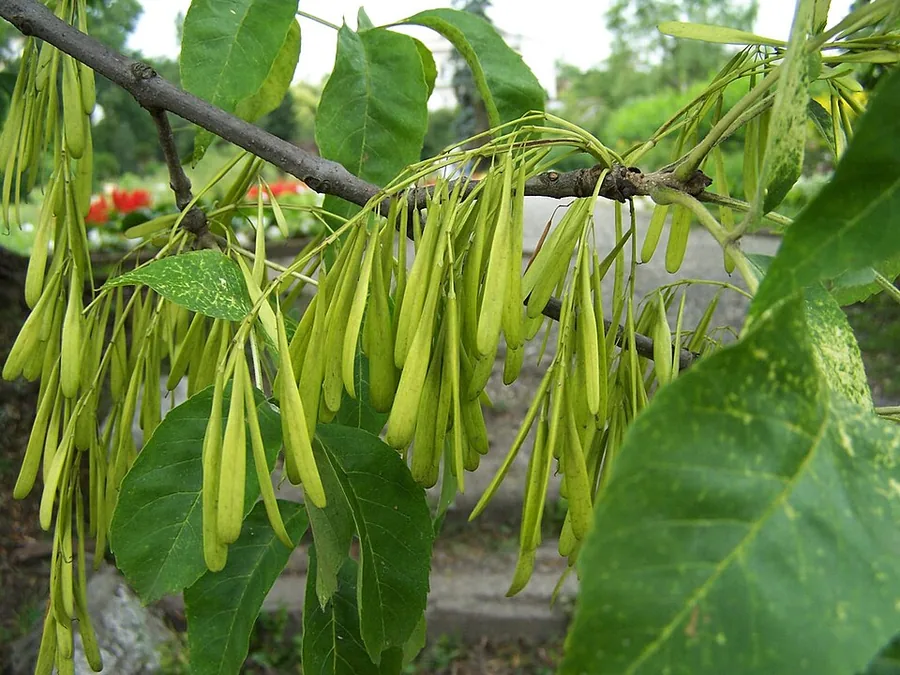
Green ash is a fast-growing native shade tree in the olive family, and it thrives on ground where fussier trees give up. Flooding, drought, wind, and alkaline soil hardly slow it down, which is just why it once lined streets and parking lots all across North America. Spot its opposite, pinnately compound leaves and winged seeds, the ones called samaras, and you can tell it from the lookalike mountain ash, a rose-family tree it is not actually related to.
The tree rewards you with handsome form and color. It climbs to 50 to 70 feet (15 to 21 m) tall under a broad, even crown, races ahead in its early years, and turns a clean yellow each fall. Cold holds no fear for it, since it shrugs off winters down to -40°F (-40°C) and settles in happily across USDA zones 3 to 9.
One honest warning belongs front and center. The emerald ash borer, an invasive beetle, has killed hundreds of millions of ash and will eventually reach almost any untreated tree. Most extension services no longer suggest planting new green ash, so the smart play is to care for the trees already standing and watch them closely.
Care
The short version: give it full sun and room to spread, keep young trees evenly moist, and prune in late winter to build a strong frame. An established ash asks almost nothing of you, but it does need a sharp eye out for borer.
Light
Plant ash in full sun for the densest crown and the brightest fall color, though it will take partial shade if that is your spot. The more direct light it drinks in, the stronger and more even the tree grows.
Water
Keep young trees in consistently moist, humusy loam while their roots dig in, giving them a drink roughly every 1 to 2 weeks through dry stretches. Once established, ash takes occasional flooding and drought in stride and rarely asks for help.
Soil
Few trees are this easygoing about their footing. Ash will dig into clay, loam, or sand wherever it drains reasonably well, and it cruises across a broad pH from 5.5 to 8.0, acidic all the way through to alkaline.
Temperature
This is a thoroughly cold-hardy tree, comfortable anywhere from about -40°F to 104°F (-40°C to 40°C) and right at home in USDA zones 3 to 9. Winter poses no threat to a healthy ash.
Humidity
Outdoor ambient humidity does not matter to ash, so there is nothing to track there. Air movement through the canopy counts for much more, since stagnant damp air is what invites leaf fungus like anthracnose to take hold.
Feeding
An established landscape ash rarely needs feeding. Reach for a balanced complete fertilizer in spring only when a soil test flags a real deficiency, never just because the calendar rolls around.
Pruning
Prune in late winter while the tree is dormant, cutting out dead, broken, or crossing limbs and shaping strong structure early. The wood runs brittle and breaks under wind and ice, so the good form you build now pays off for decades.
Repotting
none
Size & spacing
Green ash matures into a big tree at 50 to 70 feet (15 to 21 m) tall and spreads 35 to 50 feet (11 to 15 m) wide. Site it well clear of buildings, walks, and power lines, and hand that broad crown all the room it craves.
When to plant
Plant ash as balled-and-burlapped or container stock in spring or fall, whenever the soil works easily, so you get a wide window to dig. The small flowers open in April and May, right before or just as the leaves push out, and the winged seeds ripen all through the fall.
Northern hemisphere
Southern hemisphere
Typical months for a temperate climate: start earlier in warm zones, later where spring frosts linger.
- Plant: Spring or fall; balled-and-burlapped or container stock when soil is workable
- Harvest: Inconspicuous flowers April to May before or as foliage emerges; samaras mature in fall
Hardiness
USDA hardiness zones: 3–9
Temperature: down to -40°C
Troubleshooting
One pest towers over every other problem on this tree, so learn its signs first and you are well ahead. Happily, the rest are mostly cosmetic and sort themselves out. Match what you are seeing to the picture below, then choose whether to act or simply keep watch.
Crown dying back from the top, with little D-shaped holes punched into the bark
Catch this early and you change the whole story. The offender is the emerald ash borer, an invasive beetle whose larvae chew rings around the tree from inside the bark, and it takes down nearly every ash that goes untreated. Hunt for the giveaways: small D-shaped exit holes, the looping S-shaped galleries tucked beneath bark that has pulled loose, pale woodpecker flecking, and a crown that fades downward from the top. A treasured tree still holding more than 30 to 50 percent of its canopy can be rescued with professional systemic treatment, so act fast; a tree already chewed through should come down quickly, and never haul ash firewood anywhere, since that is how the beetle hitches a ride.
Fix:
- Confirm infestation and assess canopy loss
- Treat high-value trees with under 30-50 percent canopy loss using a systemic insecticide on a professional schedule
- Remove and properly dispose of heavily infested or dead trees promptly because untreated ash usually die
- Do not move ash firewood, which spreads the beetle
A slow fade, throwing up tufted witches-brooms and small, pale leaves
This is ash yellows, a phytoplasma infection that thins the tree out over several seasons and pushes up tufted witches-brooms of crowded, feeble twigs. Sadly there is no cure once it digs in, but you still have moves to make. Steady watering and a good layer of mulch slow the slide and buy the tree time, and the moment failing limbs turn into a hazard overhead, that is your cue to bring the tree down.
Fix:
- No effective cure exists
- Maintain vigor with proper watering and mulch
- Remove severely declining trees that become hazardous
Brown blotches running along the leaf veins after a soggy spring
This one looks rough but barely touches the tree, so breathe easy. It is ash anthracnose, a fungus that springs to life in cool, wet weather and stamps ragged brown marks along the veins and edges of the leaves. It tends to settle in the lower, inner reaches of the canopy and can shake leaves down early, yet a vigorous tree bounces right back and flushes fresh growth. Sweep up and bin the fallen leaves, open the canopy a bit for stronger airflow, and leave the fungicide on the shelf for an established ash.
Fix:
- Rake and destroy fallen infected leaves to reduce overwintering inoculum
- Prune to improve air circulation
- Maintain tree vigor with proper watering; fungicides are rarely warranted on established trees
Clumpy green-then-brown galls bunched on the spring flowers
Here is one you can happily ignore. These are ash flower galls, the handiwork of a tiny eriophyid mite that twists only the male flower clusters into knobby little bundles. They ripen brown and hang on as dry clumps, but they never bother the leaves or the health of the tree, so there is nothing to treat. No treatment is needed, and if the look nags at you, raking up the fallen galls is purely up to you.
Fix:
- No treatment is needed because the galls are cosmetic
- Rake and discard fallen galls if desired
Toxicity
Good news to start with. True ash does not turn up on the ASPCA toxic-plant lists and counts as safe for cats, dogs, and people, with no known poisoning risk to grazing animals or birds. Just keep it straight from the unrelated mountain ash or prickly ash, which are completely different plants.
Safe for
People · Cats · Dogs · Horses · Rabbits · Livestock · Birds
Cats None
Cross this one off your worry list: true ash never shows up on the ASPCA toxic list, so a curious cat batting around a stray leaf is just fine. A big mouthful of any plant, though, can still rattle a sensitive stomach.
Dogs None
Ash rates as non-toxic for dogs, and a chewed twig or leaf will not poison your pup. Keep an eye on splinters from gnawed wood instead, since the plant itself is the easy part.
Horses None
Horses can graze right around ash with zero trouble, because the tree carries no toxin known to bother them.
Rabbits None
A rabbit that nibbles ash leaves or bark stays perfectly safe. Just bring any new green in gradually so the gut has time to adjust.
Livestock None
Cattle, goats, and sheep can browse ash foliage with no poisoning to fear, and the leaves have long been cut as fodder in some regions.
Birds None
Backyard and wild birds come to no harm around ash. Many of them feast on the winged samaras straight through fall and into winter.
People None
There is no poisoning risk to people from ash, and the wood has been worked and burned safely for generations. It simply is not grown as a food, so there is nothing here for the plate.
Keep ash firewood out of pet bedding only for splinter and mold reasons, not toxicity.
Varieties
Most ash planted in yards are seedless male clones, chosen so you skip the samara litter and get a dependable shape season after season. Here are the names you will run into.
Patmore (green ash)
A seedless male green ash that laughs off the cold, hardy clear to zone 2, holding an even, tidy shape and lighting up clear yellow in fall.
Marshall's Seedless (green ash)
A long-running favorite, this seedless male green ash wins gardeners over with glossy, dark green summer foliage and not a speck of messy seed.
Autumn Purple (white ash, Fraxinus americana)
A seedless male white ash clone prized for fall color that runs from reddish purple to deep mahogany and lingers on the tree.
How to propagate
Ash grows readily from seed if you have the patience for its long chill, but the prized cultivars are a different game and come off the grafting bench rather than out of a seed tray.
SeedModerate
Collect samaras in fall; sow after stratification for spring germination · 1 to 2 growing seasons to a transplantable seedling
Raising ash from seed is entirely doable if you have patience for the long chill, since the seed sits dormant and refuses to sprout without it. Gather the winged samaras in fall, then run them through cold, moist stratification near 35°F to 40°F (2°C to 4°C) for about 90 to 120 days, and sow afterward for spring germination, growing the seedling on for one to two seasons until it is ready to move. Remember that named seedless cultivars will not come true this way, so those get budded or grafted instead.
GraftingDemanding
Late summer budding or dormant-season grafting · 1 to 2 years to a saleable tree
This is a nursery job through and through, not an easy backyard project, so feel free to leave it to the pros. Named clones like Patmore, Marshall's Seedless, and Autumn Purple are budded in late summer or grafted in the dormant season onto seedling rootstock, which is exactly what keeps them seedless and true to type. Count on one to two years for the graft to fill out into a saleable tree.
Myths
Ash and mountain ash are simply two names for one tree.
They share a name and nothing more. True ash is Fraxinus, an olive-family tree with opposite, pinnately compound leaves, while mountain ash is Sorbus, a rose-family tree wearing alternate leaves and clusters of red berries. Since they sit in entirely separate genera, the care that suits one rarely fits the other.
A thinning ash crown just wants a little water and feeding to perk back up.
Spot the real cause fast. Dieback that starts at the very top, paired with D-shaped exit holes and S-shaped galleries, points straight to emerald ash borer rather than thirst or hunger. No watering or feeding will halt it, and untreated trees usually die within about 2 to 5 years. Only early professional systemic treatment gives a valued tree a real shot.