Shrub · Oleaceae
Border Forsythia
Forsythia × intermedia
Plant it for the first burst of yellow that opens long before anything else wakes up in spring.
Full sun
Every 7–14 days
USDA 5–8
8–10 ft · 2.4–3 m
Overview
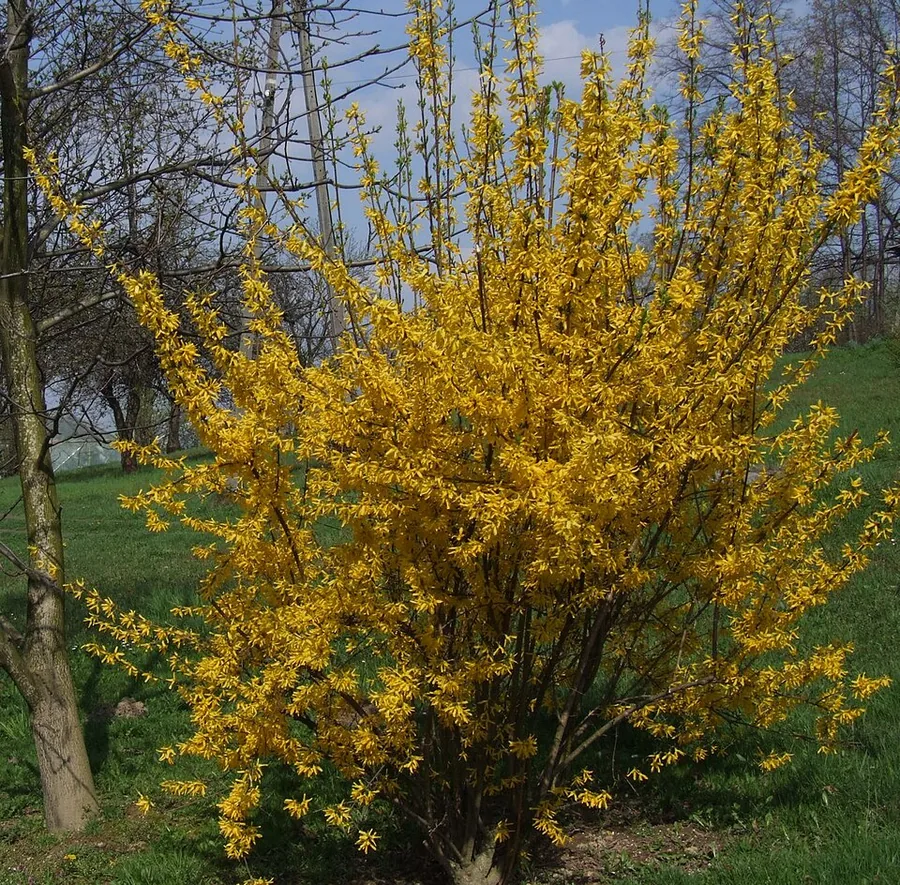
Forsythia kicks off the gardening year. Long before the leaves break and while the rest of the garden still sleeps, its bare branches erupt in bright yellow bells that stop you in your tracks. It belongs to the olive family and races into a big, arching mound, which is exactly why gardeners have planted it along shrub borders and banks for generations. For anyone itching for color the moment winter breaks, this shrub delivers.
Best part: it grows almost anywhere you put it. It powers through clay, sand, poor ground, and city soil, cruises through hardiness zones 5 through 8, and rides out a dry stretch once the roots dig in. It draws just one hard line, and that is sun. Drop it in shade and you forfeit the flowers, which are the entire payoff of growing it.
Plan for size, because this one means business. A grown shrub shoots up to 8 to 10 feet (2.4 to 3 m) tall and sprawls even wider, and the low branches root the second they touch down, so it builds thickets if you let it run. Hand it room to arch and one quick trim a year right after bloom, and it stays a stunner instead of a tangle.
Care
The short version: full sun fires the biggest bloom, nearly any well-drained soil works, keep the water even while it digs in, and prune just once a year right after the flowers fade.
Light
Hand forsythia full sun and it rewards you with the biggest bloom going. It will still grow in partial shade, but every hour of shade costs flowers, and a shaded shrub goes leafy and short on color.
Water
Water it steadily through the first year to lock the roots in, then back right off. An established plant shrugs off short dry spells and asks only for medium, even moisture, roughly a good soak every 7 to 14 days when things dry out. Keep it clear of soggy ground, the one fast track to root rot.
Soil
Forsythia is gloriously unfussy about soil. It takes clay, loam, sand, and even tired city ground in stride, asking mainly for sharp drainage and a spot somewhere in the 6.0 to 8.0 pH range.
Temperature
This shrub is built tough for cold, cruising from about -20°F to 95°F (-29°C to 35°C). The plant itself powers through hard winters, though the flower buds can take a hit once temperatures dive below roughly -5°F.
Humidity
Plain outdoor air is all it asks, so skip the humidity worry entirely. What really counts is good airflow, because crowded, damp foliage is exactly where leaf spot gets a foothold.
Feeding
Forsythia eats light. A balanced shrub fertilizer or a little compost in early spring covers it, and piling on more just pumps out leaves and robs you of flowers.
Pruning
Prune once a year, right after the flowers fade, and you are golden. Thin the oldest stems out at the base, and every 3 to 4 years cut the whole shrub back near the ground to fire up fresh growth. Cut past mid-July and you lop off next spring's buds, since the flowers form on old wood.
Repotting
Forsythia is a landscape shrub through and through, so it almost never lives in a pot. If you do run one in a container, repot only when the roots circle and mat, water blasts straight through, or new growth stalls.
Size & spacing
Plan big from the start. A grown forsythia hits 8 to 10 feet (2.4 to 3 m) tall and spreads even wider, around 10 to 12 feet (3 to 3.7 m), so give it the room to arch out without elbowing its neighbors.
When to plant
Forsythia keeps to the early-spring calendar and rewards you for following it. Get new plants in the ground in spring or fall once the soil works and hard frost clears, then watch the yellow bells fire off in March and April ahead of the leaves, and step in with your one yearly trim the moment the show wraps.
Northern hemisphere
Southern hemisphere
Typical months for a temperate climate: start earlier in warm zones, later where spring frosts linger.
- Plant: Spring or fall, after the ground is workable and the threat of hard frost has passed.
- Harvest: Early spring (March to April), before the leaves emerge.
Hardiness
USDA hardiness zones: 5–8
Temperature: down to -29°C
Troubleshooting
Forsythia is a tough customer, so problems crop up rarely, and the few that do nearly always trace back to a bad spot or a mistimed cut. The signs below cover what really goes wrong. Spot the match, then hit the cause instead of the symptom.
Rescuing a wilting plant with rotted roots
A forsythia that wilts and slides downhill in soggy ground is almost certainly battling Phytophthora root rot, which turns the roots dark and mushy. Find little knots or swellings on the roots instead and root-knot nematode is at work, and steady overwatering in packed soil drives either one harder. Dig up a struggling plant and read the roots straight away, then open up the drainage and pull the watering right back. A shrub that is too far gone is best yanked out and started fresh on a raised, well-drained site.
Fix:
- Improve drainage and reduce watering
- Remove severely affected plants
- Replant in a raised, well-drained site
Chasing down a flowerless spring
A thin bloom year almost always traces straight back to pruning at the wrong time. The buds ride on old wood, so any cut past mid-July sweeps off next spring's flowers before they ever get a chance. Shade drags the show down too, and a brutal winter can knock out the buds once the cold dives below about -5°F (-21°C). Time the pruning for right after bloom, push the shrub into full sun, and reach for a tough cultivar where winters really bite.
Fix:
- Prune only immediately after flowering, never in summer or late winter
- Move or limb up nearby plants to give the shrub full sun
- In cold regions choose hardier cultivars such as Northern Sun or Meadowlark
Tackling spotted leaves and stem dieback
Spots breaking out on the foliage usually spell fungal leaf spot, while sunken, dead tips signal stem dieback or canker that a drought-stressed plant let in. Check the base while you are at it, since rough woody swellings down there give away crown gall. Get ahead of it fast: cut the dead and cankered wood back to healthy tissue, wipe the pruners between cuts to stop anything spreading, and thin the shrub so air races through. Aim the water at the base instead of overhead, keep the leaves dry, and the spores lose their grip.
Fix:
- Remove and discard affected leaves and prune out dead or cankered wood to healthy tissue
- Disinfect pruners between cuts
- Improve air circulation by thinning the shrub
- Water at the base to keep foliage dry
Toxicity
Great news for homes full of pets and kids: forsythia comes back non-toxic across the board. The ASPCA clears it as safe for dogs, cats, and horses, and it packs no poisonous compounds at all. The flowers taste bitter on top of that, so most animals quit nibbling fast.
Safe for
People · Cats · Dogs · Horses · Rabbits · Livestock · Birds
Cats None
Cats can roam right up to it without trouble. A taste of a leaf or flower brings no poisoning, and the bitter flavor sends most cats packing before they get more than a bite.
Dogs None
Dogs can crash through it or grab a chew and walk away fine. The worst a big mouthful of any greenery might stir up is a quick, mild stomach upset that clears on its own.
Horses None
Horses are clear too, since the shrub is listed as non-toxic to them. Grazing the foliage carries no poisoning risk at all.
Rabbits Safe
Nothing in the plant can poison a rabbit, so a stem within nibbling range is no threat. The bitter flowers usually wave them off before they browse much anyway.
Livestock Safe
Cattle, goats, and sheep can work a pasture edge planted with forsythia with zero poisoning concern.
Birds Safe
Birds that dive in to perch or peck have nothing to fear, since the leaves, flowers, and stems hold no toxic hazard for them.
People Safe
Plant it where kids tear around and prune it bare-handed without a second thought. Nothing on the shrub is poisonous, though a quick hand-wash after any garden job is always smart.
No special handling required; the flowers are bitter, which discourages nibbling. Wash hands after pruning as a general practice.
Varieties
Most forsythia on the garden-center bench is this hybrid, but the named cultivars split apart on size, hardiness, and how hard they flower. A handful are well worth knowing by name.
Lynwood (Lynwood Gold)
The upright cultivar that shot to standard status, packing bright yellow flowers evenly up and down every stem.
Spectabilis
The flat-out show-stopper of the bunch, burying its branches under dense, deep yellow bloom.
Beatrix Farrand
A real go-getter that races upward and throws large flowers in a deep canary yellow.
Northern Sun
The cold-country champion, hardy to about zone 4, climbing to roughly 10 feet and keeping its flower buds alive through brutal winters.
Gold Tide
A low, spreading dwarf that sprawls into a groundcover or grabs hold of a bank or slope.
Companions
Forsythia pairs well with early bloomers that pick up where its yellow leaves off, and poorly with anything trying to grow in the shade beneath its dense canopy.
Plant near
Daffodils: Yellow daffodils bloom at the same time and echo the forsythia's early-spring color at ground level.
Lilac: Lilac flowers shortly after forsythia, extending the shrub-border bloom season; both share full-sun, well-drained conditions.
Keep apart
Turfgrass directly beneath the canopy: The dense arching canopy and surface roots shade and compete with lawn grass, which struggles under the shrub.
How to propagate
Want a whole row of these? You are in luck, because few shrubs multiply this fast. Forsythia roots from cuttings or simply layers itself wherever a branch leans down to the soil, so one plant snowballs into many.
Stem cuttingsEasy
Late spring to summer · 4 to 8 weeks to root
Forsythia strikes from cuttings so readily it is almost too easy. Snip softwood cuttings in late spring or early summer, or grab semi-hardwood ones later in the season, and watch most of them push roots within 4 to 8 weeks.
LayeringEasy
Spring through summer · One growing season to root
The arching branches practically propagate themselves, rooting wherever they flop onto the soil. Pin a low branch down any time from spring through summer, give it a full growing season to root, then cut it loose from the parent and plant your new shrub wherever you like.
Myths
Forsythia should be cut back hard in late winter to make it bloom better.
Hack it back hard in late winter and you actually strip off the flower buds, which sit on last year's wood. A heavy cut at the wrong moment guts the spring display or wipes it out entirely. Prune the instant flowering finishes and next year's buds sail through untouched.
Forsythia berries and flowers are poisonous to pets and children.
Toss this one out. The ASPCA pegs Forsythia, or Golden Bells, as non-toxic to dogs, cats, and horses, and it lands as safe around children too. The plant carries no toxic principles whatsoever, and the bitter flowers wave off browsers all on their own.