Shrub · Vitaceae
Boston Ivy
Parthenocissus tricuspidata
Grow it for a wall that ignites crimson in fall, then give it masonry to climb, not your siding.
Full sun
Every 7–14 days
USDA 4–8
30–49 ft · 9–15 m
Overview
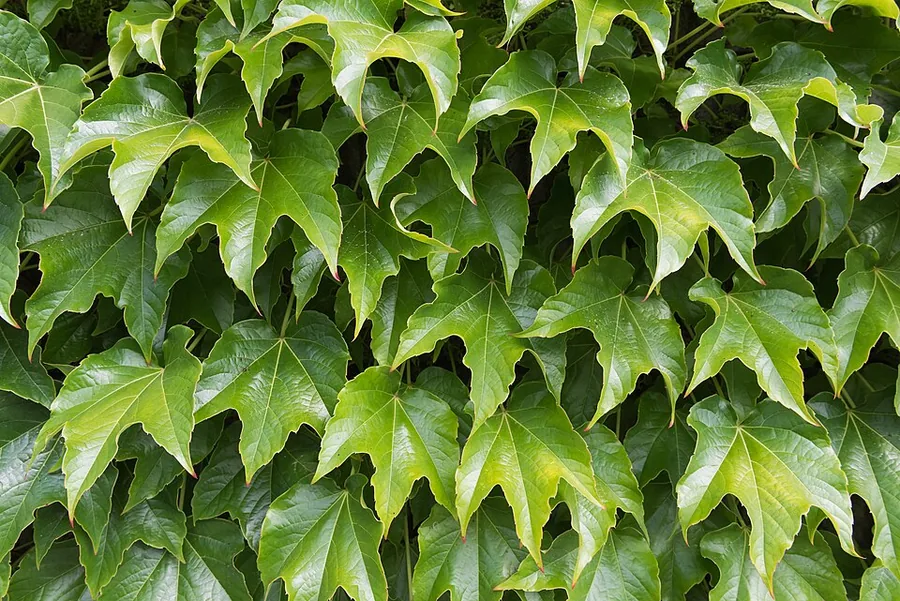
Boston ivy is the vine behind those legendary green sheets that catch fire in deep crimson-red to purple every autumn. It rides with the grape family rather than the true ivies, and it hails from eastern Asia. Tough and fast growing, it powers through cold down to USDA zone 4 and heat that pushes near 100°F (38°C), so it tackles tricky spots most vines refuse.
The way it climbs is the real thrill. Forget twining: it grabs hold with adhesive disk-tipped holdfasts that cement onto almost any surface, so a single plant can blanket an entire wall on its own steam. That same grip is the catch, since it bonds to paint, shingles, and mortar and fights every attempt at clean removal, so steer it onto masonry, stone, a fence, or a trellis rather than wood siding.
Once it digs in, this vine practically runs itself. It charges ahead in full sun or deep shade, sips little water after it settles, and barely asks to be fed. The one job that keeps it looking sharp is reining in its vigorous growth with a hard prune each year so it stays off your windows, gutters, and roof.
Care
The short version: drop it into average, well-drained soil in sun or shade, water it through the first season and rarely after, and hit it with a hard prune each late winter to keep its fast growth off your walls and roof.
Light
Boston ivy charges ahead in just about any light, from full sun to full shade. Sun cranks up the richest fall color, while in deeper shade the vine still fills in strong, just with a more muted autumn display.
Water
Water young plants while they settle, letting the top half of the soil dry between drinks. Once established the vine shrugs off drought and rolls with most conditions, so a good soak every 7 to 14 days carries it through a dry spell.
Soil
Almost any well-drained soil suits it, clay, sandy, and rocky ground included. It runs happily across a wide pH range from 5.5 to 7.5, part of why it thrives in so many spots.
Temperature
This is a seriously hardy vine, powering through cold to -29°F (-34°C) and heat up to 100°F (38°C). That span covers USDA zones 4 through 8 with zero special protection.
Humidity
Outdoor humidity suits it fine, so there is nothing to measure. Air movement matters more than moisture in the air, since still, crowded growth invites leaf spot and mildew.
Feeding
Feeding is rarely needed, because this vine already grows like a rocket. If growth lags, a single balanced general-purpose feed in spring gets it roaring again.
Pruning
Plan a hard prune in late winter or early spring to keep that fast growth from running wild. Cut it back off windows, gutters, roofs, and wood siding before the new season explodes out.
Repotting
Most plants go straight in the ground rather than a pot. For a container-grown vine, repot every 2 to 3 years, or sooner if roots circle the pot, growth stalls, or water runs straight through.
Size & spacing
Give it something to climb and it rockets to 30 to 50 feet (9 to 15 m) tall and spreads 5 to 10 feet (1.5 to 3 m) wide. Plan for that reach and the support it will cover before you plant.
When to plant
Boston ivy is woody and perennial, so skip the seed-starting scramble. Pop young plants out in spring or fall while the soil is easy to work, let the vine charge across its support over the seasons, and watch for its quiet June-to-July flowers ahead of that crimson-to-purple fireworks show in autumn.
Northern hemisphere
Southern hemisphere
Typical months for a temperate climate: start earlier in warm zones, later where spring frosts linger.
- Plant: Spring or fall
- Harvest: June to July (flowers inconspicuous); brilliant crimson-red to purple fall foliage
Hardiness
USDA hardiness zones: 4–8
Temperature: down to -34°C
Troubleshooting
Almost every Boston ivy hiccup traces back to one of two things: the wall it is gripping or the leaves it is pumping out. Spot the early signs and you can redirect or treat it before damage gets going. Match what you see below, then jump on it while it still does the most good.
Grippy disks taking hold of the wall and lifting paint
The grip that makes this vine so fun to grow is also the part that demands a smart plan. It clings with adhesive disk-tipped holdfasts that bond so tightly they tear paint and leave residue when pulled, and dense growth traps damp against the wall while it works under shingles and into mortar. Aim it at masonry, a rock wall, a fence, or a beefy trellis, and when it is time to remove a section, cut the stems at the base so the disks dry and weaken before you scrape them clean.
Fix:
- Do not grow on wood, shingle, or painted surfaces; redirect onto masonry, rock walls, fences, or sturdy trellises
- Cut vines at the base and allow holdfasts to dry and weaken before gentle removal
- Scrape or sand off remaining residue and refinish damaged surfaces
Spotted, dusty, or chewed-up leaves to tackle
A couple of common problems can knock the shine off all that lush foliage, and both bounce back fast. Fungal leaf spot and powdery mildew move in where air stalls around crowded, humid growth, splashing the leaves with dark blotches and a white film, while Japanese beetles, scale, and leafhoppers chew the foliage down to its veins. Get ahead of it: open the planting up for airflow, water at the base instead of overhead, pluck beetles off by hand, and knock out tough scale with horticultural oil.
Fix:
- Improve air circulation and avoid overhead watering to reduce fungal disease
- Hand-pick Japanese beetles and treat scale or heavy infestations with horticultural oil or an appropriate insecticide
- Remove and dispose of heavily diseased foliage
Toxicity
As much fun as this vine is to grow, it is strictly hands-off for nibbling. The leaves and the blue-black berries both pack insoluble calcium oxalate crystals and oxalic acid, sharp compounds that sting the mouth and irritate the gut. Keep pets, livestock, and children from chewing the foliage or eating the berries, which carry the higher risk.
Toxic to
Cats · Dogs · Horses · Rabbits · Livestock · Birds · People
Cats Mild
Those oxalate crystals go to work the instant a cat bites a leaf or berry, stinging the mouth, so keep an eye out for drooling, pawing at the face, and an upset stomach with vomiting or loose stool.
Dogs Mild
A dog that chews the foliage or berries usually starts drooling and skips its food, and that mouth irritation often brings vomiting or diarrhea along soon after.
Horses Mild
The same crystals fire up a horse's mouth and gut, so grazing the vine can spark drooling, mouth discomfort, and a dull, off-feed look worth heading off early.
Rabbits Mild
Keep this one out of a rabbit's reach, because the oxalates burn the mouth and can leave a bunny drooling, off its food, and battling a sore digestive tract.
Livestock Mild
Cattle, goats, and sheep rarely chase it down, but one mouthful of leaves or berries fires up the mouth and gut and can leave an animal salivating and off its feed.
Birds Caution
The blue-black berries pack the most risk here, so keep caged birds well away from the plant rather than letting them browse it.
People Caution
No part of this plant is food. Eating the leaves or berries irritates the mouth and stomach, so steer curious children clear of the foliage and fruit.
Keep pets and children from chewing the foliage or eating the berries, which are the higher-risk part.
Helpline numbers

United States
ASPCA Animal Poison Control: (888) 426-4435 (fee applies)
Poison Control: (800) 222-1222



Canada
Poison Centres: 1-844-764-7669
Varieties
A handful of named selections swap the plain green for bolder leaf shapes and colors. These are the ones you are most likely to track down.
Veitchii
Brings smaller leaves that burst out purple to bronze in spring and flame to red in fall.
Fenway Park
Dazzles with golden chartreuse to lime-yellow foliage that explodes into a multicolored autumn display.
Lowii
Sports small, curly, deeply lobed leaves that fire up crimson once fall arrives.
How to propagate
Boston ivy is a blast to multiply, and you get three routes to choose from depending on your patience and the time of year.
Stem cuttingsEasy
Softwood cuttings in early summer or hardwood cuttings in late fall to winter · 4 to 8 weeks to root
Cuttings are the fastest way to crank out new plants, and they rarely disappoint. Snip softwood cuttings in early summer or hardwood cuttings from late fall into winter, and they root in 4 to 8 weeks. Got a stem already resting on the ground? Pin it down and let it root right where it lands.
LayeringEasy
Spring through summer · Several weeks to a few months
Layering might be the most satisfying trick of all with this vine. Pin a low stem against the soil any time from spring through summer, and it roots all on its own over several weeks to a few months before you cut it loose from the parent.
SeedModerate
Sow after cold stratification in late winter or spring · Several weeks to germinate
Seed rewards the patient grower. Clean the seeds from the berries, give them a cold spell to crack dormancy, then sow in late winter or spring and watch for germination over several weeks. That cold stratification is the secret step that unlocks the whole thing.
Myths
Boston ivy is a true ivy.
Here is a fun twist: the name lies, because it is no ivy at all. Boston ivy belongs to the grape family, Vitaceae, which makes it a much closer cousin to grapes than to the true ivies in the genus Hedera.