Shrub · Lardizabalaceae
Chocolate Vine
Akebia quinata
Fragrant chocolate-purple flowers and edible fruit on a climber that takes off fast and rewards a firm hand.
Full sun
Every 7–14 days
USDA 4–8
20–40 ft · 6.1–12.2 m
Overview
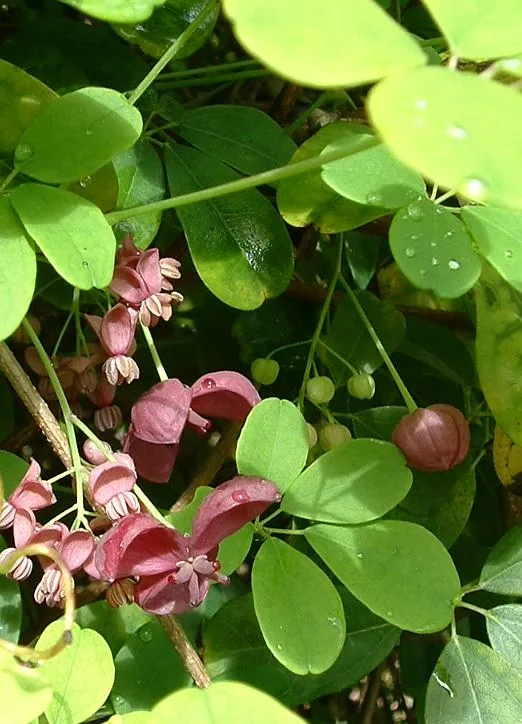
Chocolate vine charges into spring ahead of almost everything else, racing up its support and unfurling deep chocolate-purple flowers that throw out a heady chocolate and vanilla-spice scent. Pair it with a second, different plant and the year keeps delivering, ripening those quirky sausage-shaped fruit packed with sweet, edible white pulp. Spread out the five-fingered leaves and the nickname five-leaf akebia clicks into place.
Best of all, it thrives just about anywhere you point it. It powers through zone 4 to zone 8, grabs full sun, part shade, or even full shade, digs into poor loam, sand, or clay, and laughs off a dry spell once it roots in. That sheer adaptability is what makes growing it such a thrill.
That same drive comes with a job for the grower. The vigor that blankets an arbor in a single season can also send chocolate vine bolting loose to smother native plants, and much of the eastern, mid-Atlantic, and southern United States flags it as invasive. Plant it where you can prune hard and steer it, and keep it clear of the wider landscape.
Care
The short version: drop it into well-drained soil in sun or shade, water it as it roots in, then grab the shears and prune hard, because the real fun with chocolate vine is steering all that energy and keeping it in bounds.
Light
It romps along in full sun, partial shade, or even full shade, which is a big reason it spreads so freely. Full sun cranks up the flowers and fruit, while a shady corner still pumps out plenty of leaf and stem.
Water
Keep it in regular water in well-drained soil as it establishes, soaking every 7 to 14 days once the top half of the soil dries. Once the roots dig in it powers through dry spells on its own and rarely needs a hand.
Soil
It grabs almost any well-drained loam, sand, or clay and barely blinks. A pH from 5.5 to 7.5 keeps it happy, so most garden ground sends it on its way without amending.
Temperature
This plant is built tough, running strong from about -29°F to 100°F (-34°C to 38°C). That range covers USDA zones 4 through 8 and powers it straight through hard winters.
Humidity
Whatever the outdoor air offers fuels it just fine, so there is no number to chase. The vine rolls with the local moisture and keeps climbing.
Feeding
A balanced general-purpose fertilizer in spring covers it, and most years you can skip even that. The plant already grows vigorously on its own, so extra feeding just hands you more growth to cut back.
Pruning
Pruning is where the real action is with this vine. Cut it back hard right after it flowers in late spring, since the blooms set on old wood, and slash an overgrown plant clean to the ground to renovate it. Count on pruning again through the season to hold its place.
Repotting
It is rarely grown in pots, so repotting barely registers. If you do contain it, bump it up a size the moment roots circle or escape, the top growth stalls, or the soil dries out fast.
Size & spacing
Turn it loose and it rockets to 20 to 40 feet (6 to 12 m) with a spread of 6 to 9 feet (183 to 274 cm). Set it on a sturdy trellis, arbor, or fence well clear of shrubs and trees it would gladly overrun.
When to plant
This vine keeps a brisk calendar. Flowers burst out early, from March into May, and where a second plant stands nearby the fruit ripens right through fall. Plant new vines in spring once the last frost clears, then sharpen up for hard pruning the moment the flowers fade, since next year's blooms set on old wood.
Northern hemisphere
Southern hemisphere
Typical months for a temperate climate: start earlier in warm zones, later where spring frosts linger.
- Sow: Late winter to early spring after cold stratification
- Plant: Spring after last frost
- Harvest: Flowers March to May; sausage-shaped fruit ripens in fall
Hardiness
USDA hardiness zones: 4–8
Temperature: down to -34°C
Troubleshooting
With chocolate vine, the challenge is reining in too much growth, not coaxing out too little. It pushes hard and resists removal even harder, and a lone plant often flowers like mad yet sets no fruit. Spot your symptom below and jump on it early, before the vine races ahead.
Vine charging over nearby shrubs and small trees
This is the invasive habit that turns chocolate vine into a problem across much of North America. It twines 20 to 40 feet, throws a mat over whatever it climbs, and roots wherever a stem hits the ground. Cut it back hard after it flowers, keep cutting through the season, and rip out the runners before they launch a whole new colony.
Fix:
- Cut back hard after flowering and repeat through the season to keep it in bounds
- Cut to the ground to renovate an overgrown vine
- Trace and dig out long roots (a single vine can produce roots 22 ft long); remove rooted stem nodes and seedlings
An established vine that flat refuses to die
The fight comes down to the deep root system, which can run 22 feet and resprout from any scrap left behind. Cut stumps and severed roots fire off fresh growth, and stray seedlings rush in to fill the gaps. Dig out as much root as you can, treat the cut stumps, and keep yanking resprouts and seedlings until they finally quit.
Fix:
- Dig out as much of the root system as possible
- Cut and treat cut stumps, then monitor and remove resprouts and seedlings repeatedly
Flowers galore but no sausage-shaped fruit
Chocolate vine is self-incompatible, so a single plant can flower for years and never set a pod. It also needs a long, warm season to ripen fruit. Plant two genetically different vines close together, or hand-pollinate the flowers with pollen from another plant, and the fruit will follow.
Fix:
- Plant two or more genetically different individuals for cross-pollination
- Hand-pollinate female flowers with pollen from a different plant
Toxicity
Grow this one without a worry around pets or people. It stays off the ASPCA toxic-plant lists, and the white pulp of the ripe fruit gets eaten in parts of East Asia. The thing to watch is ecological, not toxic, since the vine spreads hard and smothers native plants, so the real question is where it goes, not who might take a bite.
Safe for
People · Cats · Dogs · Horses · Rabbits · Livestock · Birds
Cats None
A curious cat can sample a leaf with nothing to fear, since chocolate vine never lands on the ASPCA toxic list. A big mouthful of any plant can upset a stomach, but the vine itself packs no known poison.
Dogs None
Dogs are in the clear. A pup that chews the foliage or a fallen fruit will not be poisoned, though wolfing down a load of greenery can loosen a stomach the way any plant would.
Horses None
No toxin here lays a finger on horses, so they can graze right beside it without harm.
Rabbits None
Rabbits can nibble the leaves with zero toxic risk. Roll in any new browse slowly, as with any fresh green, to keep their digestion settled.
Livestock None
Cattle, goats, and sheep dodge any poisoning from chocolate vine. The real worry is the plant overrunning a paddock rather than harming the animals grazing it.
Birds None
Birds shrug off the plant entirely and gladly eat the ripe fruit, which is exactly how the seeds get flung into new ground.
People None
The white pulp inside the ripe sausage-shaped fruit is edible and eaten in parts of East Asia. The rest of the plant is not food, so stick to the ripe fruit and let everything else stay ornamental.
No special handling needed for pet safety. The main risk is ecological invasiveness, not poisoning.
Varieties
Beyond the classic purple-flowered plant, a handful of named forms turn up, picked mostly for a fresh flower color or a livelier leaf.
'Alba' (also sold as 'Shirobana')
A white-flowered form that swaps the usual chocolate-purple bloom for pale flowers and pale, whitish fruit.
'Rosea'
A lively switch-up that blooms in pink to rose-purple instead of the deep chocolate shade.
'Variegata'
Grown for the foliage, with leaves mottled and splashed in white and cream.
Akebia trifoliata (three-leaf akebia)
A close cousin rather than a cultivar, sporting three leaflets to each leaf where Akebia quinata carries five.
How to propagate
Spinning up more plants is a breeze, almost suspiciously so, because the same knack that makes layering simple is exactly what sends the vine roaming on its own.
SeedModerate
Sow fresh seed in fall, or cold-stratify and sow in late winter to early spring · Several months to a year
Seed is the slow lane, and it comes with a hurdle, since the plant is self-incompatible and you need two genetically different vines just to land viable seed. Sow it fresh in fall, or give it a cold spell and sow in late winter to early spring. Brace for anywhere from several months to a year before a seedling settles in and takes off on its own.
LayeringEasy
Spring to summer · One growing season
Layering is the quick win. Pin a stem to the soil in spring or summer and it roots on its own within a single growing season, ready to sever and move. The flip side is that this same eager rooting is exactly what sends the vine roaming where you do not want it.
Stem cuttingsModerate
Summer (semi-ripe wood) · Several weeks to root
Take semi-ripe cuttings in summer and root them over bottom heat, which usually wraps up in a few weeks. Once roots form, pot each cutting on and let it bulk up before it heads outside.
Myths
The flowers must be edible because the plant is called chocolate vine.
Catchy name, but it points at the flowers, not a snack. They are chocolate-purple and pour out a chocolate and vanilla-spice scent, and that color and smell are the whole story behind the name. Only the white pulp of the ripe sausage-shaped fruit is actually eaten.