Houseplant · Crassulaceae
Echeveria
Echeveria
Hand it bright light and a soil that dries out fast, and this rosette succulent practically grows itself.
Full sun
50–77°F · 10–25°C
USDA 9–11
3–12 in · 8–30 cm
Overview
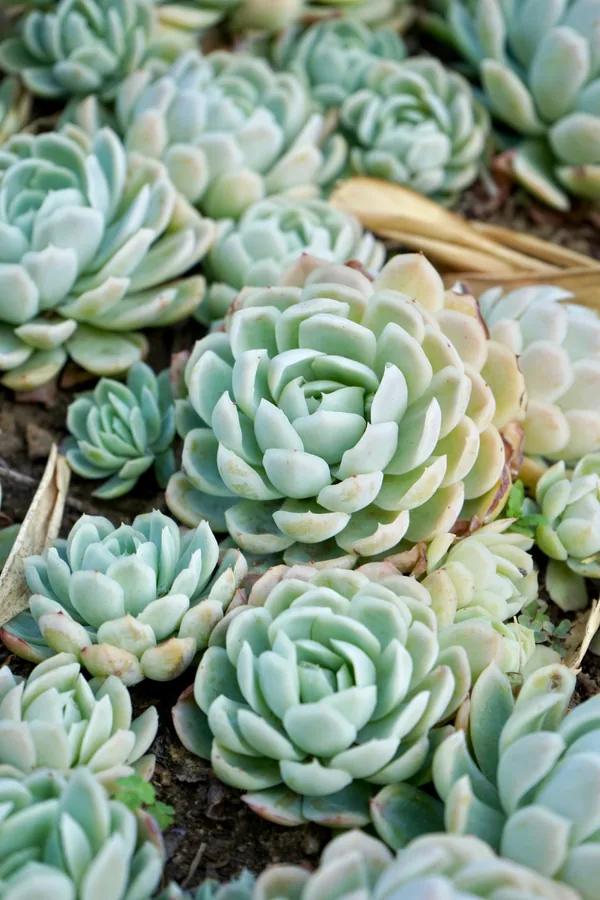
Echeveria charges out of the dry highlands of Mexico and Central America as a rosette-forming succulent, and it has shot up the ranks of easy windowsill plants. The fleshy leaves spiral out from a tight center into a shape that looks almost carved, glowing in shades of blue-green, lavender, and silver. Plenty of them wear a fine powdery coating called farina that throws a frosted sheen across every leaf.
What makes it so rewarding is how hard it works for so little. The plant banks water in those plump leaves, so it shrugs off a skipped watering and would always pick dry over wet. Pour on strong light and a gritty mix and it stays compact and colorful, often flaring pink or red at the leaf tips when the sun cranks up.
It keeps a small frame, usually 3 to 12 inches (8 to 30 cm) across, and it multiplies on its own by firing off little offsets around the base. Those pups are why one rosette snowballs into a whole shelf of plants. Dodge just two pitfalls, too much water and too little light, and growing it stays a joy from start to finish.
Care
The short version: bright light, a gritty fast-draining mix, and a deep soak only once the soil has dried out completely, with light feeding through the warm months.
Light
Echeveria craves full sun to very bright light, several hours of it a day, to lock in its tight rosette and its color. A sunny south or west window nails it indoors. Short it on light and the rosette shoots up tall while the leaves wash out.
Water
Soak the soil through, then hold off until it has dried out completely before you water again. This desert plant rots fast in wet soil, so water at the base and never let water pool in the heart of the rosette. Unsure? Give it another few days and let it run dry.
Soil
Set it into a gritty cactus or succulent mix that drains in seconds instead of clinging to water around the roots. A pH between 6.0 and 7.0 keeps it happy. Sharp drainage drives everything, so work in perlite or coarse sand the moment your mix feels dense.
Temperature
It thrives between 50°F and 77°F (10°C to 25°C) and rolls along at normal room warmth. Frost flattens it instantly, so haul any outdoor plants inside well before the first cold snap.
Humidity
Low, dry air is exactly its scene, so skip the humidity chase entirely. Steamy bathrooms and kitchens are the wrong spot, since moisture stalling around the leaves opens the door to rot.
Feeding
Feed it lightly through spring and summer, while it is charging through active growth. A dilute balanced or low-nitrogen succulent fertilizer a few times across the season does the job. Cut the feeding in winter when growth slows.
Pruning
There is barely anything to do here. Strip off the spent lower leaves and snip faded flower stalks to keep it sharp. If a rosette has stretched and gone leggy, behead the top and re-root it to snap the compact shape back.
Repotting
Bump it into a slightly larger pot every 2 to 3 years, or sooner once offsets crowd the rim and roots punch through the drainage holes. Seize the moment to refresh the gritty mix and scan the roots for any soft, rotted spots.
Size & spacing
A mature rosette holds small, hitting 3 to 12 inches (8 to 30 cm) tall and about as wide depending on the species. Its slow, compact growth slots right onto a windowsill, into a small pot, or among a mixed succulent dish.
Troubleshooting
Run down nearly any echeveria problem and it lands on one of two things: not enough light or too much water. Read the rosette and the base, and you can pounce on trouble before it spreads. Match what you see below, then move on it fast.
Mushy, see-through leaves over a soft, blackening base
Soft, see-through leaves and a squishy base flag root and crown rot, the damage that follows too much water and soil that refuses to dry. The blunt truth: once the rot hits the crown, the original plant is finished. Pull the watering can away, slice off every soft scrap, and relaunch the plant by re-rooting a clean top cutting or a strong pup in dry gritty mix.
Fix:
- Stop watering and let the plant dry
- Cut away rotted tissue and dust with no further water until callused
- Re-root healthy top growth or offsets in dry gritty mix
White cottony tufts packing into the leaf joints
Catch those cottony white clumps in the leaf joints early and you have got mealybugs, sap-feeders that smear a sticky residue as they go. Hit each one with a cotton swab soaked in 70 percent isopropyl alcohol, rinse the plant down, and pull it away from the rest of the collection. Keep scouting every week until no fresh tufts show, and the plant bounces right back.
Fix:
- Dab insects with a cotton swab dipped in 70 percent isopropyl alcohol
- Rinse and isolate the plant
- Repeat treatment weekly until clear
Rosette shooting up tall with pale, far-spaced leaves
Spot a rosette climbing skyward and that is etiolation, the plant straining hard toward light it cannot reach. The stem runs long, the leaves pull apart and tip toward the brightest window, and that crisp rosette loses its edge. Get it into stronger sun or fire up a grow light, then behead the stretched top and re-root it to launch a tidy new plant.
Fix:
- Move to a sunnier spot or add grow lighting
- Behead the stretched rosette and re-root the top
- Propagate usable leaves from the bare stem
Toxicity
Great news for a home buzzing with pets and kids. Echeveria carries no known toxins, and the ASPCA lists it as safe for both cats and dogs. A nibbled leaf might spark a brief stomach upset, the way any odd plant could, but nothing here will poison anyone.
Safe for
People · Cats · Dogs · Horses · Rabbits · Livestock · Birds
Cats None
Bring it into a home with cats and grow without a worry. A curious one that bites a leaf might get a brief, mild stomach upset, just like with any non-food plant, and nothing toxic comes of it.
Dogs None
Dog owners can keep growing freely, since there is no toxic effect to fear. A pup that chews a rosette may drool a bit or pass a loose stool from the strange plant matter, and that wraps it up.
Horses Safe
It poses zero poisoning risk to horses, though these little rosettes grow as houseplants and bring nothing to the table as forage.
Rabbits Safe
Grow it around rabbits with confidence, because the leaves pack no toxin. A nibbled plant stings the grower far more than it threatens the rabbit.
Livestock Safe
It carries no poison for grazing animals such as goats, sheep, or cattle.
Birds Safe
Pet birds pick up no toxicity from it, so a stray peck at a leaf does no harm whatsoever.
People Safe
Handle it and grow it freely, with no risk to adults or children. Nobody raises it to eat, but a curious taste will not poison anyone.
Varieties
The genus rockets to hundreds of species and hybrids, but a few keep stealing the show. These are the ones worth knowing by name.
Echeveria elegans
Called Mexican snowball, it packs into tight pale blue-green rosettes ringed with almost translucent margins.
Echeveria 'Perle von Nurnberg'
Growers chase this hybrid for its dusty lavender-pink leaves wrapped in a soft, powdery farina coating.
Echeveria agavoides
Its sharp, triangular leaves throw the look of a small agave and often spike into a bright red tip.
How to propagate
Few plants pay you back like echeveria when you multiply them, and you can kick it off from a single dropped leaf or from the pups it churns out on its own.
Leaf cuttingsEasy
Spring through summer during active growth · Several weeks to a few months to form roots and a new rosette
One leaf grows a whole new plant, and watching it happen never gets old. In spring or summer while it is growing, twist off a whole healthy leaf so none of it tears, let the cut end callus for a few days, then lay it on dry gritty mix and mist it lightly. Across several weeks to a few months, tiny roots and a fresh rosette burst from the base.
Offsets & pupsEasy
Spring through summer · A few weeks to root once separated
The fastest win comes from the offsets, or pups, that crowd in around the mother rosette through spring and summer. Snap one off, let the cut surface callus over, drop it into dry succulent mix, and it digs in within a few weeks.
Myths
Echeveria is the same plant as true hens and chicks.
They trade the same nickname but land in different genera. The cold-hardy hens and chicks is Sempervivum, which powers through hard winters and dies after flowering once, while Echeveria is tender and frost will kill it.
Succulents like echeveria never need watering.
They cruise through a dry spell, but they still crave a deep soak once the soil has dried out completely. Leave one thirsty too long and it shrivels, the leaves caving soft and wrinkled as the plant runs down.