Herb · Fabaceae
Fenugreek
Trigonella foenum-graecum
Drop the seed into cool soil and fenugreek rewards you with fresh methi leaves in a month flat.
Full sun
Every 3–5 days
50–86°F · 10–30°C
90–120 days
Overview
Fenugreek packs a real punch for such a quick little legume, handing over two crops from one sowing: fragrant methi leaves for the kitchen and golden, faintly bitter seeds for the spice rack. It rides in the pea and bean family and has powered kitchens and fields across the Mediterranean and South Asia for thousands of years. Sow it in cool weather and it sprints from seed to harvest.
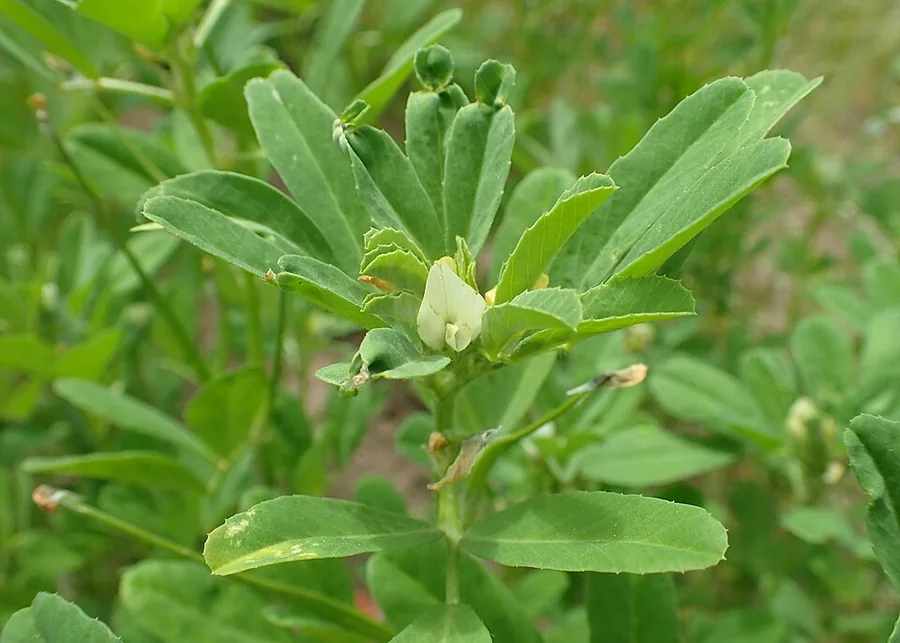
Best of all, this legume largely fuels itself. Nodules on its roots grab nitrogen straight out of the air, so it shrugs off most feeding and even hands the next crop a richer bed. It keeps a tidy, compact frame, knee height at most, dressed in clover-like leaves and pale flowers that swell into slim, curved pods.
It pays back the effort fast, with one catch worth knowing: it cannot stand heat. Let warm weather move in and it bolts, firing out flowers and seed before the leaves hit their stride. Aim the sowing at the cool stretches of the year and you walk away with both the herb and the spice.
Care
The short version: plant fenugreek in full sun and well-drained loam, sow it straight into cool soil, keep the bed evenly moist but never wet, and feed it sparingly, because this hardworking legume makes its own nitrogen.
Light
Aim fenugreek at full sun, six hours a day or more, and it churns out the fullest leaves and the strongest seed set. It still soldiers on in partial shade, and a dash of afternoon shade pulls real weight in warm weather by slowing the rush to bolt.
Water
Keep the soil lightly and evenly moist while the plant powers through growth, splashing it every 3 to 5 days. Dodge waterlogging at all costs, since soggy ground rots the roots fast. Once the seed pods start filling and drying, dial the water back.
Soil
Plant into well-drained, fertile loam and target a pH between 6.0 and 7.0. Chase drainage over richness, because the plant hauls in its own nitrogen, and loose ground lets the taproot drive straight down where it wants to go.
Temperature
Fenugreek runs happily across 50°F to 86°F (10°C to 30°C) but truly hits its stride at the cooler end. Push past roughly 80°F (27°C) and it bolts, so the cool shoulders of the year are its prime window.
Humidity
Plain outdoor humidity near 40% to 60% covers it, so leave that alone. Airflow earns the attention instead, because crowded, still, damp foliage rolls out the welcome mat for powdery mildew.
Feeding
Go light on the feed, or skip it outright. As a nitrogen-fixing legume it asks for nothing more than a single low-nitrogen feed at planting, and phosphorus or potassium come in only when the soil is genuinely poor. Overdo the nitrogen and you grow leaf at the expense of everything else.
Pruning
Pinch the growing tips to drive the plant bushier, and pick the outer leaves often to keep a steady stream of new growth coming. Growing it for leaves alone? Snap off the flower stalks the moment they appear and the plant pours its energy into foliage.
Repotting
Repotting never enters the picture. Fenugreek blasts through one season from seed, so you sow a fresh batch rather than shift plants around. In a container, roots punching through the drainage holes or growth that stalls signal it has run out of room.
Size & spacing
It keeps a compact build, topping out at 12 to 24 inches (30 to 60 cm) tall with a spread of just 6 to 12 inches (15 to 30 cm). Thin the seedlings to that spacing so air whips through and mildew never gets a foothold.
When to plant
Fenugreek thrives in cool weather and bolts the second heat arrives, so timing drives the whole show. Sow it into warm soil right after the last spring frost, then sow again in late summer to chase a fall cutting. Leaves charge in within three to six weeks, and the seed pods round things off later in the season.
Northern hemisphere
Southern hemisphere
Typical months for a temperate climate: start earlier in warm zones, later where spring frosts linger.
- Sow: Not recommended; fenugreek forms a taproot and resents transplanting, so direct sow.
- Plant: Direct sow after last frost when soil is at least 60°F (15°C); sow in spring or late summer for a cool-season crop.
- Harvest: Leaves ready 20 to 40 days after sowing; small white to pale-yellow flowers, then seed pods harvested at about 90 to 120 days when pods turn yellow.
Hardiness
USDA hardiness zones: 6–9
Temperature: down to -23°C
Troubleshooting
Almost every fenugreek snag boils down to two culprits: soil that holds too much water and weather that climbs too warm. The plant flags trouble early on its leaves and seedlings, so a quick scan lets you pounce before it spreads. Spot the match below and jump on it.
Lower leaves yellowing while the plant wilts
Soggy ground is the usual offender here, not hunger. When the soil refuses to drain, the roots suffocate and turn brown and mushy, which kicks off root rot. Back off the water, sharpen up the drainage, and never let the plant stand in a puddle.
Fix:
- Improve soil drainage
- Reduce watering frequency
- Avoid standing water around roots
A white, dusty film racing across the leaves
Meet powdery mildew, a fungus that storms in when plants crowd together and the air sits warm and still. The patches rub off but keep charging back until the air moves, so spread the plants out, strip the worst leaves, and water at the base to keep the foliage dry.
Fix:
- Increase plant spacing and airflow
- Remove affected foliage
- Avoid overhead watering
Seedlings toppling at the soil line or never breaking ground
Cold, wet soil unleashes damping-off, a fungus that pinches young stems at ground level until they keel over. Warmth fixes it, not extra water, so soak the seed, sow it shallow at about 1 cm deep, and hold out until the soil hits 60°F (15°C).
Fix:
- Sow in warm (60°F or above) well-drained soil
- Avoid overwatering
- Do not sow seed too deep
Early flowers and seed with thin, sparse leaves
Heat lit the fuse. Once the weather blows past about 80°F (27°C), fenugreek bolts into flower and quits pushing tender leaves, a move growers call bolting. Sow it in the cool of early spring or late summer, throw it light afternoon shade in a heat wave, and grab the leaves before the flower stalks shoot up.
Fix:
- Harvest leaves before bolting begins
- Sow during the cool season (early spring or late summer)
Toxicity
Fenugreek lands near the top of the safe-plant list. People tuck into the leaves and seeds all the time, the FDA backs it as a safe spice, and farmers have grown it as fodder for ages. The single thing to watch is a concentrated seed supplement, which can drop blood sugar in large amounts.
Safe for
People · Cats · Dogs · Horses · Rabbits · Livestock · Birds
Cats None
Safe to have around. A cat that nibbles a load of leaves might turn a bit gassy or pass a soft stool, and that clears up on its own.
Dogs None
No real danger from the plant itself. A big mouthful of leaves can bring mild gas, and the concentrated seed supplement is the one thing to keep out of reach, since it can nudge blood sugar down.
Horses Safe
Fine for horses. The plant counts as a recognized forage legume, and the foliage grazes down without any fuss.
Rabbits Safe
Rabbits chomp the fresh leaves with no harm at all. Just bring any new green in slowly so their gut keeps up.
Livestock Safe
Long grown as fodder for cattle, sheep, and goats. The whole plant is safe to graze or cut for hay.
Birds Safe
Both the leaves and the sprouted seeds are safe for poultry and pet birds to peck at.
People Safe
A kitchen staple from leaf to seed. Worth flagging that a heavy dose of seed can lower blood sugar, so anyone managing diabetes should keep that in mind.
Leaves and seeds are non-toxic, but seeds eaten in large amounts can lower blood sugar, and concentrated extracts or essential oils should be avoided in pets.
Varieties
Fenugreek splits into seed types and leaf types, and a handful of standout names keep cropping up. Pick by the prize you are chasing: go seed for the spice, go leaf for the fresh herb.
Common seed fenugreek
A tall, upright type grown chiefly for its golden-brown aromatic seeds, the ones that head to the spice jar whole or ground.
Pusa Early Bunching
An Indian cultivar bred for fast, leafy regrowth, so it cuts and comes again several times across a single season.
Kasuri (Qasuri) methi
A small-leaved type prized for its dried leaves, which deliver a punchier, more aromatic flavor than the fresh herb.
Companions
Fenugreek works best as a soil-builder in rotation. Because it leaves nitrogen behind, the crops that follow it gain the most.
Plant near
Heavy-feeding leafy greens and brassicas grown after fenugreek: Fenugreek fixes atmospheric nitrogen, enriching the soil for subsequent nitrogen-hungry crops.
How to propagate
Fenugreek keeps propagation gloriously simple by growing from seed alone. The taproot knocks cuttings and transplants off the table, so you just sow a fresh batch and let it rip each time.
SeedEasy
Spring after last frost or late summer for a fall crop · Germinates in about 5 to 7 days
Fenugreek grows from seed alone, which fits a plant whose taproot slams the door on transplanting. Soak the seed a few hours to soften the coat, then sow it about 1 cm deep straight into warm, well-drained soil. Sprouts burst through in 5 to 7 days, and from there you sow again wherever the next crop belongs.
Myths
Fenugreek needs heavy nitrogen feeding like leafy vegetables.
It cooks up its own. Being a legume, fenugreek snatches nitrogen from the air through root nodules, so a heavy feed just burns money. Cut the nitrogen and let the plant fix its own, tossing in phosphorus or potassium only when the soil is truly poor.
You should start fenugreek indoors and transplant the seedlings.
That move stalls the plant cold. Fenugreek drives down a taproot and hates having it jostled, so a transplanted seedling sulks or flat-out fails. Direct sow it where it will grow and ditch the pots.
Fenugreek needs a long, hot growing season.
Flip that on its head. It is a fast cool-season crop that rockets from seed to harvest in about 90 to 120 days, and warm weather only shoves it toward bolting. Sow it in the cool of spring or late summer and the leaves come out best.