Tree · Pinaceae
White Fir
Abies concolor
Hand it room, sun, and well-drained acidic soil, and the white fir keeps its silvery-blue pyramid standing for generations.
Full sun
Every 7–14 days
USDA 3–7
30–70 ft · 9.1–21.3 m
Overview
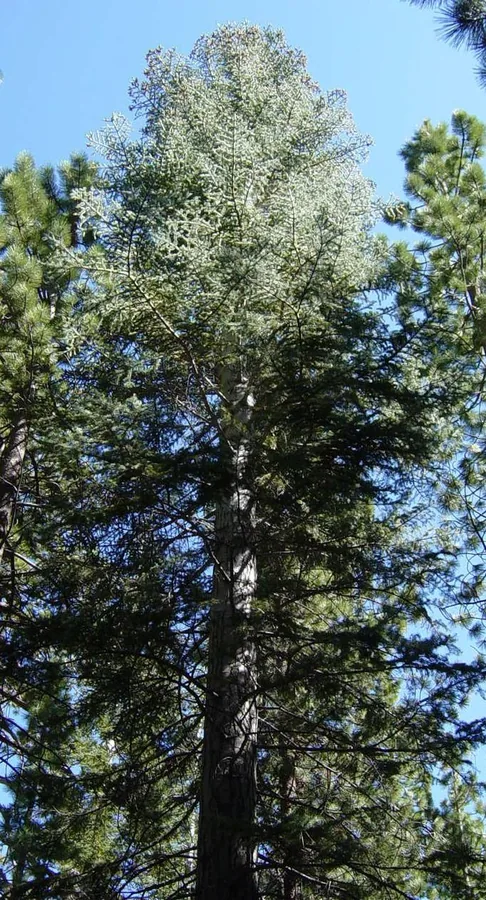
White fir hails from the mountains of the western United States as a true fir, and it has won over gardeners well past its native range as a shade and specimen tree. It wears a neat pyramidal shape and soft blue-green to silvery-blue needles that mark it out from spruce and pine. Grow it well and it stands for a very long time, since this is a slow, long-lived perennial evergreen.
Among the firs people set in their gardens, white fir forgives the most. It rides out cold down to -40°F (-40°C), takes heat in stride better than its relatives, and puts up with city air and clay where other firs throw in the towel. The sticking point is wet feet. Drainage settles whether this tree races ahead or rots away.
Most gardeners plant the straight species, though a handful of blue-needled picks crank the color up further. Whatever form wins you over, plan around its bulk. This tree grows big, so where you plant it is the call that matters most.
Care
The short version: give it full sun, deep acidic soil that drains well, and steady moisture while it roots in. Once settled it asks for next to nothing beyond elbow room, and the single thing it will not stand for is a wet, heavy site.
Light
Set white fir in full sun and it rewards you with the thickest, best-colored growth. It will cope in partial shade and still get on fine, but a tree out in the open keeps its trim pyramid and its silvery-blue cast far better.
Water
Keep up deep, regular watering while it roots in and through any drought, since this tree leans toward soil that stays evenly moist. Let the top half of the root zone dry between drinks, and never let it stand in soggy ground, which races it straight toward root rot.
Soil
This fir craves rich, deep, acidic soil that drains freely, sandy or loamy alike. A pH between 5.0 to 7.0 sits well with it, while heavy compacted clay or a low wet pocket will wear it down over time.
Temperature
Hardly any garden tree shrugs off cold like this one. White fir handles winters down to -40°F (-40°C) and summers up to roughly 95°F (35°C), which is how it carries on through climates that flatten softer firs.
Humidity
Plain outdoor air does the job, so there is no target number to chase. Of the western firs, this one takes the dry heat and the humidity swings of the broader garden in the best stride.
Feeding
A settled white fir in decent ground rarely needs feeding. Bring out a balanced or acidifying tree fertilizer in spring only when a soil test flags a true deficiency, never as a habit.
Pruning
Mostly leave it be. Cut out dead, damaged, or crossing branches in late winter, and guard the central leader so the tree holds onto its natural pyramid.
Repotting
none
Size & spacing
White fir is a forest tree down to its roots, stretching 30 to 70 feet (9 to 21 meters) tall with a spread of 15 to 30 feet (4.5 to 9 meters), and taller yet out in the wild. Hand it that whole footprint and plant it well away from buildings and power lines.
When to plant
White fir goes into the garden as a plant, not a sown seed, and the timing could not be easier. Tuck balled-and-burlapped or container stock into the ground in early spring or fall, while cool, moist soil helps the roots ease into their new spot.
Northern hemisphere
Southern hemisphere
Typical months for a temperate climate: start earlier in warm zones, later where spring frosts linger.
- Plant: Plant balled-and-burlapped or container stock in early spring or fall.
Hardiness
USDA hardiness zones: 3–7
Temperature: down to -40°C
Troubleshooting
A thriving white fir asks for very little, and nearly all its troubles come back to a wet site or a few usual pests. Keep an eye on the needles and the bark, since that is where the earliest clues turn up. Match what you spot below, then move on it before a small snag reaches the roots or the leader.
Woolly white fluff on the bark and joints knotted into swollen lumps
Those waxy white blobs clinging to the bark and branch joints are the balsam woolly adelgid, a minute sap drinker that camps on the wood and the nodes. Give it a few years and it warps the joints into knobby swellings, chokes off fresh growth, and finishes off the crown. Cut away the worst-hit branches, hit the rest with a labeled horticultural oil or systemic, and keep the tree drinking well so it can rally.
Fix:
- Prune out and destroy heavily infested branches
- Apply a labeled horticultural oil or systemic insecticide following the product label and local extension guidance
- Maintain tree vigor with proper watering and avoid drought stress
Needles browning and the canopy going thin after a soggy stretch
Needles draining of color and a canopy opening up after a waterlogged season usually mean Phytophthora or Armillaria root rot is at work down in the soil. Both move in on wet, compacted, or poorly drained ground and eat the roots upward from the crown. A failing tree cannot be saved, so scrape away soil at the collar to confirm it, sort out the drainage, and steer clear of replanting a fir in that same tainted ground.
Fix:
- Improve site drainage and stop overwatering
- Remove and destroy severely affected trees to limit spread through root grafts
- Avoid replanting firs in the same infected soil
Dusty, bronzed needles and faint webbing through a hot spell
A bronzed, faded cast over the needles during summer heat is the calling card of spruce spider mites. They go to work in dry weather and string fine webbing through the foliage. Hold white paper under a branch and rap it to spot them scuttling, then blast the tree with water and only reach for a labeled miticide if their numbers refuse to drop.
Fix:
- Hose down foliage with a strong stream of water
- Apply horticultural oil or a labeled miticide if populations are high
Tapered silk bags swaying from stripped twigs
Those little silk sacks dangling from the twigs hold bagworms, each a caterpillar cloaked in bits of needle as it chews along. Spruce budworm strips the new growth in much the same fashion. Pluck the bags off across winter and into early spring, then spray Bacillus thuringiensis on the larvae while they are still small in late spring.
Fix:
- Handpick and destroy bags in fall through early spring
- Apply Bacillus thuringiensis or a labeled insecticide while larvae are small in late spring
Toxicity
Welcome news for homes with pets and kids: white fir is not toxic. Millions of households stand one indoors each December as a Christmas tree with zero risk of poisoning. The needles run sharp and resinous, so a big mouthful might unsettle a stomach, but no toxin is in play.
Safe for
People · Cats · Dogs · Horses · Rabbits · Livestock · Birds
Cats None
No toxin lurks in a fir for cats, so a quick nibble does nothing to fear. A mouthful of stiff needles might bring a little drool or a single bout of vomiting, and that is the end of it.
Dogs None
Dogs can munch fallen needles with no poisoning to dread, because the tree holds nothing toxic. A hearty helping might rough up the stomach for a day, then settle on its own.
Horses None
Fir foliage sits fine with horses and is not among the conifers known to harm them. Sharp, off-putting needles keep most horses grazing elsewhere anyway.
Rabbits None
A rabbit nibbling bark or needles meets no poison from a true fir. The sticky, prickly foliage rarely draws them in to begin with.
Livestock None
Cattle, goats, and sheep can browse fir free of the abortion danger some other conifers carry. The tree makes honest forage, though sharp needles keep grazing light.
Birds None
Birds nest and roost in firs with nothing to fear from the foliage, and plenty feed on the seeds. The tree carries no toxin for them.
People None
White fir is safe around children, which is why it earns its place indoors every December as a Christmas tree. Needles are no snack, but a stray one brings no poisoning.
Needles are not chemically toxic, but ingestion of needles or sap can cause mild mouth and stomach irritation with vomiting or drooling, and large amounts of stiff needles could pose a GI obstruction risk.
Varieties
Most gardens stick with the plain species, yet a few picks earn their keep for their color, their compact size, or their starring role under the holiday lights.
Candicans
Few white firs match the needle color on this one: an intense silvery-blue that stays put through every season.
Violacea
Prized for its glaucous blue-gray foliage, this form serves up the same eye-catching color in a gentler shade.
Compacta
Slow, dwarf, and pleasingly irregular with blue-green needles, this one slots into small gardens that could never hold a full fir.
Abies fraseri (Fraser fir)
The number-one commercial Christmas tree out of the Appalachians, with short dark-green needles silvered beneath, though heat is its undoing.
Abies balsamea (balsam fir)
A northern true fir cherished for the strong balsam scent it brings to Christmas, yet it wilts in the heat and humidity of the Southeast.
How to propagate
White fir multiplies slowly, and the method you reach for hinges on your goal. Seed hands you the true species across several patient years, while grafting keeps the named blue forms locked to their color.
SeedModerate
Sow stratified seed in spring. · Several years to a sizable sapling
Seed is the go-to path, and it pays to be patient. Each seed wants a cold, damp chill before it will break dormancy, so you sow in spring once that stratification wraps up. Seedlings rise slowly and balk at dry, hot soil, so park them in partial shade through their early years, and count on several seasons before they grow into a sizable sapling.
GraftingDemanding
Late winter under cover. · 1-2 seasons to a viable graft
Named blue forms such as Candicans skip the truth when grown from seed, so growers join them onto fir rootstock by grafting. Done under cover in late winter, it calls for a practiced hand. Allow one to two seasons for the graft to knit and push out growth of its own.
Myths
Douglas fir counts as a true fir, right alongside white, Fraser, and balsam fir.
Douglas-fir sits in the genus Pseudotsuga and is not a true fir at all. True firs in the genus Abies stand their seed cones upright on the branch and let them crumble apart right where they grew, and the needles meet the twig on a flat, round base that leaves smooth bark behind. Douglas-fir cones hang downward, drop whole, and flash three-pointed bracts, while spruces leave behind little woody pegs once their needles fall.