Houseplant · Asteraceae
String of Pearls
Curio rowleyanus
Master its thirst signals and this succulent rewards you with long strands of round green pearls pouring over the edge.
Bright indirect
50–81°F · 10–27°C
USDA 9–12
1–3 ft · 0.3–0.9 m
Overview
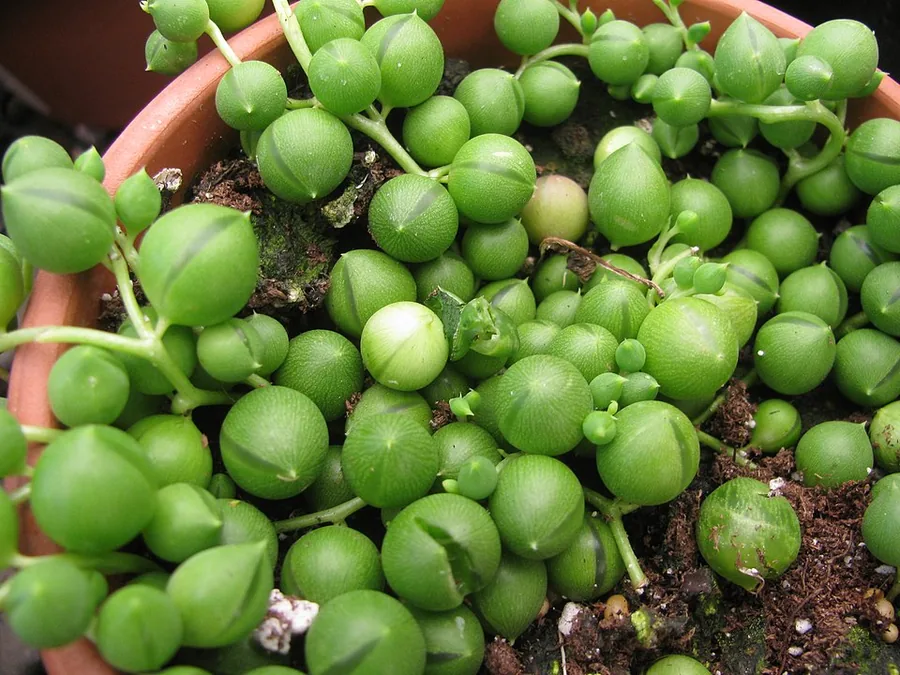
String of pearls tumbles out of its pot on wiry strands beaded with round, pea-sized orbs, a trailing succulent sprung from the parched country of South Africa. Each little sphere works as a water tank, stockpiling moisture to power the plant through long dry stretches, and a slim see-through band runs down every bead to funnel light inward while the plant loses barely any water. Give it a high perch and those strands pour toward the floor.
It sits squarely in the aster family right alongside the common daisy, and a content plant can throw up little white summer flowers that smell faintly of cinnamon, though blooming indoors stays a rare bonus. Collectors first knew it as Senecio rowleyanus, and plenty of plant tags still say exactly that, but taxonomists have since moved it into the genus Curio. Track down either name and the same beaded strands land in your hands.
Almost all the craft here boils down to water, and the plant flags its own needs plainly: the pearls swell tight when it thrives and pucker the instant it runs dry. The quickest way to lose one is to let its roots sit in wet soil, so hand it plenty of bright light and a container that sheds water in a hurry, let the mix bake bone dry between soakings, and it pays you back with years of cascading strands.
Care
The short version: park it in bright indirect light, plant it in a shallow pot of gritty, fast-draining mix, and soak it only once the soil has dried out completely, easing back in winter and slipping it a light feed each spring.
Light
Chase bright indirect light for it, the bright glow of a window with no scorching sun striking the beads head-on. Once it toughens up it shrugs off a little direct sun, but raw midday rays will burn the pearls. Starve it of light and the strands run thin, long, and bare.
Water
Water is the make-or-break here. Flood the mix until it pours from the drainage hole, then back off entirely until the soil has dried out completely, pouring on more through summer and far less through winter. Thirsty beads wrinkle up as a warning, but waterlogged soil triggers the root rot that takes down most of these plants.
Soil
Set it into a gritty, fast-draining cactus or succulent mix that whisks water away from the roots instead of trapping it. It happily takes any pH from 6.0 to 8.0, and a shallow clay pot lets the soil breathe and dry between rounds.
Temperature
Standard indoor warmth keeps it thriving, somewhere in the 50°F to 81°F (10°C to 27°C) band. It welcomes a cooler winter breather near the bottom of that range, and since frost flattens it, bring it in the moment the nights bite.
Humidity
This succulent thrives on plain, dry household air, so ditch the mister and the pebble tray. That dryness quietly works in its favor, holding rot off the stems and beads.
Feeding
It runs on next to nothing. Hand it a light spring feed of dilute balanced or cactus fertilizer while growth is charging along, then cut it off completely for the winter rest.
Pruning
Snip off any leggy or naked strands and the plant bushes out fuller, and a quick pinch of the longest stems keeps it in shape. Every piece you remove roots into a brand-new plant, so toss nothing.
Repotting
Bump it up only every one to two years, always into a shallow container instead of a deep one. Watch for roots jamming the pot or soil that flashes dry almost the second you water, and you will know it wants a move.
Size & spacing
The strands run out to roughly 1 to 3 feet (30 to 91 cm), and the plant fans about as wide as it drops. Perch it in a basket and the beaded stems sail well past the base of the pot.
Troubleshooting
Track almost any trouble with string of pearls back to two things: how you water and where it sits. Happily, the beads broadcast the answer, sagging soft when they run dry and turning to mush when they stay too wet. Spot your plant in the list below and tweak fast, before a squishy stem tips over into rot.
Mushy stems and beads dropping or going glassy
Stems going soft and black while beads drop off or turn to glass flag root and stem rot, the number one killer of this plant. The culprit is mix that stays wet and never dries out. Cut the watering immediately, slice away every mushy section, and relaunch a few healthy stem tips in fresh gritty mix rather than babying the failing plant along. Fresh cuttings charge ahead far faster than a rotted crown ever will.
Fix:
- Stop watering and remove affected mushy sections
- Take healthy unaffected stem cuttings and restart in fresh gritty mix
- Repot into fast-draining cactus mix in a shallow, well-drained container
Beads gone wrinkled, soft, and deflated
Beads that were plump turning creased and squishy are the plant flat-out begging for water, and that is straightforward underwatering showing once the mix has gone dry far below the top layer. Douse it until water escapes the drainage hole, then let the whole pot run dry again before you reach for the can. It plumps back up fast, so keep the momentum going.
Fix:
- Water thoroughly until it drains, then let the mix dry completely before watering again
- Resume a regular dry-down cycle, watering more in summer than winter
Bleached or crispy beads facing the window
Beads that fade pale or char brown along the window-facing side have caught sun scorch from raw, unfiltered rays. The plant chases bright light, it just cannot handle fierce midday sun slamming onto beads that have not toughened up. Slide it back into bright indirect light, and whenever you push it toward stronger sun, ramp it up across a week or two so it can adjust.
Fix:
- Move to bright indirect light
- Acclimate gradually before increasing sun exposure
Toxicity
Keep the enthusiasm in check on one front: this plant is toxic. Its leaves and sap pack pyrrolizidine alkaloids, so a cat or dog that chews the pearls can end up vomiting and sluggish, and the milky sap stings skin and upsets the stomach. Hang it high and clear of pets and kids, and snap on gloves before every pruning session.
Toxic to
Cats · Dogs · Horses · Rabbits · Livestock · Birds · People
Cats Toxic
A cat that snacks on the pearls tends to vomit and then slump into a quiet, low-energy funk. Drooling and loose stools can pile on, and the sap may leave its mouth raw and sore.
Dogs Toxic
Dogs land in much the same boat, with vomiting and sagging energy leading the pack of symptoms. A few pick up diarrhea as well after gnawing the dangling strands.
Horses Caution
The pyrrolizidine alkaloids threaded through this genus hammer a horse's liver, so stow the trailing stems well beyond its reach. A mouthful of the leaves can spark a churning gut and a flat, off-feed slump.
Rabbits Caution
Rule it firmly off-limits for rabbits. The very alkaloids that hit other animals turn these leaves into a risky, no-good nibble, so block any bunny from grazing the pearls that swing within reach.
Livestock Caution
Cattle, sheep, and goats all react to Senecio-type alkaloids, which stack up and wreck the liver over the long haul. A houseplant seldom lands in a barn, but park it far from any grazing animal all the same.
Birds Caution
Solid data on birds is thin, so the smart play is to keep a pet bird clear of the strands and let it graze only on greens you have vetted as safe.
People Caution
Nothing on this plant belongs on a plate, and swallowing the leaves can churn up the stomach. Its milky sap bites broken skin as well, so glove up before you prune and steer small children away from popping the pearls into their mouths.
Wear gloves when handling or pruning, as the sap can irritate skin and cause a rash in sensitive individuals.
Helpline numbers

United States
ASPCA Animal Poison Control: (888) 426-4435 (fee applies)
Poison Control: (800) 222-1222



Canada
Poison Centres: 1-844-764-7669
Varieties
The plain green form dominates windowsills, yet one named pick surfaces here and there for growers hunting something different.
'Variegata' (variegated string of pearls)
Green and creamy white swirl across its round beads, giving the trailing strands a far lighter cast than the standard green plant.
How to propagate
Multiplying string of pearls is a breeze, and nearly every trim hands you fresh strands ready to root.
Stem cuttingsEasy
Active growth, spring through summer · Roots typically develop at the nodes within a couple of weeks
Cuttings are hands-down the quickest, surest route to more plants, and spring through summer is prime time to grab them. Clip 3 to 4 inch stem tips, peel the lower beads off, and press the exposed nodes onto damp gritty mix or tuck them just under. Fresh roots break from every buried node within a couple of weeks, and the new plant is off and running.
SeedModerate
Not commonly used in cultivation · Slow and uncommon in cultivation; less reliable than cuttings
Seed is doable but hardly ever pays off at home. Each wind-borne seed trails a cottony tuft and stays tough to find in the trade, and once sprouted they crawl along and prove far less dependable than cuttings, so most growers wave them off and reach for clippings instead.
Myths
This plant's proper name is Senecio rowleyanus.
That label still rides most plant tags and shop listings, but the science has moved on and reclassified it. Kew's Plants of the World Online now recognizes Curio rowleyanus as the accepted name and files Senecio rowleyanus as a synonym, so chasing either one lands you on the identical plant.
As a succulent, it thrives on neglect and barely ever wants watering.
It asks for more attention than that easygoing myth claims. Let it bake and the pearls collapse, keep it wet and it rots out in a hurry, so it wants a full dry-down between deep waterings, neither parched nor perpetually damp.