Shrub · Bignoniaceae
Trumpet Vine
Campsis radicans
Give it full sun and a strong support, and the trumpet vine will pack the summer with hummingbirds.
Full sun
Every 7–14 days
730–1095 days
USDA 4–9
Overview
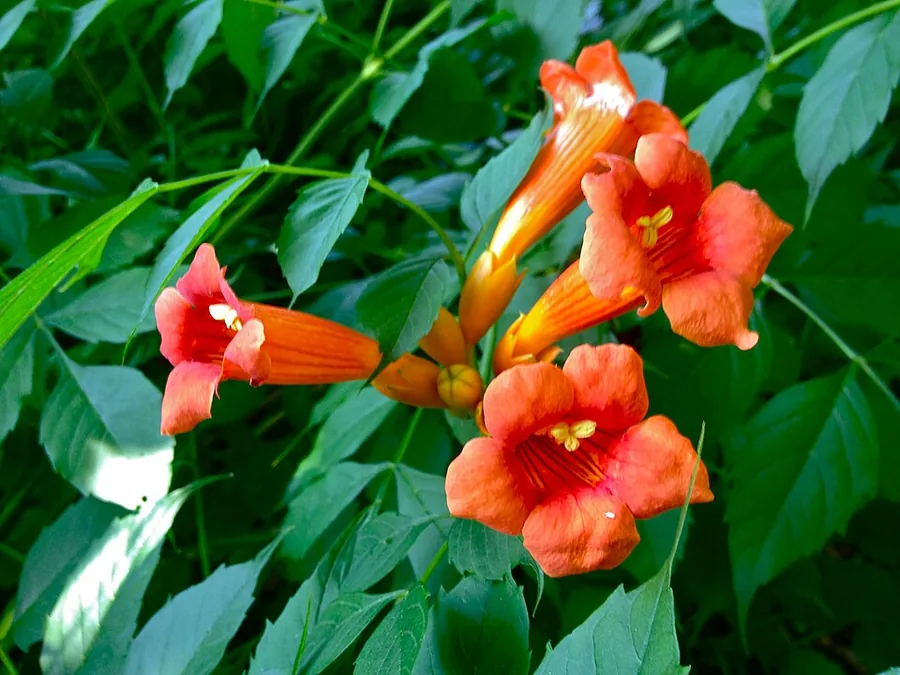
Here is a climber that grows with real drive. The trumpet vine is a fast, woody native of the eastern United States, and it throws out orange-red trumpets that hummingbirds chase from midsummer well into fall. Gripping with aerial rootlets, it powers 25 to 40 feet (7.5 to 12 m) up an arbor, fence, or wall in short order. It thrives across zones 4 to 9, brushing off cold, heat, drought, and thin soil like they are nothing.
That energy is the whole story with this plant. Turn your back and it charges outward on root suckers and self-sown seed, packing the ground with thick growth, while its weight and clinging roots start bearing down on whatever it climbs. So aim it at a spot where it can stretch out or where someone will keep pace with it, not a fussy corner by the door.
The payoff comes fast when the setup is right. Anchor it to a heavy, freestanding structure, plant it in lean soil, and swing the pruners hard once a year, and it rewards you with flower after flower and no regrets. Keep the gloves handy while you work, since the sap behind the name cow itch vine can nip at bare skin.
Care
The short version: full sun, lean soil, and a support that can really take the load. Water young plants until they dig in, then back right off, skip the fertilizer, and cut it back hard in late winter to keep all that drive pointed the right way.
Light
Aim it at full sun, six or more hours a day, and the flowers pour out. It will grow on in partial sun or light shade, sure, but shade swaps those blooms for leaves and hands you a runaway green vine with barely a spot of color.
Water
Keep young plants watered while they get their footing, then step back and let them run. Once it is established it turns drought tolerant, coasting on rainfall through dry to moist soils, so a settled vine hardly ever needs a drink from you.
Soil
Drop it into just about anything: clay, sand, loam, or poor ground, anywhere from pH 5.5 to 8.0. Lean soil is the sweet spot, though, since rich ground only feeds the growth and starves the flowers, and it powers through dry to occasionally wet spells without missing a beat.
Temperature
This one shrugs off weather that stops other climbers cold, coming through from -29°F to 100°F (-34°C to 38°C) and holding strong across zones 4 through 9. A brutal winter and a scorching summer both roll right past it.
Humidity
No humidity target to chase here at all. Plain outdoor air keeps it going, and it grows across a huge sweep of climates without a care about moisture in the air.
Feeding
Put the fertilizer down and walk away. Feeding just drives more leaf and fewer flowers, so this vine performs better lean and hungry, and thin ground helps hold its full-throttle growth in check.
Pruning
Cut it back hard in late winter or early spring and go for it. It flowers on new growth, so cutting it back never costs a single bloom, and a yearly thinning of the woody stems plus yanking the root suckers is exactly what keeps it off your structures.
Repotting
This is a ground-runner, not a houseplant, so repotting almost never comes up. On the rare chance yours lives in a pot, watch for roots packing the pot and suckers shooting out the drainage holes.
Size & spacing
Brace for a big grower: 25 to 40 feet (7.5 to 12 m) tall and 5 to 10 feet (1.5 to 3 m) wide. Hand it a strong structure and plenty of elbow room, and keep it well back from anything you would rather it did not overrun.
When to plant
This plant runs on its own schedule and rewards a little patience. Get it in the ground in spring once frost clears, or in fall where winters stay mild, then cut it back hard in late winter before it fires up again. From there the orange trumpets roll out all summer, June into September, riding on the fresh new wood.
Northern hemisphere
Southern hemisphere
Typical months for a temperate climate: start earlier in warm zones, later where spring frosts linger.
- Sow: Late winter to early spring; seed needs cold stratification, though the plant is usually propagated from root cuttings or suckers rather than seed.
- Plant: Spring after frost, or fall in mild zones
- Harvest: Summer (June to September)
Hardiness
USDA hardiness zones: 4–9
Temperature: down to -34°C
Troubleshooting
Nearly every issue with a trumpet vine springs from its drive, not from pests or disease, which honestly makes it easy to handle. It surges past its boundaries, throws its weight on the support, and now and then pushes leaves instead of flowers. Track down your symptom below and jump on it early.
Siding, mortar, and gutters taking damage from the vine
The culprit is those clinging aerial rootlets, which drive into mortar, wood, and every crack, and a mature plant loads on enough woody weight to snap a fence or a flimsy trellis. Peel it off a wall and the surface tears away with it. Run it only on a heavy freestanding support such as a metal arbor or masonry, never the house, and prune it back hard every year to keep the load down.
Fix:
- Grow only on a very sturdy freestanding support such as a heavy metal arbor or masonry, not on house walls or wooden structures
- Keep the vine off buildings, gutters, and weak fences by pruning back hard
- Avoid clinging vines on wood, which can be damaged or rot from trapped moisture
Fresh shoots springing up far from the parent plant
Meet aggressive suckering, the move that defines this vine. Underground runners shoot outward and the bean-like pods fling seed, so new shoots and seedlings burst up well beyond the parent and can steamroll the plants nearby. Get after every sucker the instant it appears, run the mower over any that hit the lawn, and clip the seed pods before they pop open.
Fix:
- Dig or pull root suckers as soon as they appear, removing as much root as possible
- Mow suckers repeatedly where the plant adjoins lawn to exhaust them
- Remove spent flowers and seed capsules before they split to limit self-seeding
- Site it near concrete or mowable areas to make suckers easier to control
A vine all fired up on leaves but skipping the flowers
A trumpet vine roaring with growth yet stuck without flowers is usually too young, too shaded, or too well fed. Young plants often need a few years to hit their stride, and shade or rich, nitrogen-heavy soil drives leaves ahead of blooms. Shift it into full sun, cut off the fertilizer, and give it time, because the flowering only ramps up as it ages.
Fix:
- Site or relocate in full sun (6 or more hours)
- Be patient; allow the plant to mature, as blooming improves with age
- Avoid nitrogen-rich fertilizer and grow in leaner soil
- Root-prune or restrict the roots slightly to encourage flowering
Toxicity
Grow it boldly, just handle it smart. The main thing to watch lands on people, since the leaves, flowers, and sap can spark the itchy rash behind the name cow itch vine. Pets that chew it get off with mild irritation, so pull on gloves whenever you work with it and keep nibbling animals clear of the foliage.
Toxic to
Cats · Dogs · Horses · Rabbits · Livestock · People
Safe for
Birds
Cats Mild
A cat that chews a leaf or flower might drool a bit or catch a quick stomach upset, and the sap can leave its mouth or skin sore. Nothing close to serious poisoning is in play.
Dogs Mild
A dog that gnaws the foliage usually gets away with some drool and a passing stomach upset, maybe with a touch of mouth or skin irritation from the sap.
Horses Mild
A horse that samples the vine may pick up light mouth or skin irritation and a bit of digestive upset, but this is no dangerous plant for one.
Rabbits Caution
How rabbits handle it is barely on record, so the smart move is to keep them well clear of it rather than let them graze on it.
Livestock Caution
Grazing animals mostly steer around it, and any irritation from a stray bite stays mild, but it is still best fenced off from pasture rather than grazed.
People Caution
Handling the leaves, flowers, or sap can kick off contact dermatitis, with skin redness, itching, and blistering plus eye irritation. The name cow itch vine spells it out, so gear up with gloves and long sleeves before you prune.
Birds Safe
Birds run no risk from it and swoop in for the nectar over the leaves, with hummingbirds crowding the blooms the hardest.
Not internally poisonous to pets, but the leaves, flowers, and sap can cause contact dermatitis with skin redness, itching, and eye irritation in sensitive people who handle the plant (hence the folk name cow itch vine). Wear gloves and long sleeves when pruning or handling.
Helpline numbers

United States
ASPCA Animal Poison Control: (888) 426-4435 (fee applies)
Poison Control: (800) 222-1222



Canada
Poison Centres: 1-844-764-7669
Varieties
Chasing a different color or a calmer grower? A handful of named forms and one close Asian relative open up the choices, and these are the standouts.
'Flava' (Yellow Trumpet, f. flava)
This form ditches the usual orange-red and fires off clear yellow to orange-yellow trumpets instead.
'Madame Galen' (Campsis × tagliabuana)
A cross of C. radicans and C. grandiflora, it shows off cantaloupe-orange to salmon-red flowers and still suckers and self-seeds, just charging a little less hard than the straight species.
Campsis grandiflora (Chinese trumpet creeper)
This Asian species puts out big orange-and-yellow flowers, climbs far more gently with fewer aerial rootlets, and leans on added support to hold itself up.
How to propagate
Few plants throw out new starts as eagerly as this one, whether from cuttings, division, seed, or a stem that lands on the soil and roots. The real trick with a trumpet vine is reining it in, not making more.
Stem cuttingsEasy
Summer (softwood) cuttings · 4 to 8 weeks to root
Snip softwood cuttings in summer and they root in a snap, striking in roughly 4 to 8 weeks. Hardly any plant starts more easily from a cutting.
DivisionEasy
Dormant season or early spring · One season
The vine keeps pumping out its own rooted suckers, so the quickest win is to dig one in the dormant season or early spring and drop it in somewhere new. A divided sucker takes hold within a single season.
SeedModerate
Spring after cold stratification · Several years to first bloom
Seed from the bean-like pods germinates freely once it has had a cold spell, sown in spring after stratifying. Brace for a wait, though, since seedlings can take several years to hit their first bloom.
LayeringEasy
Spring to summer · One season
Lay a stem along the soil from spring through summer and its rootlets and nodes grab hold on their own. Within a season that layered stem is set to cut free and move.
Myths
Trumpet vine is poisonous and will badly harm a dog or cat that chews it.
Not the case at all. Campsis radicans stays off the ASPCA toxic-plant lists, and eating it rates low, so a chewing pet walks away with maybe some drooling or a mild stomach upset. The real catch is contact dermatitis, a skin and eye reaction in people who handle the foliage or sap, not any poisoning from the inside.
It is a tidy, well-mannered climber for the side of a house.
Far from it. It charges out by root suckers and self-seeding into dense colonies, and its clinging roots and heavy growth can tear into siding, mortar, wood, gutters, and any weak support. Set it on a strong support of its own and prune it hard every year, and keep it clear of the house.