Ornamental · Amaranthaceae
Amaranth
Amaranthus caudatus
Hand it full sun and warm soil, and amaranth rewards you with trailing tassels that run from summer into fall.
Full sun
USDA 2–11
3–5 ft · 0.9–1.5 m
Overview
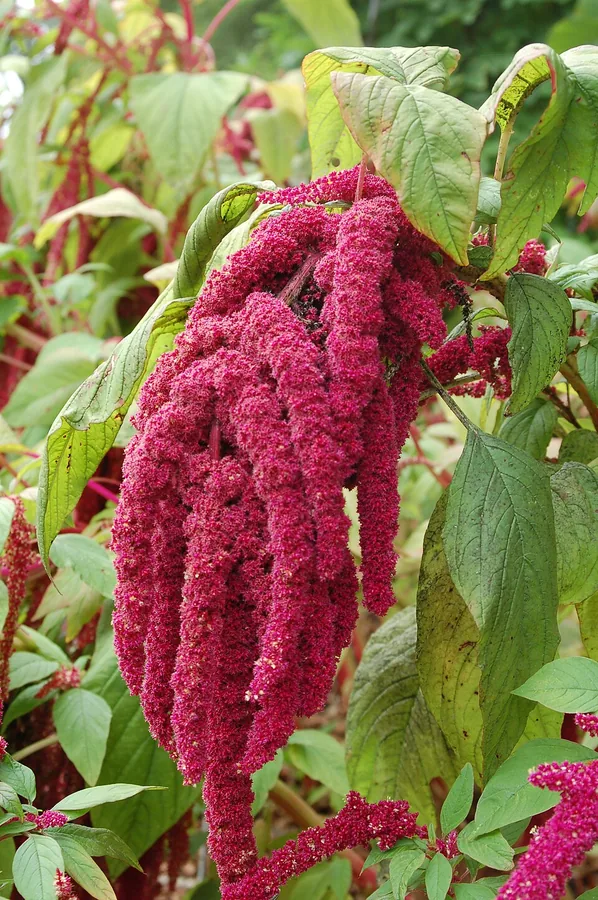
Amaranth packs a long, exciting history into an easy annual. People have raised it for grain across the Andes and Mexico for thousands of years, and growers now chase it for its show-stopping flowers. The ornamental star, Love-Lies-Bleeding, throws down thick ropes of crimson or gold tassels that spill almost to the ground, all from a plant that wants little more than warmth and sun.
There is real variety to dig into here, and the family splits into clear camps. Some kinds put on a pure spectacle, trailing or shooting up in deep reds, greens, and golds. Others are the grain types, loaded with tiny edible seeds tucked into their heads, while the weedy pigweeds claim the same genus and a rougher streak.
Out in the garden amaranth makes growing feel effortless. It powers through heat, thrives in lean soil, and reseeds itself once it gets going, so it comes back on its own. The one thing to keep on your radar is that the foliage can carry high nitrates, which only matters where grazing animals share the ground.
Care
The short version: plant amaranth in full sun and well-drained, moist soil, keep it watered while it gets going, go light on the fertilizer, and stake the tall types once the flower spikes form.
Light
Hand amaranth full sun for the richest color and the toughest plants. It will take some afternoon shade, but a shady spot leaves you nursing weak, leggy growth and thin flower spikes.
Water
Keep the soil evenly moist while the plants are young and getting established. Once they settle in they ride out a dry spell, though steady water always drives the fullest growth.
Soil
Amaranth wants well-drained, moist soil and asks for nothing more. Sharp drainage matters most, since soggy ground is what invites root rot.
Humidity
Ordinary outdoor humidity suits amaranth fine, so there is no target to chase. Good airflow does far more for it, keeping the foliage dry and leaf spot at bay.
Feeding
Amaranth rarely needs feeding and thrives in lean ground. Go light on nitrogen above all, because heavy nitrogen drives soft growth and pushes the foliage to store up nitrates.
Pruning
Little pruning is called for here. Deadhead or cut the spikes for fresh or dried arrangements, and stake the tall types once the heavy flower heads form so they hold their stand.
Size & spacing
Plants shoot to 3 to 5 feet (91 to 152 cm) tall and spread 12 to 24 inches (30 to 61 cm) across. Give the taller kinds room to stand and air to move around them.
When to plant
Amaranth thrives on warmth and will not stand frost, so let the cold clear before it goes out. Start seed indoors in early spring or sow it straight in the bed once frost is gone, and the plants flower from midsummer into fall, about three months after sowing.
Northern hemisphere
Southern hemisphere
Typical months for a temperate climate: start earlier in warm zones, later where spring frosts linger.
- Sow: 6 to 8 weeks before last frost, or direct sow after last frost
- Plant: After danger of last frost has passed
- Harvest: Blooms summer through fall; flowering begins about 3 months after sowing
Hardiness
USDA hardiness zones: 2–11
Temperature: down to -46°C
Troubleshooting
Amaranth powers through most seasons in great shape, and the few problems it meets show up on the leaves, the flower spikes, or the roots. Match what you see below, then jump on it before it spreads.
A wilting plant going dark and mushy near the soil
Soggy soil opens the gate to Phytophthora blight and root rot, which rots the roots and lower stem dark and soft until the plant topples. A plant this far gone is past saving, so pull it and toss it without delay. Fix the drainage first and the next planting in that spot will power away.
Fix:
- Remove and destroy affected plants
- Improve soil drainage
Sharp-cornered dark spots boxed in by the veins
Angular, water-soaked spots ringed with a yellow halo flag bacterial leaf spot. Pluck off the marked leaves the moment you spot them and you stay ahead of it. Aim your water at the soil instead of over the canopy, since dry foliage robs the bacteria of the wet surface they need to spread.
Fix:
- Remove affected foliage
- Avoid overhead watering to reduce leaf wetness
Sticky leaves and twisted, curling new shoots
Sticky residue and curling new growth give away an aphid infestation, and these are an easy pest to beat. Scout the flower spikes and leaf undersides for clusters of soft little insects parked in their honeydew. Blast them off with a sharp jet of water and they scatter fast, and insecticidal soap finishes the job whenever a population really takes hold.
Fix:
- Spray off with a strong jet of water
- Apply insecticidal soap if populations are heavy
Toxicity
Good news for pet owners: amaranth is safe to grow around cats and dogs, which the ASPCA lists as non-toxic. The real focus is grazing animals, since the leaves can store up nitrates and oxalates, and a livestock animal eating a large amount of stressed foliage can be poisoned. Keep cattle, horses, and other grazers off big stands of it.
Toxic to
Horses · Rabbits · Livestock · Birds · People
Safe for
Cats · Dogs
Horses Caution
The ASPCA calls amaranth non-toxic to horses, yet horses graze by the mouthful, and leaves loaded with nitrates can still trouble any grazing animal. Keep them off a big stand, above all once a drought has set in.
Rabbits Caution
A couple of leaves rarely bother a rabbit, but the same nitrates and oxalates that hit grazing stock pile up in the foliage. Make it a rare treat instead of a daily staple.
Livestock Severe
Nitrate poisoning in cattle and other grazing animals: increased salivation, labored breathing, incoordination, weak pulse, muscle tremors, weakness, chocolate-brown blood, and death; signs appear about two to six hours after eating. Soluble oxalates and nephrotoxin can also cause kidney damage.
Birds Caution
Birds dive on ripe amaranth seed and that part is theirs to enjoy. The only catch is heavy grazing on nitrate-rich leaves, so let them strip the seed heads and leave the foliage be.
People Caution
People grow amaranth for grain and greens, and both go on the plate cooked. The thing to watch is the nitrates and oxalates that build up in leaves from stressed plants, so cook the greens and skip foliage from drought-hit plants.
Cats None
Grow amaranth with cats around and breathe easy, because the ASPCA marks it non-toxic to them, so a curious nibble means nothing.
Dogs None
Dogs get the green light too. The ASPCA keeps amaranth on its non-toxic list, so a chewed leaf does no harm at all.
Safe to grow around dogs and cats; the main risk is to grazing animals eating large amounts of foliage, especially under drought stress or high soil nitrogen.
Helpline numbers

United States
ASPCA Animal Poison Control: (888) 426-4435 (fee applies)
Poison Control: (800) 222-1222



Canada
Poison Centres: 1-844-764-7669
Varieties
Amaranth runs the full range from ground-sweeping ornamentals to upright grain crops. These are the types you are most likely to meet.
Amaranthus caudatus (Love-Lies-Bleeding)
The classic ornamental, dripping long, drooping tassels of red or gold that cascade toward the ground.
'Viridis'
A green-flowered take on Love-Lies-Bleeding, grown for the bright punch of its chartreuse tassels.
Amaranthus cruentus
An upright grain and ornamental type that thrusts its plume-like heads skyward and delivers an edible seed.
Amaranthus hypochondriacus (Prince's Feather)
A tall, bolt-upright grain amaranth, and the species the ASPCA lists as non-toxic to cats and dogs.
How to propagate
Amaranth is about the easiest plant going to raise from seed, and it cheerfully seeds itself around the garden once you grow it.
SeedEasy
Sow indoors 6 to 8 weeks before last frost, or direct sow outdoors after last frost. · Flowering begins roughly 3 months after sowing
Amaranth races up from seed and reseeds itself around the garden once it settles in, so a single planting keeps giving. Sow it indoors 6 to 8 weeks before your last frost, or fling seed straight into the bed once the frost danger lifts. Thin or transplant the seedlings from there, and the first tassels burst open about three months later.
Myths
Amaranth flowers are poisonous to cats and dogs.
Cross this one off the list, because the ASPCA puts amaranth on its non-toxic roster for cats, dogs, and horses, so the flowers pose no real danger to pets. The documented risk falls on grazing livestock, where nitrate and oxalate buildup in the foliage is what does the harm.
Amaranth is edible, so any animal can graze it freely.
Pigweeds in this genus pump nitrates and soluble oxalates into their leaves and rank among the top causes of nitrate poisoning in cattle. Drought stress and high nitrogen drive those levels to a peak, which is exactly when a grazing animal faces the greatest risk.