Bulb · Asparagaceae
Common Camas
Camassia quamash
A spring bulb that turns a wet meadow into rolling blue.
Full sun
Every 3–7 days
USDA 3–8
1–4 ft · 0.3–1.2 m
Overview
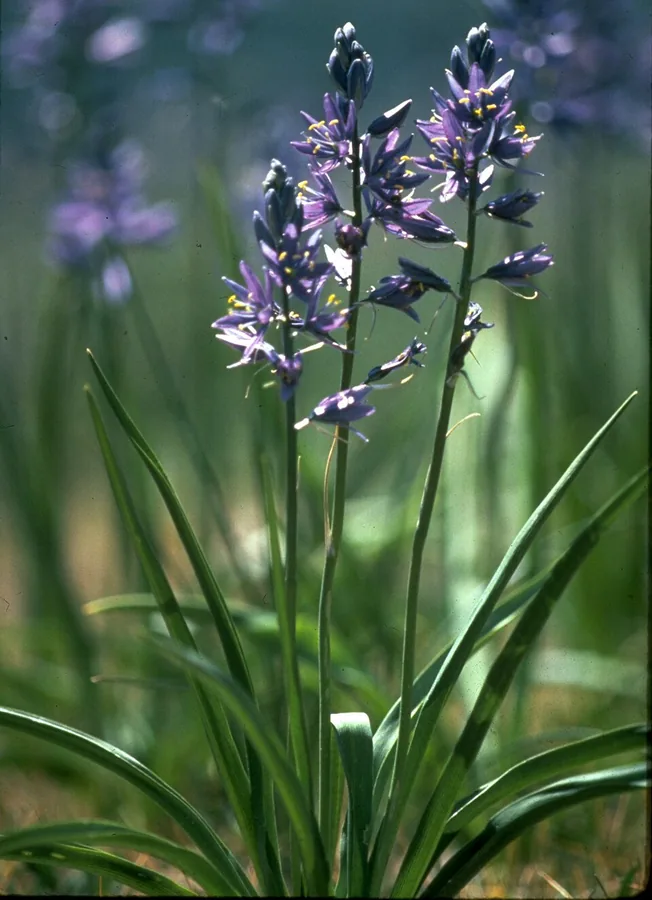
Common camas (Camassia quamash) is a hardy North American bulb that rewards growers with blue-violet flower spikes carpeting damp meadows from March to June. It belongs to the Asparagaceae family, rates as easy, and lives outdoors as a long-running perennial.
This bulb runs on a clear yearly rhythm: leaves and tall flower spikes push up in spring, then the plant dies back and rests underground through dry summer heat. Lean into that cycle and it returns year after year, slowly building natural drifts.
Native American peoples cooked the bulbs as a food staple, and true common camas is safe across the board. The catch worth committing to memory: it closely resembles the deadly death camas, so never eat a wild bulb without expert identification.
Care
The short version: plant the bulbs in fall, give them full sun and moist humus-rich soil through spring growth, then back off the water once the foliage dies down for summer dormancy. Feed lightly at planting, leave them undisturbed, and divide only when crowding cuts the flowering.
Light
Give camas full sun and it flowers at its best. It will take partial sun or light partial shade, but push it into too much shade and you get leafy growth with few blooms to show for it.
Water
Through spring growth and bloom, keep the soil evenly moist; this bulb lives in wet meadows and drinks it up, so water it again before the ground dries during active growth. Once the foliage dies back for summer dormancy, ease off and keep the resting bulbs drier.
Soil
Plant into well-drained, moist, humus-rich soil loaded with organic matter. Camas is relaxed about acidity and runs happily anywhere from pH 5.5 to 7.5.
Temperature
This is a tough customer across USDA zones 3 to 8, cold-hardy down to about 10°F (-12°C) and content with summer heat up to roughly 86°F (30°C) before it slips into dormancy.
Humidity
Air humidity is a non-issue outdoors; average conditions suit it fine. What truly matters is moisture at the roots through the spring growing stretch.
Feeding
Keep feeding light. Work a balanced bulb fertilizer or compost into the soil at planting in spring, and that single boost carries the bulb through the season.
Pruning
No routine pruning here. Let the foliage die back on its own after bloom so the bulb can recharge for next year, and clip spent flower stalks only when you want to head off self-seeding.
Repotting
Leave camas be. It rarely needs lifting; divide only when a clump grows so crowded the flowering drops off, or when bulb offsets push up to the soil surface.
Size & spacing
Flower spikes reach 1 to 4 feet (30 to 120 cm) tall, while each clump spreads 12 to 24 inches (30 to 60 cm). Left in place, the plants knit together into natural drifts over time.
When to plant
Camas keeps a steady calendar you can plan around. Set bulbs out in fall so they root over winter, watch the spikes climb and bloom from March to June, then let the foliage fade as the bulbs settle into summer rest.
Northern hemisphere
Southern hemisphere
Typical months for a temperate climate: start earlier in warm zones, later where spring frosts linger.
- Plant: Plant bulbs in fall; sow seed outdoors in fall or spring
- Harvest: Spring (March to June)
Hardiness
USDA hardiness zones: 3–8
Temperature: down to -40°C
Troubleshooting
Camas asks for little, but two issues come up. Both trace back to siting and moisture, and both clear up fast once you spot the cause.
Soft, hollowed-out bulbs lurking below the soil
Resting bulbs that turn mushy point to narcissus bulb fly larvae or soggy ground. Dig up the damaged ones, toss them, and sharpen summer drainage so dormant bulbs sit dry.
Fix:
- Remove and destroy infested or rotten bulbs
- Improve soil drainage for summer dormancy
- Avoid leaving wounded bulbs in waterlogged soil
Strong leaves, but the spikes never show up
When the foliage looks great yet blooms stay scarce, light and crowding usually drive the problem. Open up the planting to full sun, thin packed clumps, and give young bulbs the seasons they need to mature.
Fix:
- Site in full sun for best flowering
- Lift and divide crowded clumps of bulb offsets after foliage dies back
- Be patient with seed-grown plants, which need several years to bloom
Toxicity
True common camas earns a clean none rating: it poses no poisoning risk to people, dogs, cats, or grazing animals, and its bulbs were a cooked food. The single real hazard is misidentification against the deadly death camas, covered below.
Safe for
People · Cats · Dogs · Horses · Rabbits · Livestock · Birds
Cats None
A curious cat that takes a garden nibble has nothing to fear; this bulb carries no toxin for them.
Dogs None
A dog that digs up and chews a bulb should come through just fine, since the plant holds no poison for them.
Horses Safe
Grazing horses face no reported toxicity from true common camas.
Rabbits Safe
Rabbits can browse the foliage and bulbs without harm; there is no toxin to trouble them.
Livestock Safe
Cattle, goats, and sheep grazing true common camas are not put at risk by it.
Birds Safe
Birds face no known danger from this plant.
People Safe
Cooked bulbs fed Native American peoples as a staple and stay safe to eat once correctly identified; the lone hazard is mistaking the plant for deadly death camas, so never eat a wild bulb without an expert's confirmation.
The true danger is misidentification: edible camas bulbs closely resemble the highly poisonous death camas (Toxicoscordion/Zigadenus). Never forage or consume wild bulbs without expert identification.
Varieties
Two named selections take the wild species and push it further. Both bring deep blue color, and one even gives you something to look at well before the flowers arrive.
Camassia quamash 'Blue Melody'
Pairs deep blue-violet flowers with cream-edged variegated leaves, so it pulls its weight before a single spike opens.
Camassia quamash 'Orion'
Lifts deep blue flowers on tall stems, a standout choice for naturalizing across a moist meadow.
How to propagate
Camas multiplies readily, so building a colony is half the fun. Lift offsets, plant fresh bulbs, sow seed, or split a clump, depending on how quickly you want a flowing drift.
Offsets & pupsEasy
After foliage dies back in summer dormancy · 1 to 2 seasons
Once the foliage fades into summer dormancy, lift a clump and twist away the bulb offsets ringing the parent. Replant them into moist humus-rich soil, and over 1 to 2 seasons they settle in. This is the fastest route to a flowing drift.
Bulbs & cormsEasy
Fall · 1 to 2 seasons
Tuck dormant bulbs into moist humus-rich ground in fall and let them root through winter for blooms the following spring. Allow 1 to 2 seasons before they put on a full display.
SeedModerate
Sow outdoors in fall or spring · Up to 3 years to flower
In a moist meadow this plant self-seeds freely. Sow your own outdoors in fall or spring, and count on seedlings needing up to 3 years to reach blooming size.
DivisionEasy
During summer dormancy · 1 to 2 seasons
Split an established clump during summer dormancy to keep it vigorous and spread it around. The divided pieces re-establish within 1 to 2 seasons.
Myths
All camas bulbs are safe to eat because Native Americans ate camas.
Edible common camas looks nearly identical to death camas (Toxicoscordion/Zigadenus), whose bulbs are poisonous and can kill. The two are easy to mix up out of bloom, once the flower color that tells them apart is gone, so never eat a wild bulb without expert identification.