Bulb · Asparagaceae
Grape Hyacinth
Muscari armeniacum
Push the little bulbs into fall soil and watch them fire off rivers of blue each spring.
Full sun
Every 7–14 days
USDA 4–8
4–8 in · 10–20 cm
Overview
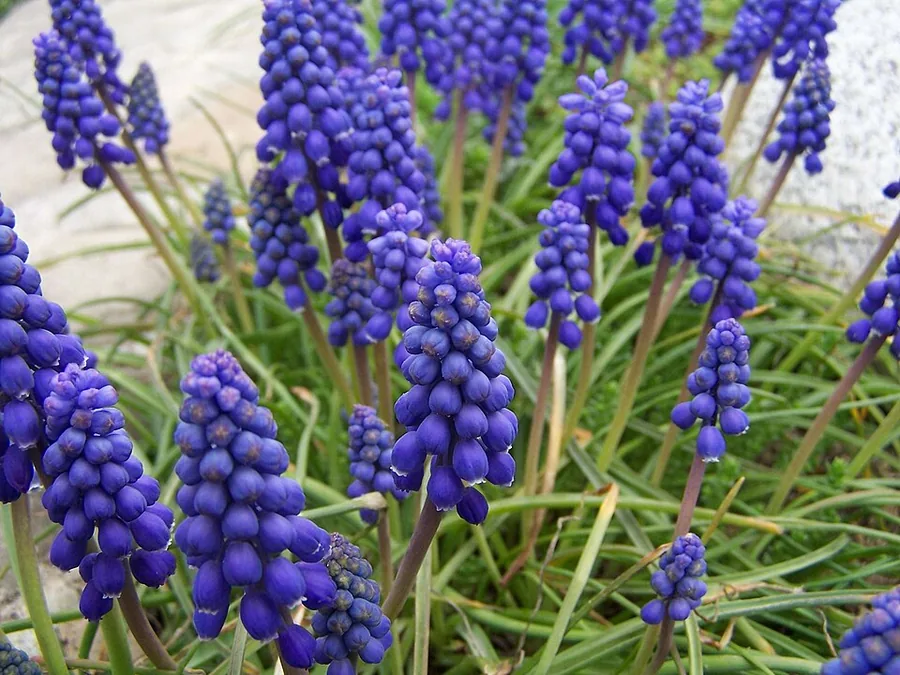
Grape hyacinth grabs its name from the tight spikes of small, rounded flowers that stack up like a bunch of upside-down grapes. Each bulb rises just 4 to 8 inches (10 to 20 cm) tall, but plant it in drifts and it comes roaring back year after year, punching well above its size. Despite the name, it keeps zero ties to the true hyacinth and holds its own genus, Muscari.
Few bulbs reward a grower this fast. Push the bulbs into the ground in fall, and they send up grassy leaves through winter before firing open their deep blue spikes in mid-spring, right beside the tulips and daffodils. They root into almost any site and laugh off cold that plunges to -29°F (-34°C).
The trait that keeps growers on their toes is its drive to spread. Grape hyacinth self-seeds and multiplies by offset bulbs, so a small patch can race into the lawn over a few seasons. That energy is a gift in a wild corner and a headache in a neat border, so plant it where a little roaming is welcome and let it run.
Care
The short version: plant the bulbs in fall in well-drained soil, give them full sun to part shade, keep them moist through spring growth, then ease off the water once the foliage dies back.
Light
Grape hyacinth flowers hardest in full sun, yet it takes partial sun or partial shade in stride. Pour on more light for denser spikes and stronger color, and know that a bit of afternoon shade works fine in hot spots.
Water
Keep the soil evenly moist while the leaves and flowers are growing in spring. Once the foliage yellows and dies back, cut the water hard, because the bulbs want to stay dry through their summer and fall dormancy.
Soil
Average, well-drained soil suits it, and it even shrugs off clay as long as water does not sit. A pH between 6.0 and 7.0 with some organic matter mixed in keeps the bulbs firing.
Temperature
This tough, cold-hardy bulb powers through winters down to -29°F (-34°C) and grows well up to about 75°F (24°C). That deep winter chill is the exact trigger that drives a strong spring bloom.
Humidity
Ordinary outdoor humidity is all it wants, so there is no figure to chase. Drainage matters far more, since bulbs stuck in damp ground are the ones that rot.
Feeding
Work a little bone meal or balanced bulb fertilizer into the soil at planting, then feed again after the flowers fade to help the bulbs load up for next year. It is no glutton, so a light hand does the job.
Pruning
There is no real pruning to bother with. Let the foliage die back on its own after bloom so the bulb can bank energy, and only then clear away the spent leaves, because cutting them green just saps next year's show.
Repotting
In the ground, let the bulbs multiply and divide a crowded clump every 4 to 5 years. The signs to watch are congested clumps, fewer flowers, and bulbs heaving up to the surface.
Size & spacing
Grape hyacinth stays compact at 4 to 8 inches (10 to 20 cm) tall with a spread of just 3 to 6 inches (8 to 15 cm). Pack the bulbs close in groups so they read as a solid sheet of blue rather than scattered dots.
When to plant
Grape hyacinth runs on the bulb calendar, and it rewards a grower who follows it. Push the bulbs into the ground in fall before it freezes, let them root and rest through winter, and they fire back with blue spikes in mid-spring, around April to May.
Northern hemisphere
Southern hemisphere
Typical months for a temperate climate: start earlier in warm zones, later where spring frosts linger.
- Plant: Fall, before ground freezes
- Harvest: Mid-spring (April to May)
Hardiness
USDA hardiness zones: 4–8
Temperature: down to -34°C
Troubleshooting
Grape hyacinth throws almost nothing at you, and what does turn up is usually cosmetic or a sign it is spreading too freely. Learn to read its normal winter scruffiness apart from a real problem and you can mostly let it run. Match what you see below before you grab a fix.
Plants charging well past where they started
Grape hyacinth loves to travel, since it is a prolific self-seeder that also pumps out offset bulbs, so a tidy patch can march into the lawn and beds within a few years. Snip the spent flower spikes before they set seed to slow it down, then dig out the seedlings and stray bulbs you would rather skip. Drop it into a pot or a bordered bed and it stays right where you plant it.
Fix:
- Deadhead spent flower spikes before seed sets
- Dig and remove unwanted seedlings and offset bulbs
- Grow in containers or contained beds to limit spread
Floppy, yellowing leaves that look rough through fall and winter
Hold off on the panic, because this scruffiness is almost always the plant's normal growth habit at work. Grape hyacinth throws up its grassy leaves in autumn and carries them right through winter, so they look tired long before the spring flowers burst open. Let the foliage ride until it yellows and dies back on its own, and split the clump if it has packed itself too tight.
Fix:
- Leave foliage in place until it yellows and dies back naturally
- Divide crowded clumps every 4 to 5 years
- Reduce watering once foliage begins to die back
Chewed leaves and flower stalks that went missing
Grape hyacinth brushes off almost every pest, but deer will grab a bite when their usual food dries up. Ragged, torn foliage next to fresh tracks or droppings points straight at them. A repellent spray knocks the problem out most of the time, and where deer visit often, a fence or a ring of bulbs deer skip guards the patch even better.
Fix:
- Apply deer repellent
- Use fencing or interplant with less palatable bulbs
Toxicity
Grape hyacinth is a low-toxicity plant and an easy pick for most homes. The leaves and flowers are harmless, and the flowers even get eaten in some places, but the bulbs hold mild saponins that can cause drooling or an upset stomach if a pet or child digs one up and eats it. Keep an eye on the diggers and the curious toddlers, and the rest looks after itself.
Safe for
People · Cats · Dogs · Horses · Rabbits · Livestock · Birds
Cats Caution
Cats can nose around the leaves and flowers without any worry, though the bulbs pack mild saponins that may leave one drooling or queasy if it digs a bulb up and chews it. A quick nibble of foliage is truly nothing to fret over.
Dogs Caution
A digging dog might snatch a bulb, and the saponins inside can spark some drooling and a round of stomach upset. Everything above the soil poses little risk.
Horses None
Horses can crop the grassy foliage without harm, since the plant carries no toxin that reaches them.
Rabbits None
Rabbits can graze the leaves safely, because nothing in the foliage troubles them.
Livestock None
Cattle, goats, and sheep can graze around grape hyacinth with no trouble from the foliage.
Birds None
Birds stay unaffected, and backyard flocks can forage near a planting without any concern.
People Caution
The flowers even land on plates pickled in some parts of the world, but leave the raw bulb alone, since its saponins can trigger drooling and an upset stomach if eaten. Keep small children from sampling the bulbs.
No special handling precautions are required; the plant is considered pet-safe.
Varieties
Most grape hyacinth on offer is the straight species, but a handful of named cultivars are well worth chasing down for their different shades and forms.
Cantab
A sweetly scented, sky-blue cultivar that opens later than the species and climbs to about 6 to 9 inches tall.
Valerie Finnis
Its soft powder-blue flowers ride stiff 8-inch spikes that stand tall on their own.
Blue Spike
A double-flowered form that jams its crowded florets into a fuller, plumper spike.
Saffier
Deep blue and sterile, it holds its flowers longer than most and never self-seeds.
Album
A white-flowered cultivar that grows a shade less vigorously than the blue species.
Companions
Grape hyacinth shines among other spring bulbs, where its low blue spikes carpet the ground beneath taller flowers that bloom at the same time.
Plant near
Daffodils (Narcissus): Bloom at the same mid-spring time and combine for layered drifts of color.
Tulips: Pairs well in mass plantings and borders for contrasting spring color.
Crocus: Early-blooming companion bulb for naturalized lawn and rock-garden plantings.
How to propagate
Grape hyacinth multiplies almost on its own, and you can push it along by lifting offsets, splitting clumps, or letting it set seed.
Offsets & pupsEasy
Lift and separate offset bulbs in summer dormancy or fall. · Offsets typically flower the following spring.
The fastest way to build up a stand of grape hyacinth is to lift the offset bulbs that gather around the parent and replant them, a job that fits summer dormancy or fall. Most of these offsets charge straight into bloom the very next spring, which makes the payoff quick. Work a congested clump this way every 4 to 5 years and it keeps flowering strong.
DivisionEasy
When foliage has died back, in summer to early fall. · One season
Once the leaves have yellowed and died back, from summer into early fall, dig a tired clump and split it into fresh pieces. Those divisions root in and settle within a single season. It doubles as your sharpest tool for reining in a patch that wants to run.
SeedModerate
Self-sows readily; collected seed sown after ripening. · Seed-grown plants may take up to 4 years to flower.
Grape hyacinth self-sows so eagerly that sowing it on purpose is rarely worth the effort, though you can gather and sow the ripened seed for fun. Patience is the price, since a seed-grown plant can take up to 4 years to hit its first bloom. Deadhead the spent spikes to keep all that self-seeding from running wild.
Myths
Grape hyacinth is as poisonous to cats and dogs as a true hyacinth.
Toss that fear out. The ASPCA lists Muscari armeniacum as non-toxic to dogs and cats, and it is unrelated to the genuinely toxic true hyacinth despite the shared name. The bulbs do hold mild saponins, so a pet that digs one up and eats it may drool or get an upset stomach, but the plant is nothing like its dangerous namesake.
Grape hyacinth is a kind of true hyacinth.
It stakes out its own genus, Muscari, in the family Asparagaceae, not the genus Hyacinthus. The hyacinth in its name just flags the look of the flower clusters, not any close family tie.