Shrub · Theaceae
Camellia
Camellia japonica
Hand it acidic soil, dappled shade, and steady water, and the camellia fires off blooms when little else dares to flower.
Partial shade
Every 5–10 days
USDA 7–9
6–13 ft · 1.8–4 m
Overview
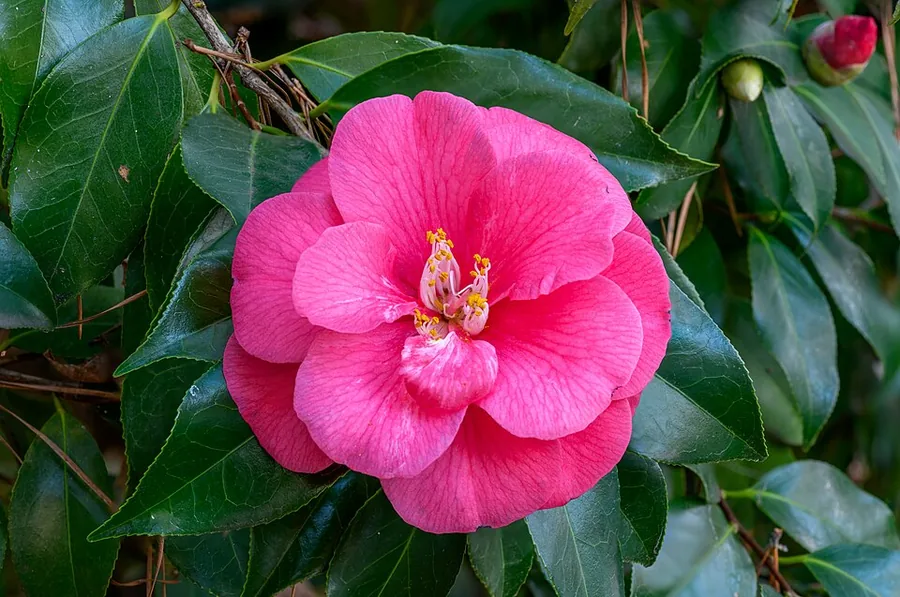
A camellia throws color into the garden at the year's quiet end, right when most shrubs have clocked out. The common or Japanese camellia opens from late winter into spring, while its sasanqua cousin lights up fall and early winter, so the two of them carry the cold months between them. Back the blooms with thick, glossy evergreen leaves and the plant earns its keep all year round.
Plant a slow, long-lived woody shrub like this and you lock in a permanent star for the garden. It climbs to roughly 6 to 13 feet (1.8 to 4 m) tall over many years, taking its sweet time, so you set it once and watch it grow for the long haul. Hardy across zones 7 to 9, it runs on acidic, well-drained soil and a sheltered spot clear of harsh sun and drying winter wind.
Nail the setting and a camellia practically runs itself. Dial in acidic soil, dappled light, and steady moisture, and the plant rewards you for years with hardly any fuss. Stick it in alkaline ground or roast it in afternoon sun, though, and it answers with yellowing leaves and dropped buds instead of flowers.
Care
The short version: give it partial shade out of hot afternoon sun, acidic and well-drained soil rich in organic matter, and steady moisture through summer, then a light acid-forming feed in spring and a quick pruning right after the flowers fade.
Light
A camellia hits its stride in partial shade, ducked out of hot afternoon sun. It'll roll with partial sun and even full shade, but park it where morning light meets afternoon cover for the best flowers and scorch-free leaves.
Water
Keep the soil evenly moist but well drained, soaking it roughly every 5 to 10 days and stepping it up in summer heat. Let it dry out while buds are setting and those buds drop on you. Skip overhead watering too, since wet flowers roll out the welcome mat for petal blight.
Soil
Plant it in acidic, well-drained ground loaded with organic matter, ideally a pH of 5.5 to 6.5. Alkaline soil locks up the iron and yellows the leaves with green veins, so a camellia in the wrong dirt never really takes off.
Temperature
This shrub shrugs off a wide range, from about 5°F to 95°F (-15°C to 35°C), right across zones 7 to 9. Sharp swings or a hard freeze while buds form can still rob you of flowers, so a sheltered site earns its keep.
Humidity
Plain outdoor humidity suits a camellia fine, so there's no number to hit. Air movement does the heavy lifting, because still, damp air is exactly what cracks the door for petal blight and leaf gall.
Feeding
Feed it lightly in spring with an acid-forming azalea or camellia fertilizer. Go easy, though, because piling it on scorches the leaf edges and shoves the foliage right off the plant.
Pruning
Prune it right after flowering, and save any hard cutting for the window from mid-February through May 1. Yank dead or weak stems the second you spot them, and clear infected and fallen blooms to keep petal blight from gaining ground.
Repotting
Since a camellia grows slowly and lives long, a potted one only wants repotting every 2 to 3 years or once it's clearly rootbound. Move it into an acidic, well-drained mix, and let roots circling the pot or water blasting straight through call the shot.
Size & spacing
A mature shrub shoots up to 6 to 13 feet (1.8 to 4 m) tall and spreads 5 to 10 feet (1.5 to 3 m) wide over time. Hand it that room from day one so air rips through the branches and disease loses its grip.
When to plant
A camellia is a slow-growing evergreen you plant once and ride out for decades. Set it in spring or fall into a sheltered, partly shaded spot, and look forward to japonicas flowering from late winter into spring and sasanquas from fall into early winter.
Northern hemisphere
Southern hemisphere
Typical months for a temperate climate: start earlier in warm zones, later where spring frosts linger.
- Plant: Spring or fall in a sheltered, partially shaded site protected from hot afternoon sun and cold drying winter wind.
- Harvest: Camellia japonica blooms late winter to spring (about February-April); Camellia sasanqua blooms fall to early winter.
Hardiness
USDA hardiness zones: 7–9
Temperature: down to -18°C
Troubleshooting
Most camellia troubles strike the flowers and leaves, and the fungal kinds spread through fallen debris, so stay sharp. Match what you spot below, then clear the ground under the plant before it snowballs. A fast cleanup pulls as much weight as any spray.
Flowers browning center-first with dark veins
Catch browning that spreads from the flower's center while the veins darken into a netted pattern and you've found petal blight, a fungus on the move. Cold damage plays a similar trick, but it bites at the petal edges, so zero in on where the browning starts. Get ahead of it by picking off and destroying every infected and fallen bloom, since the spores hold in the soil for years and ride the wind a long way.
Fix:
- Hand-remove and destroy infected blooms and fallen blossoms promptly
- Rake up and remove fallen petals and debris under the plant
- Replace surface mulch with fresh pathogen-free organic mulch
- Apply a labeled fungicide during bloom as supplementary control
Yellow-flecked tops, scale-crusted undersides
Flip a yellow-spotted leaf and meet tea scale, a sap-feeding insect that crusts the underside with brown and white flecks while the top fades to yellow. Let it run and it saps the blooms and sheds leaves across several generations, so jump on it. Hit those undersides hard with horticultural oil, and bring in a systemic insecticide when an infestation really digs in.
Fix:
- Apply horticultural oil to thoroughly coat leaf undersides, repeating as needed
- Use insecticidal soap during crawler emergence
- Apply a systemic soil insecticide such as dinotefuran in early spring or fall for heavy infestations
- Prune out and destroy heavily infested branches
Buds bailing before they crack open
Buds that swell and then bail before they open usually trace back to uneven moisture, most often a plant that ran dry through summer while it was setting those buds. Temperature swings, freezes, poor drainage, and a nutrient shortfall can pile on too. Keep the water steady through the heat, plant where afternoon shade takes the sting off, and grab cultivars that bloom right in time with your local frost.
Fix:
- Provide consistent soil moisture, especially during summer bud development
- Improve drainage and relocate plants from extreme exposures
- Correct nutrient imbalances based on a soil test
- Choose cultivars suited to the local frost timing
Black sooty grime blanketing the foliage
That black film is sooty mold, and here's the upside: it grabs onto the sticky honeydew that scale and aphids leave, never the plant itself. Swipe a leaf and it lifts right off, doing no real damage underneath. Knock out the insects pumping out the honeydew and the mold runs clean out of fuel.
Fix:
- Control the underlying scale or aphid population producing honeydew
- Wash foliage to remove mold once the insect source is controlled
Fat, fleshy spring shoots paling and browning
Spring growth that bursts in thick, fleshy, and weirdly pale is leaf gall, a fungus that goes after the sasanqua types. Flip the puffy leaves and a whitish dusting of spores shows up before the galls firm and brown. Pop them off and destroy them before that spore layer forms, and you've stopped it cold.
Fix:
- Remove and destroy young galls before they produce spores
- Apply a labeled fungicide from budbreak through June at 7-14 day intervals for partial protection
Toxicity
Pet owners can breathe easy: the ornamental camellia is safe. The ASPCA lists the common camellia as non-toxic to cats, dogs, and horses, and it carries nothing that would poison other animals or people. Like any garden plant it isn't meant to be eaten in bulk, but a stray nibble won't faze a thing.
Safe for
People · Cats · Dogs · Horses · Rabbits · Livestock · Birds
Cats None
Grow it freely with a curious cat around, since the ASPCA marks the common camellia non-toxic and a nibble won't poison one. A cat that really tucks into any leaf might land a passing stomach upset, and that's the worst of it.
Dogs None
A dog can romp right past the shrub and even chomp the foliage with zero poisoning risk. The most a big helping kicks up is some mild, short-lived tummy trouble.
Horses None
It's non-toxic to horses, so a grazed leaf is nothing to sweat. No special handling enters the picture around a paddock.
Rabbits None
Nothing in a camellia turns it into a hazard for rabbits. Rich foliage in bulk can still loosen any small animal's gut, so keep it to a nibble and not a feast.
Livestock None
Cattle, goats, and sheep run no known poisoning risk from camellia. Like any ornamental it isn't built for grazing, so it stays out of their feed.
Birds None
Backyard and pet birds can share space with a flowering camellia without a hitch. The plant packs nothing that would harm them through a peck at a leaf or petal.
People None
It's grown for the flowers, not the table, yet it poses no poisoning danger to people. No need to fence kids off beyond the usual rule against chewing on garden plants.
No special toxicity handling is needed; as with any plant, discourage pets and children from chewing ornamental foliage to avoid mild stomach upset.
Varieties
Camellias split first into two species with different bloom seasons, then branch into named cultivars picked for flower form and color. Get to know these standouts.
Camellia japonica
The common or Japanese camellia takes its time growing, flashes large glossy leaves and showy late-winter to spring blooms, and thrives once you shelter it from hot afternoon sun.
Camellia sasanqua
This one races ahead with smaller leaves and flowers, blooms from fall into early winter, and soaks up more sun than the japonica.
Kramer's Supreme
A japonica cultivar that fires off large, fragrant, red peony-form blooms.
White by the Gate
A japonica cultivar that wins fans with its formal double white flowers.
How to propagate
There's more than one way to multiply a camellia, though every method takes its time, so pack some patience. Pick yours based on whether you want an exact copy of a cultivar or you're chasing rootstock or breeding.
Stem cuttingsModerate
Take semi-hardwood cuttings of current-season growth in summer. · Several weeks to a few months to root; slow to establish overall.
Snip semi-hardwood cuttings from this season's growth in summer and plug them into a well-drained acidic medium, dusting the base with rooting hormone to boost your strike rate. Roots break anywhere from several weeks to a few months out, and the plant keeps settling in slowly even after they do.
LayeringEasy
Spring through summer. · Several months to over a year for a layered branch to root.
The easiest win is to wound a low branch, pin it into acidic soil, and let it root while it feeds off the parent. Run it any time from spring through summer, and expect several months to over a year before that branch puts down roots.
Air layeringModerate
Spring to summer on healthy stems. · Several months for roots to form before severing.
Air-layering tackles the bigger stems you can't wrangle to the ground, rooting them right where they stand while they ride along with the parent. Pick healthy stems in spring or summer and give it several months to root before you cut the new plant loose.
GraftingDemanding
Late winter to early spring. · Several months to establish a successful graft union.
Grafting is the challenge pick, fusing a choice cultivar onto vigorous rootstock. Tackle it in late winter to early spring and give the graft union several months to knit together.
SeedModerate
Sow fresh seed in fall after harvest. · Slow; seedlings do not come true to the parent cultivar.
Sow fresh seed in fall the moment it ripens, but know that seedlings won't match the parent cultivar. It's a slow ride that's really aimed at breeding or rootstock work rather than copying a named variety.
Myths
The flowering garden camellia doubles as the tea plant.
Not so, since tea springs from a separate species, Camellia sinensis. The shrubs lighting up gardens are Camellia japonica and Camellia sasanqua, grown for their flowers rather than leaves to steep.
Camellias will poison cats and dogs.
Great news for pet owners: the ASPCA marks the common camellia (Camellia japonica) as non-toxic to cats, dogs, and horses. A pet that chews a leaf won't be poisoned, though a big mouthful of any foliage can spark a brief stomach upset.