Shrub · Theaceae
Tea
Camellia sinensis
Give it acidic soil, dappled shade, and steady moisture, and this evergreen shrub keeps pushing out the leaves behind every cup of tea.
Partial shade
Every 5–10 days
USDA 7–9
3–7 ft · 0.9–2 m
Overview
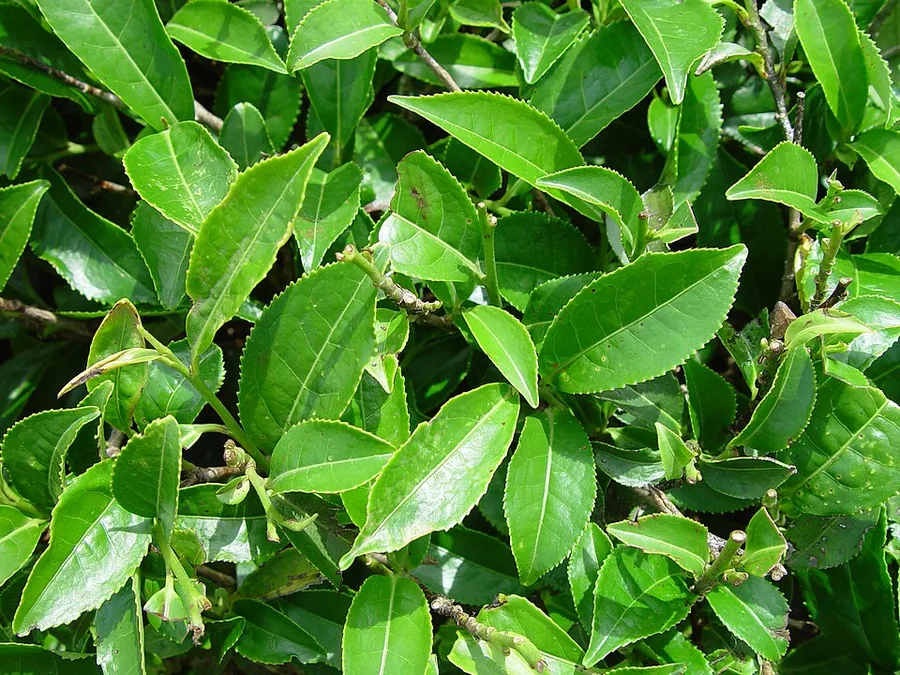
Here is the thrill of it: every cup of tea starts with one evergreen shrub, Camellia sinensis, the powerhouse behind green, black, and oolong alike. It runs in the same family as the garden camellia and craves the same things, above all acidic soil and dappled shade. Let it loose and it climbs past head height, but clip it into a low, leafy hedge and it turns into a productive little machine.
Patience pays off with this one. Fresh growth breaks as flushes of a bud and the top two leaves, and those tender tips are the prize you pick for tea. Then fall delivers a treat you did not plant it for: fragrant white flowers crowning a shrub grown for its leaves.
Do not write it off as a tropical softie. The China type takes light frost once it digs in and powers along outdoors through USDA zones 7 to 9, and where winters bite you can grow it in a pot and haul it inside. Dial in the acidic soil and sharp drainage, and from there it just keeps going.
Care
The short version: plant it in part shade and acidic, well-drained soil, keep it evenly moist, hit it with a seasonal acid feed, and prune in late winter to keep those pickable tips coming.
Light
Tea thrives in part shade, the dappled light beneath taller trees. Push it into more sun in cooler climates, and even full sun where the roots stay moist, but a hot afternoon blast will scorch the leaves, so give it a break from harsh glare.
Water
Keep the root zone evenly moist but never waterlogged, watering roughly every 5 to 10 days and stepping it up in a dry spell or while the plant is flushing new leaves. Lay down mulch to lock that moisture in. Steer well clear of soggy ground, the fast lane to root rot.
Soil
This one is a committed acid lover, at its best in well-drained, organic-rich loam at a pH of 4.5 to 6.5. Load in the organic matter and skip any spot where water pools.
Temperature
Once established, tea powers through a wide range, roughly 5°F to 86°F (-15°C to 30°C). The China type shrugs off light frost, but a hard freeze nips tender new growth, so shelter young plants or pull pots under cover in the coldest snaps.
Humidity
Average humidity of 40% to 60% keeps it happy, right in line with most temperate gardens. Outdoors there is nothing to track, but a plant kept inside really perks up with a little extra moisture in the air.
Feeding
Feed seasonally from spring through summer while it is growing hard, reaching for an acidic azalea or camellia fertilizer. That holds the soil in the acidic range the roots demand and fuels the leaf flushes you are picking.
Pruning
Prune in late winter to early spring to hold it at a workable hedge of around 90 to 120 cm. Better yet, tipping the young flushes all season shapes the shrub and hands you the exact leaves that become tea, a proper two-for-one.
Repotting
Bump a container plant up every 2 to 3 years, or sooner the moment roots circle the pot, burst from the drainage holes, or send water straight through. When growth stalls, that is your green light to move it into fresh acidic mix and a bigger pot.
Size & spacing
Run as a hedge it hits 3 to 6.5 feet (90 to 200 cm) tall and nearly as wide, spreading 3 to 5 feet (90 to 150 cm). Hand each plant that space so air keeps moving and pruning stays quick.
When to plant
Tea grows on a slow, steady clock, and half the fun is watching the season unfold. Fire up seed or cuttings in late winter, move young plants outdoors in spring once frost lifts, and start picking the young leaf flushes from spring through summer. The white flowers roll in come fall.
Northern hemisphere
Southern hemisphere
Typical months for a temperate climate: start earlier in warm zones, later where spring frosts linger.
- Sow: late winter in a warm propagator
- Plant: spring after the last frost
- Harvest: Fragrant white flowers in fall; harvest young leaf flushes (bud and top two leaves) from spring through summer.
Hardiness
USDA hardiness zones: 7–9
Temperature: down to -18°C
Troubleshooting
Tea is a rewarding grow, and the few snags it throws almost always come from soil that has slipped out of the acidic range or ground that stays too wet, with scale insects trailing far behind. Read the leaves and roots and you will catch every one early. Spot your symptom below and jump on it before it spreads.
Wilting and dieback in ground that stays soaked
Root rot moves in when the soil never drains and the roots sit in water, and the plant tends to sag harder after every heavy rain. Dig down and check for dark, mushy roots to be sure. There is no rescuing one that is far gone, so pull it, fix the drainage, and replant where the water actually moves through.
Fix:
- Improve drainage and stop overwatering
- Remove and discard severely affected plants
- Replant in raised or amended well-drained beds
Leaves going yellow with the veins still green
That is interveinal chlorosis, a flag that the soil has swung too alkaline for the plant to grab iron and manganese. Drive the pH back down with elemental sulfur or an acidifying feed, then pile on pine bark or pine needle mulch to keep it there. A shot of chelated iron greens up the new growth in a hurry while the soil catches up.
Fix:
- Lower soil pH with elemental sulfur or an acidifying fertilizer
- Apply chelated iron for quick correction
- Mulch with pine bark or pine needles
Sticky leaves, black film, and tiny bumps underneath
Tea scale and its kin clamp onto the leaf undersides and pump out honeydew, which then blackens into sooty mold. Flip the leaves and scan for small white or brown bumps near the stem. Blast them with horticultural oil at the label rate, cut out the worst branches, and turn loose the natural predators to finish up.
Fix:
- Treat with horticultural oil following label rates
- Prune out heavily infested branches
- Encourage natural predators
Toxicity
The leaves are safe for people and the whole payoff of growing it, but they pack the same caffeine and theobromine that give the cup its kick. That kick hits animals hard, so keep cats, dogs, horses, and other pets clear of the foliage. Guard brewed tea, dried leaves, and used grounds even more closely, since they are far more concentrated.
Toxic to
Cats · Dogs · Horses · Rabbits · Livestock · Birds
Safe for
People
Cats Caution
The leaves carry the same caffeine and theobromine as the cup, and cats feel both fast. A quick nibble may pass, but more can trigger vomiting, restlessness, a racing heart, and tremors, so keep curious cats off the plant.
Dogs Caution
A dog that chews the foliage loads up on caffeine and theobromine, the same stimulants that make chocolate risky. After a bigger mouthful, watch for vomiting, hyperactivity, a fast heartbeat, and shaking.
Horses Caution
Horses handle caffeine poorly, so keep them clear of the hedge. A graze on the leaves can leave one jittery, with a quickened pulse and muscle tremors.
Rabbits Caution
The methylxanthines that hit cats and dogs hit rabbits just as hard, and a small animal needs barely any to feel it. Keep the plant out of reach and skip the racing heart and the jitters.
Livestock Caution
Cattle, goats, and sheep have no business browsing tea foliage, since the caffeine can upset the gut and send the heart racing. Fence the shrubs off from grazers.
Birds Caution
Birds react sharply to caffeine, and even a little leaf can overstimulate a small body. Keep pet birds well away from the plant and any tea left lying around.
People Leaves safe
For people this is the star behind the daily cup, its leaves picked, processed, and brewed with zero fuss. Here the caffeine is the whole point, not a hazard.
Keep brewed tea, dried tea leaves, and used grounds well out of reach of pets, as these are the most concentrated and dangerous forms.
Helpline numbers

United States
ASPCA Animal Poison Control: (888) 426-4435 (fee applies)

United Kingdom
Animal PoisonLine: 01202 509000 (fee applies)

Australia
Animal Poisons Helpline: 1300 869 738
Varieties
Nearly all tea springs from two varieties of this single species, plus a few selections bred to shrug off the cold. These are the ones worth chasing down.
var. sinensis
The tough China type carries smaller leaves, handles cooler climates with ease, and delivers both green and black teas.
var. assamica
The big-leaved Assam type hails from warm, tropical country and drives mostly into black tea.
'Sochi'
'Sochi' is a cold-hardy Russian selection, the go-to pick for growing tea in a temperate garden.
Companions
Tea grows best among the other acid-loving shrubs that want the same soil and the same dappled light.
Plant near
Azalea: Shares the same acidic, well-drained soil and part-shade preferences.
Camellia japonica: Same Theaceae cultural needs for acidic soil and dappled shade.
Rhododendron: Acid-loving understory shrub with matching light and moisture requirements.
How to propagate
Ready for more plants? Tea grows from cuttings or seed, and while neither races to the finish, both get you there. Each takes a few years to reach a harvestable size, and cuttings hand you the more predictable plant.
Stem cuttingsModerate
Late summer from semi-hardwood growth · Several months to root, then 2-3 years to harvestable size
Cuttings are the reliable powerhouse route. Snip semi-hardwood pieces in late summer, dip them in rooting hormone, and hold them in a warm, humid medium. They root over several months, then the young plant needs 2 to 3 years to hit a size you can pick from.
SeedModerate
Sow fresh seed in late winter to spring · Germinates in weeks; plants take about 3 years before leaf harvest
Seed works too, though it keeps you guessing. Soak fresh seed and sow it from late winter into spring, and it bursts up within weeks. Seedlings vary from one to the next, so most growers lean on cuttings for uniform clones, and either way you wait about 3 years before that first leaf harvest.
Myths
Green tea and black tea come from different plants.
Both burst from the very same shrub, Camellia sinensis. The whole difference is the processing, with black tea oxidized fully and green tea barely oxidized at all.
The tea plant is strictly tropical and cannot survive frost.
Not a chance. Tea is an evergreen shrub hardy to about USDA zone 7 that shrugs off light frost once it settles in. The Assam type wants warmth, sure, but the China type and picks like 'Sochi' take off in a temperate garden.