Tree · Sapindaceae
Golden Rain Tree
Koelreuteria paniculata
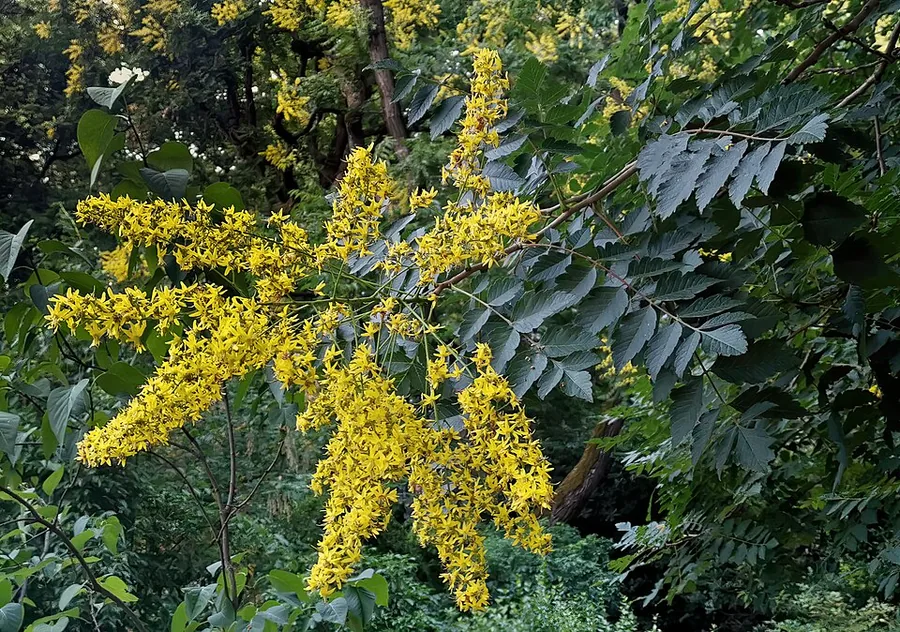
A rugged shade tree, firing up midsummer with papery lantern pods and vivid yellow flowers.
Full sun
Every 7–14 days
USDA 5–9
30–40 ft · 9.1–12.2 m
Overview
The golden rain tree really turns it on in summer, when the whole crown erupts in loose sprays of small yellow flowers. As the blooms fade, they hand off to papery seed pods shaped like little Chinese lanterns that dangle on into fall, so the display keeps going. It is a deciduous shade tree in the soapberry family, wearing divided leaves on a rounded, spreading head.
What really wins gardeners over is how little it demands while giving back so much. It powers through drought once its roots dig in, takes clay, sand, or thin rocky ground without blinking, and stares down cold to -20°F (-29°C). Hand it full sun and drainage that works, and it practically grows itself.
One habit is worth knowing before the shovel comes out. The tree flings seed in huge numbers and sows itself with real gusto, enough that it has gone weedy and invasive across parts of the eastern and southeastern US. Where that raises a flag, rake up the pods or pick a spot where stray seedlings pull out in a snap.
Care
The short version: full sun, well-drained soil of nearly any kind, and a deep drink through long dry spells while the tree is young. Past the first year or two it runs itself, and a light prune in late winter keeps the frame strong.
Light
Plant it in full sun to fire up the heaviest flowering, though it will take part sun without much grumbling. The more direct light it soaks up, the fuller that summer bloom comes in.
Water
Water a young tree regularly through its first year or two while the roots drive down. After that it turns drought tolerant and only wants a drink during long dry spells, so let the top half of the soil dry between waterings.
Soil
Few trees roll with the soil like this one does. It grows in clay, loam, sand, and even shallow rocky ground, asks only for decent drainage, and takes a wide pH from 6.0 to 8.0 in stride.
Temperature
This is a cold-hardy powerhouse, cruising anywhere from -20°F to 100°F (-29°C to 38°C). That massive range unlocks a ton of climates, part of why it has spread so far.
Humidity
Plain outdoor air does the job, so there is no humidity number to chase. Good drainage carries far more weight than anything going on in the air.
Feeding
It hardly ever wants feeding. If growth drags, a single hit of balanced slow-release tree fertilizer in spring does plenty, since this tough tree is no big eater.
Pruning
Prune in late winter while the tree is dormant to build one strong central leader and clear out crossing, weak, or dead branches. The wood runs a bit brittle, so a solid frame set early pays off big down the line.
Repotting
A landscape tree stays put in the ground, so repotting barely enters the picture. In a container, bump it up only when roots circle the pot, water rushes straight through, or top growth stalls.
Size & spacing
Give it room to stretch out. A mature golden rain tree shoots up to roughly 30 to 40 feet (9 to 12 m) tall and spreads about as wide, so plant it well clear of buildings and overhead lines.
When to plant
Play this one for the long haul instead of sweating a tight planting window. Drop it in the ground in spring after the last frost or in fall, wait for the yellow flowers to fire up in early to midsummer, and let the lantern pods roll in behind them and drive the show toward autumn.
Northern hemisphere
Southern hemisphere
Typical months for a temperate climate: start earlier in warm zones, later where spring frosts linger.
- Sow: Late winter, after seed scarification and cold-moist stratification
- Plant: Spring after last frost, or fall
- Harvest: Summer (June to July; cultivar 'September' blooms August to September)
Hardiness
USDA hardiness zones: 5–9
Temperature: down to -29°C
Troubleshooting
A thriving golden rain tree hands you next to nothing to fix. What does pop up is usually a wilt disease in the wood or a harmless bug swarm on the seed pods. Match what you spot below and jump in while the tree still has plenty of vigor.
One-sided wilt with dark stripes running through the wood
When one side wilts and the wood shows dark streaks, put your money on verticillium wilt, a soilborne fungus that unfortunately has no cure. Canker or coral spot fungi jump on wood that is already stressed or wounded, and soggy ground can kick off root rot too. Get ahead of it: prune well below the damage, wipe your tools clean between cuts, and fix the drainage so the tree keeps its punch.
Fix:
- Prune out and destroy affected branches well below symptoms, disinfecting tools between cuts
- Improve drainage and avoid drought and mechanical wounding to reduce stress
- Remove severely declining trees, as there is no cure for verticillium wilt
Red-and-black bugs piling onto the seed pods
Those red-and-black crowds piling onto the papery pods are the goldenrain tree bug, a boxelder relative that goes after the seeds. Good news: they read as a nuisance, not a real threat, so let them party or blast them off with a strong jet of water or insecticidal soap. Rake up the fallen pods to cut off the seed buffet that pulls them in, and knock back any twig scale with a horticultural oil.
Fix:
- Tolerate the bugs where possible, as they are a nuisance rather than a serious threat to tree health
- Knock bugs off or spray congregations with a strong stream of water or insecticidal soap
- Treat heavy scale infestations with horticultural oil
Toxicity
Great news for homes with pets and kids: this tree is not poisonous. The name sounds fierce, but golden rain tree carries no toxin and stays off the ASPCA toxic-plant lists. Just do not mix it up with the genuinely poisonous golden chain tree, Laburnum, which is a totally different plant.
Safe for
People · Cats · Dogs · Horses · Rabbits · Livestock · Birds
Cats Safe
Let a curious cat prowl and nibble to its heart's content, because this tree packs no toxin that affects them. A cat that goes overboard on greenery might cough up a hairball or a scrap of leaf, and that is standard cat behavior, not poisoning.
Dogs Safe
Dogs can roam right up to this tree with nothing toxic to worry about. A pup that gnaws a fallen pod may run a little loose from the roughage, so keep water topped up and you are done.
Horses Safe
Horses can graze around a golden rain tree without a hitch, since it carries no toxin that touches them. This is the harmless cousin of the dangerous golden chain tree, so the fear that trails Laburnum just does not follow it here.
Rabbits Safe
Rabbits face zero poisoning risk from the leaves. As with any fresh green, roll it out in small amounts first so a sensitive gut can catch up.
Livestock Safe
Cattle, goats, and sheep can share a pasture with this tree in complete safety, because it is not toxic to grazers. Pile on too much of any one plant and a stomach may grumble, but that is overeating talking, not poison.
Birds Safe
Birds get nothing toxic from the foliage or seeds, and plenty of them breeze right past the papery pods anyway. Backyard poultry can scratch around beneath the canopy without a care.
People Safe
This tree is not poisonous to people, and honestly the common name kicks up way more drama than the plant ever does. Still, the seeds earn their keep as a show, not a snack, so leave them off the plate.
No special handling required; as with any plant, discourage pets and children from chewing on foliage or seed pods to avoid mild stomach upset.
Varieties
Only a handful of selections turn up in the trade, plus one close relative that often rides along beside the species. Here are the ones worth learning to spot.
'September'
This cultivar keeps its yellow flowers waiting until August and September, pushing the show weeks past the usual summer bloom, though it swaps away a touch of winter hardiness in the trade.
Koelreuteria bipinnata (Chinese flame tree)
A close relative sporting twice-divided leaves and eye-catching rosy-pink lantern pods, it runs more tender and thrives in warmer zones than the golden rain tree does.
How to propagate
Chances are your first golden rain tree shows up as a self-sown seedling, since this tree multiplies with zero help. Want to crank out more on purpose? Start from seed or take root cuttings.
SeedModerate
Sow in fall outdoors, or stratify and sow in late winter to early spring · Seedlings appear in weeks; several years to a sizable tree
Here is the fun part: the tree pumps out seed by the bucketful and self-sows so freely that you rarely have to lift a finger to start it. To grow one on purpose, nick the hard seed coat, run the seed through a cold, moist stratification, and sow outdoors in fall or in late winter to early spring. Seedlings shoot up within weeks, but bank on several years before you land a tree of any real size.
Stem cuttingsModerate
Dormant season for root cuttings · One to two growing seasons
Root cuttings taken in the dormant season are the go-to way to clone this tree, and named cultivars ride this route rather than seed so they come true. Hand a rooted cutting one to two growing seasons to dig in before you chase much top growth.
Myths
Golden rain tree turns out to be the toxic golden chain tree and a hazard to pets.
Do not let the rhyming names throw you. Golden rain tree lands in the soapberry family and stays clear of the ASPCA toxic-plant lists, while the truly poisonous golden chain tree is Laburnum, an unrelated legume. Lock in the botanical name, Koelreuteria paniculata, and you can plant this one and never look back.