Tree · Sapindaceae
Sugar Maple
Acer saccharum
Hand it deep, moist soil and elbow room, and the sugar maple rewards you with cooling shade and a fall canopy that catches fire.
Full sun
Every 7–14 days
USDA 3–8
39–79 ft · 12–24 m
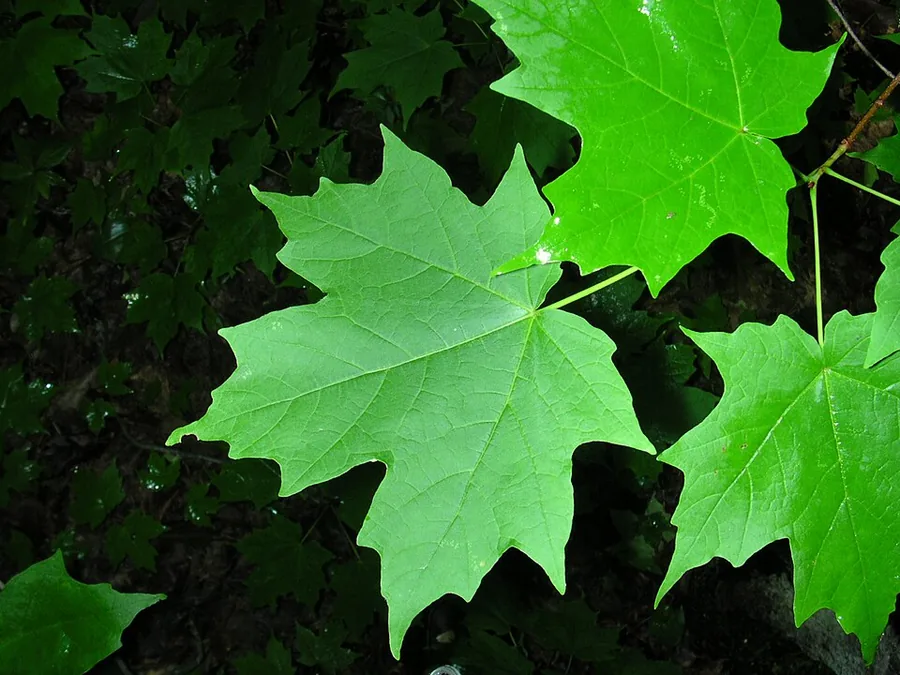
Overview
The sugar maple is the tree lighting up every New England October and the source of the syrup on the table. It climbs slowly into a broad, rounded shade tree that can push past 80 feet (24 m), hauling a burly trunk under a packed canopy that keeps the yard cool all summer long. Then autumn hits and the leaves erupt in orange, red, and gold, the very fireworks most people plant one to chase.
This tree lives for cold country. It thrives across zones 3 through 8 and laughs off winters plunging to -40°F (-40°C), but it has zero tolerance for the heat, salt, and packed-down dirt of a cramped city lot. Hand it deep, fertile, evenly moist ground with real room for the roots to travel, and it digs in for generations.
Patience buys your ticket. Sugar maple grows slowly and lives long, so you plant it for the decades stacking up ahead, not for a quick payoff next season. Come late winter its sap turns sweet, which is why sugarhouses all across the north tap it every spring and boil it down into maple syrup.
Care
The short version: set it in full sun to part shade, in deep, fertile, evenly moist but well-drained soil, pour on about an inch of water a week when heat or drought bites, and keep it well back from pavement and road salt.
Light
Sugar maple charges ahead in full sun and takes partial shade in stride, especially while young. Pour on more sun and you fuel richer fall color and a denser crown, though even a half-day of light still raises a healthy tree.
Water
Keep the soil deep and evenly moist, watering somewhere around every 7 to 14 days whenever the rain falls short. When real heat or drought clamps down, hit an established tree with about an inch of water a week to stay ahead of the leaf scorch this species is prone to.
Soil
Plant it in deep, fertile loam that grips moisture yet drains fast and runs loaded with organic matter. A pH from 5.5 to 7.0, slightly acidic to neutral, is right in its wheelhouse, and it flatly rejects compacted, waterlogged ground.
Temperature
This is a genuinely cold-hardy tree, right at home from -40°F to 95°F (-40°C to 35°C). It hits its stride up north and wrestles with places where summers drag on long and hot.
Humidity
Plain outdoor air covers everything it wants, so there is no humidity number to chase. Airflow and steady soil moisture do far more for its health than anything floating in the air.
Feeding
Feed in early spring with a balanced slow-release tree fertilizer, and let a soil test call the dose it truly needs. A ring of mulch spread around the drip line drip-feeds the roots as it breaks down.
Pruning
Cut only in summer or full dormancy to strip out dead, damaged, or crossing limbs, because a maple pruned in late winter or early spring bleeds sap hard. Swab your tools between cuts with 10 percent bleach or 70 percent alcohol so no disease hitches a ride from branch to branch.
Repotting
Sugar maple is a landscape tree, not a pot dweller, so repotting rarely enters the picture. Keep tabs on nursery or potted stock for roots circling the trunk flare or a top that trails a jammed root ball, and work those roots loose before planting.
Size & spacing
Give this tree serious room. It shoots up 40 to 80 feet (12 to 24 m) tall and fans out 30 to 60 feet (9 to 18 m) wide, so plant it well clear of houses, drives, and power lines.
When to plant
Get a sugar maple into the ground in spring or fall, while the weather stays cool and the roots can dig in before any stress rolls in. The greenish-yellow flowers pop in April, right before or alongside the leaves, and the grand finale waits for autumn, when the whole canopy blazes red, orange, and gold.
Northern hemisphere
Southern hemisphere
Typical months for a temperate climate: start earlier in warm zones, later where spring frosts linger.
- Plant: Spring or fall
- Harvest: Inconspicuous greenish-yellow flowers in April before or with the leaves; brilliant red, orange, and yellow fall color
Hardiness
USDA hardiness zones: 3–8
Temperature: down to -40°C
Troubleshooting
Nearly every sugar maple problem flashes a warning on the leaves first, whether the trigger is heat, a soil fungus, or a drenching spring. Get sharp at reading those signals and you can sort a harmless blemish from a genuine threat in a glance. Match what you spot below before you grab a sprayer.
One section collapsing while the rest powers along
Watch for a lone limb or a whole flank browning out while the other side keeps thriving, because that lopsided crash usually means Verticillium wilt, a soil fungus that jams the wood's water pipes from within. Slice a sliver of bark off a fading branch and hunt for green or brown streaks in the sapwood, then ship a sample to a lab, since most maple diseases fool the naked eye. Nothing cures it, so clear out dead wood the moment it shows and keep the tree watered and fed to buy it as many strong years as possible.
Fix:
- There is no cure; prune out dead branches as they appear
- Water about one inch per week and fertilize based on a soil test to prolong tree life
- Mulch around the drip line and sanitize pruning tools with 10 percent bleach or 70 percent alcohol between cuts
Crisped brown edges flaring up in a summer heat wave
Brown patches racing along the leaf edges and filling the strips between the veins during a hot, dry stretch point straight to leaf scorch: the roots simply cannot deliver water fast enough to keep the canopy fed. Salty soil, packed ground, or a squeezed root zone next to pavement crank the problem up. Answer it by soaking an established tree with roughly an inch a week through heat and drought, then piling mulch over the roots to lock in every drop already down there.
Fix:
- Water established trees with about one inch of irrigation per week during heat and drought
- Mulch over the root zone to conserve moisture and moderate soil temperature
- Avoid salt accumulation and soil contaminants around the roots
Gleaming black dots studding the leaves toward summer's end
Those chunky, lacquer-black blotches rimmed in yellow are tar spot, a leaf fungus that startles everyone yet barely dents the tree's health. Gather up and toss the fallen leaves every autumn, because that litter is exactly where the fungus camps out to launch its next round. A copper fungicide at leaf-out can clean up a small specimen, though on most maples the effort just is not worth it.
Fix:
- Rake up and destroy fallen leaves where the fungus overwinters
- If desired on small trees, apply a copper-based fungicide, mancozeb, or triadimefon three times at two-week intervals starting at spring leaf unfurl
Browned foliage and dead buds trailing a soggy spring
Drag out a long, chilly, drenching spring and you invite anthracnose, a fungus that scorches the leaves along their veins, kills off buds, and leaves twisted twig dieback in its wake. Sweep up and destroy the infected leaves so the spores cannot ride into next season. Crank up the airflow and keep the foliage drying fast, and the fungus rarely gets its grip in the first place.
Fix:
- Rake and destroy fallen infected leaves
- On valuable small trees, spray a copper-based fungicide, mancozeb, or chlorothalonil three times at two-week intervals from spring leaf emergence
Toxicity
It is all clear on every side here. Sugar maple is safe for people, pets, and livestock alike, and its boiled-down sap is the exact syrup that lands on your pancakes. That wilted-leaf poisoning spooking horse owners springs from red and silver maple, not from this tree.
Safe for
People · Cats · Dogs · Horses · Rabbits · Livestock · Birds
Cats None
Cats can prowl around it freely. Let a nosy cat gnaw a stray fallen leaf and it walks away untroubled by this tree.
Dogs None
Dogs get a clean pass here. Not a thing in the leaves, bark, or twigs will bother them.
Horses None
Horses stay in the clear with sugar maple. That infamous red-blood-cell poisoning traces to the wilted leaves of red maple and silver maple, never to this species.
Rabbits None
Rabbits can munch the foliage all they like and come to no harm.
Livestock None
Cattle, goats, and sheep can graze right up to a sugar maple with zero fallout.
Birds None
Birds build and feed high in the canopy in perfect safety, and the seeds keep loads of wildlife fed.
People None
People are entirely safe with it. Boil the sap down and out comes maple syrup, so a piece of this tree ends up right on the breakfast plate.
Non-toxic to cats and dogs. Note that it is the related red maple (Acer rubrum) whose wilted leaves are notoriously toxic to horses; sugar maple is not the species classically implicated, but as a general precaution wilted maple leaves of any species are best kept away from horses.
Varieties
Most sugar maples sold for the yard are named cultivars picked for tougher leaves and hotter fall color. These are the standouts worth requesting by name.
Green Mountain
Built to power through heat and drought, it keeps a tight oval crown and flares orange-red the moment fall lands.
Legacy
A hard-charging, scorch-resistant selection whose thick, glossy leaves brush off both tearing and dry spells.
Fall Fiesta
A tough workhorse that establishes fast and delivers dependable yellow-orange to red autumn color on leaves that cling on well past the rest.
How to propagate
You can raise a sugar maple from seed with a stretch of cold treatment, but the named selections only hold true when a grower grafts them.
SeedModerate
Sow outdoors in fall or after 60-90 days of cold, moist stratification before spring sowing · 1 to 2 growing seasons
Sugar maple seed stays stubbornly asleep until a cold spell wakes it, so drop it outdoors in fall or run it through 60 to 90 days of cold, moist stratification ahead of a spring sowing. A young tree digs in and finds its stride across 1 to 2 growing seasons. Feel like branching out? You can also raise the species from layering or from stem cuttings.
GraftingDemanding
Late winter (bench graft) or summer (budding) · 1 to 2 seasons
Named picks like Green Mountain and Legacy refuse to come true from seed, so growers graft or bud them onto seedling rootstock instead. Bench grafting fires off in late winter and budding in summer, with the union fusing over 1 to 2 seasons. It demands a sure, practiced hand, which is exactly why this one lands in the demanding column.
Myths
Every maple, sugar maple among them, is deadly poison to horses.
The real threat rides with red maple and silver maple, whose wilted leaves can tear apart a horse's red blood cells. Sugar maple is not the offender, and rather than poisoning anyone, it is the very tree growers tap for maple syrup.