Houseplant · Apocynaceae
Wax Plant
Hoya carnosa
Give it bright light and a let-it-dry watering habit, and this easy-going wax plant rewards you with clusters of porcelain flowers.
Bright indirect
45–75°F · 7–24°C
USDA 10–12
2–4 ft · 0.6–1.2 m
Overview
The wax plant grabs its name from thick, glossy leaves that feel almost artificial under a fingertip, and it wins over new growers fast. It climbs as an epiphyte across a band of Asia from southern China down to Laos and over to Taiwan and Japan, scaling trees in the wild instead of rooting in the ground. Set it up indoors and it takes off as an easy, long-lived vine that spills from a shelf or scrambles up a small trellis.
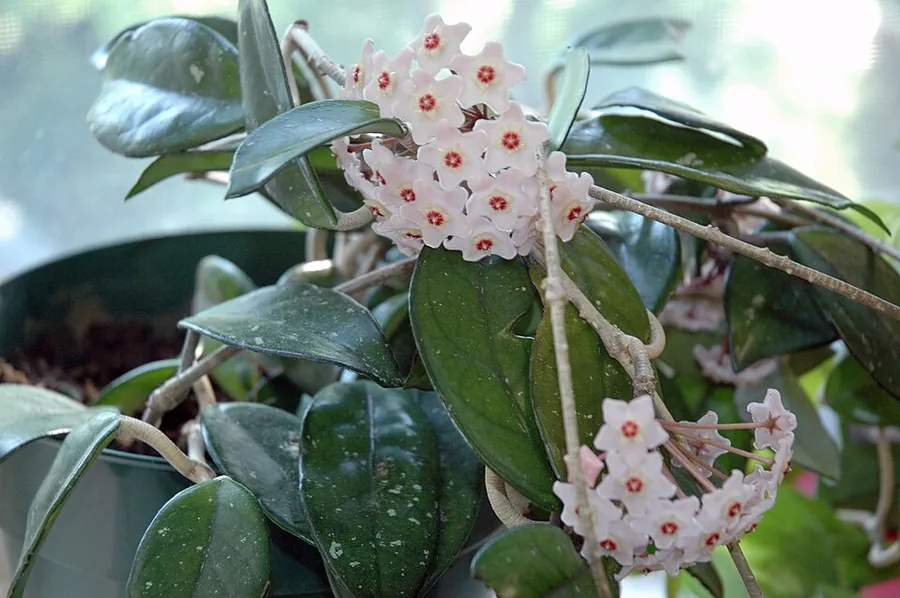
The bloom is the real prize that keeps growers hooked. A mature plant fires out rounded clusters of star-shaped, waxy flowers that look carved from porcelain, often sweetly scented and beaded with a drop of sticky nectar. The one catch is a bit of a wait, since a young plant usually needs 2 to 3 years before it flowers at all.
Nail two habits and this vine practically runs itself: flood it with light, and know exactly when to set the watering can down. Those semi-succulent leaves bank their own water, so the plant powers through a missed drink far better than a soggy pot ever lets it. Dial in light and drainage and the wax plant asks for next to nothing else.
Care
The short version: give it bright indirect light with a little direct morning sun, water only once the top third to half of the mix has dried, and pot it in a loose, fast-draining mix. Keep it warm, add some humidity, and leave those old flower spurs right where they are.
Light
Pour on the bright indirect light, ideally right beside a window where the wax plant grabs a few hours of direct morning sun. It hangs on in partial shade, sure, but low light shuts down blooming and washes out the variegation on the flashy forms.
Water
Water freely through spring and fall, then hold off until the top third to half of the mix dries before the next round. Slam the brakes on watering in winter. Overwatering is the number-one plant killer here, so whenever doubt creeps in, wait.
Soil
Reach for a loose, fast-draining mix loaded with organic matter, something like one part potting soil, one part orchid bark, and one part perlite. The plant shrugs at pH and takes anything from 6.0 to 8.0, yet it flat-out refuses soil that clings to water.
Temperature
Keep it toasty in the 45°F to 75°F (7°C to 24°C) range, and treat the low end as a hard floor, not a target. This tropical wants steady room warmth, so park it away from cold drafts and chilly window glass.
Humidity
The wax plant thrives on high humidity and puts out its best growth in a moist room like a bathroom or kitchen. Dry indoor air won't finish it, but it does roll out the welcome mat for spider mites, so a humidifier or pebble tray really pulls its weight in winter.
Feeding
Feed it through the growing season, spring to fall, with a liquid fertilizer that fuels flowering, roughly a 2:1:2 or 3:1:2 NPK ratio. Liquid beats slow-release granules here, since the plant gets watered too rarely for granules to break down evenly.
Pruning
Trim lightly in early spring to keep the vine tight and shapely. The one rule you cannot bend is to leave the bare flower spurs alone, because the plant reblooms straight off those same old stalks year after year.
Repotting
Repot it rarely, and only when you truly have to. The wax plant blooms harder when it's a little pot-bound, so skip the upgrade and move it on only when roots jam the pot or the mix dries almost as fast as you water it.
Size & spacing
Indoors the vine stretches 2 to 4 feet (61 to 122 cm) long with a spread of 12 to 24 inches (30 to 61 cm). Hand it a trellis to climb or a high shelf to trail from, and leave room around it so air keeps moving.
Troubleshooting
Track almost every wax plant hiccup back to watering or light. Read the leaves and roots before you dive in, since a wrinkled leaf and a soft, rotting one demand opposite moves. Match the symptom below, then get to work.
Yellowing leaves and soft, mushy stems and roots
Tag this as root rot, which almost always springs from soil that stays too wet. A pot that dwarfs the root ball, or a mix that drains at a crawl, leaves the roots stewing until they turn brown and soft. Jump on it fast: stop watering, pop the plant out and trim away every rotted root, then replant into fresh fast-draining mix in a container with a drainage hole.
Fix:
- Stop watering and let the mix dry
- Unpot and trim away soft, rotted roots
- Repot into fresh fast-draining mix in a container with drainage
- Use the pot-weight test before watering again
Plump leaves turning wrinkled and limp
Watch for the firm, waxy leaves puckering and going soft, which shouts that the plant has run dry for too long. Heft the pot, and a feather-light lift confirms the mix has baked bone-dry. Water it thoroughly until liquid pours from the drainage hole, then swing back into that steady let-the-top-dry rhythm right through the growing season.
Fix:
- Water thoroughly until it drains from the bottom
- Resume regular watering on a let-top-dry schedule
- Check that the mix is not hydrophobic and rewetting properly
White tufts, webbing, or bumps on stems and leaves
Zero in on these clues, because they flag the usual indoor pests. Cottony clusters tucked in the leaf joints are mealybugs, fine webbing over tiny specks means spider mites that thrive in dry winter air, and firm, immobile bumps are scale. Hit the mealybugs with an alcohol-soaked cotton swab, follow up with insecticidal soap or neem oil, and quarantine the plant while you repeat the treatments until it bounces back clean.
Fix:
- Dab mealybugs with a cotton swab soaked in isopropyl alcohol
- Treat with insecticidal soap, horticultural soap, or neem oil
- For spider mites, raise humidity and treat undersides thoroughly
- Isolate the plant and repeat treatments until clear
A thriving vine that just won't flower yet
Chase down the light first, because a wax plant that refuses to bloom almost always wants more of it, so slide it right up to a bright window where it can drink in a few hours of direct morning sun. Age counts too, since a young plant needs to hit 2 to 3 years old before it flowers, so a bit of anticipation pays off. Guard those bare peduncles and never snip them, because next year's blooms burst straight out of that same old spur.
Fix:
- Move to a brighter spot with bright indirect light plus a few hours of direct morning sun
- Leave all bare flower spurs/peduncles intact - they rebloom from the same spur
- Be patient; young plants need 2-3 years to reach flowering maturity
- Do not move the pot once flower buds appear
Sticky film on the leaves and surfaces nearby
Celebrate a little, because a wax plant in bloom naturally drips a sweet, nectar-like sap from its flowers, and a quick swipe of a damp cloth clears it right up. The other trigger is honeydew dropped by sap-sucking pests, so scout the leaf joints and undersides for cottony mealybugs. Turn up any bugs and treat the plant, but if the leaves are clean, those sticky drops are just the flowers showing off.
Fix:
- If pests are present, treat for mealybugs (see pest entry)
- If from flowers, simply wipe surfaces - the sticky sap is normal
- Wipe leaves with a damp cloth
Toxicity
Great news for pet lovers: the wax plant lands squarely in the non-toxic camp. The ASPCA and NC State Extension both wave it through for cats, dogs, and horses, and no poisoning shows up for other common household animals. The one thing to keep an eye on is the sticky sap from a cut stem, which can stain but will never poison a soul.
Safe for
People · Cats · Dogs · Horses · Rabbits · Livestock · Birds
Cats None
Grow it around cats with confidence, since the ASPCA and NC State Extension both stamp the wax plant non-toxic to cats, with no poisoning reported. A curious nibble does zero harm, though a big mouthful of any plant might leave a cat with a brief, mild stomach upset.
Dogs None
Dogs share that all-clear, because the same toxicity databases rate the plant non-toxic for them. Nothing here will poison a dog, so a chewed vine calls for a quick check and nothing more.
Horses Safe
NC State Extension marks the wax plant non-toxic to horses, so it poses no poisoning risk out in a barn or paddock.
Rabbits Safe
No toxic compounds turn up in this plant, so a rabbit that grabs a trailing stem stays completely unharmed by it.
Livestock Safe
No poisoning in grazing animals has ever been recorded from the wax plant, which keeps it well off the danger list for livestock.
Birds Safe
Pet birds carry no known toxicity risk from this plant, so a parrot that shreds a leaf comes through just fine.
People Safe
Grow the wax plant around children and adults without a second thought, since nobody grows it to eat. The only thing to watch is the sticky sap from cut stems, which can stain skin and surfaces but poses no real danger.
Although non-toxic, ingestion of any plant material can still cause mild stomach upset; cut or damaged stems and flowers can exude a sticky/milky sap that may stain
Varieties
Past the plain green species, the wax plant shows up in a whole run of variegated and novelty forms that collectors love to chase. Here are the ones you will spot most often.
'Variegata' (incl. f. variegata)
Kew backs this accepted variegated form, its leaves rimmed in creamy white that sometimes flushes a lively pink.
'Tricolor' / 'Krimson Queen'
It flaunts green leaf centers wrapped in creamy-white to pink margins.
'Krimson Princess'
It flips the whole scheme, driving pink and white variegation into the center of green leaves ringed by darker outer margins.
'Compacta' / 'Krinkle Kurl' (Hindu Rope plant)
Sold as the Hindu Rope plant, it coils its crowded leaves into curled, folded, rope-like trailing stems.
How to propagate
Barely any houseplant multiplies as readily as the wax plant, and one vine can spin off several new plants with almost no effort.
Stem cuttingsEasy
Spring to summer · Roots in a few weeks
Grab a tip or stem cutting that packs a node and at least one leaf, then stand it in water or moist mix any time from spring through summer. It roots eagerly within a few weeks and hands you a fresh plant identical to the parent, ready to grow on.
LayeringEasy
Spring to summer · Several weeks
The long vines practically beg to be layered. Pin a node onto moist medium in spring or summer, and it drives out roots in several weeks while it stays fed by the parent plant.
Myths
Cut off the bare flower stalks once the blooms fade.
Hold on, because those bare stalks, the spurs or peduncles, are exactly where the next flowers launch from. Leave them in place and the plant reblooms on the same spur year after year, while cutting them away throws your future flowers straight in the bin.
A waxy semi-succulent like this barely needs watering.
True, the thick leaves stockpile water and the plant must never sit soggy, but it still craves a regular drink through spring and fall. Let only the top third to half of the mix dry between waterings, because a long drought shrivels the leaves and drops them.