Vegetable · Brassicaceae
Turnip
Brassica rapa subsp. rapa
Sow it cool, water it even, and pull it young, and the turnip rewards you with roots and greens in one short, satisfying season.
Full sun
Every 3–7 days
41–77°F · 5–25°C
40–60 days
Overview
Turnips are a cool-season root in the brassica family, running with the same crew as cabbage and mustard. Growers have chased both the swollen root and the leafy tops for a very long time, and the plant keeps earning that attention by growing fast and asking for little. Sow in spring or late summer and you are cutting greens in about a month, with roots hot on their heels.
The turnip is a biennial on paper, banking energy in the root one year and flowering the next, but you will rarely watch that play out. Growers run it as a quick annual and harvest long before it thinks about blooming. The roots hit their sweetest, most tender stride when they size up in cool weather, so the heat of midsummer is the one stretch to plan around. Aim the sowings at the cool shoulders of the season and let the plant tear ahead.
Almost all of the payoff rides on timing and a bit of thinning, and neither slows you down. Give turnips loose, even ground and steady water, and the roots power up crisp and mild. Let them dry out and then drown, or leave them baking in warm soil too long, and you trade that snap for woody, sharp-flavored roots, which is the one slip worth guarding against.
Care
The short version: hand turnips full sun and loose, rock-free soil, plus about an inch of water a week to keep the moisture even. Sow direct in cool weather, thin the seedlings to open up room for the roots, and pull them young, before heat or a hard frost, for the best haul.
Light
Turnips crank out their best in full sun, though they will take a little partial shade in stride. The greens stay leafy even in some shade, while the roots bulk up faster and fuller under a long, steady run of direct light.
Water
Give about 1 inch (2.5 cm) of water a week and keep it even, the single best move for the roots. That steady moisture keeps them tender and mild, while a swing from bone dry to a sudden soaking leaves them pithy, cracked, or harsh.
Soil
Plant into loose, well-drained loam you have cleared of rocks and kept free of fresh manure, since both fork and scar the roots. A pH from 6.0 to 7.5 suits them, and near-neutral ground also helps beat back clubroot.
Temperature
This crop thrives cool, running best from about 41°F to 77°F (5°C to 25°C). Roots that try to size up in real heat turn woody and sharp, so aim every sowing at spring and fall and skip the peak of summer.
Humidity
Plain outdoor air is all turnips ask for, so there is no humidity to chase. Even soil moisture matters far more to the roots than anything the air is doing.
Feeding
Work a balanced granular feed such as 10-10-10 into the bed before sowing, guided by a soil test. Go light on nitrogen, since a heavy hand drives lush tops at the expense of the roots you are chasing.
Pruning
There is no pruning to tackle here. Thin the seedlings to 3 to 6 inches (8 to 15 cm) apart once they stand a few inches tall, then pick the outer greens at 4 to 6 inches and leave the growing point so the tops keep firing back.
Size & spacing
Plants shoot up to about 12 to 18 inches (30 to 45 cm) tall and 6 to 12 inches (15 to 30 cm) wide. Thin to 3 to 6 inches (8 to 15 cm) between plants, in rows 18 to 30 inches (45 to 75 cm) apart, and give the roots all the room they need to swell.
When to plant
Turnips are wired for cool weather and simply idle in the heat, so timing is your fast track to a great crop. Sow the seed straight into the bed in early spring the moment the ground can be worked, then sow again in late summer for a fall crop. Pull the roots young, ahead of summer heat or a hard freeze, and let a light fall frost roll in, since it only sweetens them.
Northern hemisphere
Southern hemisphere
Typical months for a temperate climate: start earlier in warm zones, later where spring frosts linger.
- Plant: direct sow in early spring as soon as soil can be worked (around mid-April in the Upper Midwest), and again in late summer (around August 1) for a fall crop
- Harvest: harvest roots at about 2-3 inches in diameter before hot weather or hard freezes; flavor sweetens after light fall frost; greens harvestable at 4-6 inches tall
Hardiness
USDA hardiness zones: 2–9
Temperature: down to -46°C
Troubleshooting
Nearly every turnip hiccup lands in one of two spots, on the leaves or down in the root, and the brassica pests hit young seedlings hardest. Catch it early and the fix is quick, usually a fast row cover or a small shift in timing. Match what you see below and jump on it while the plants are still small.
Seedlings flopping over fast with mined-out roots
When a seedling keels over with no story to tell, tug it up and read the root for winding brown tunnels and small white legless grubs. That is the cabbage root maggot at work, the larva of a fly that drops its eggs right at the soil line, though wireworms can carve the same damage in ground that carried sod not long ago. Rip out and destroy the affected plants, re-sow beneath a row cover pinned tight at the edges, and stagger the sowing dates so the next planting charges past the peak of egg-laying.
Fix:
- Remove and destroy infested plants and roots
- Re-sow under floating row cover sealed at the edges
- Delay or stagger sowing to miss peak fly egg-laying
Plants stalling out small and yellow over knotted, bloated roots
Plants that stall out small, yellow over, and wilt on warm days are flagging trouble down below. Dig one up and you may uncover clubroot, a soilborne disease that warps the root into irregular club-like swellings instead of a clean round bulb. An infected plant is a lost cause, so lift it with the soil around it and keep it far from the compost. Then park brassicas out of that bed for several years and lime the soil toward neutral before you plant the family there again.
Fix:
- Remove and discard infected plants with surrounding soil (do not compost)
- Stop growing brassicas in that bed for several years
- Raise soil pH toward neutral with lime before replanting brassicas
Leaves riddled with a scatter of tiny circular punctures
Spot a spray of little pinholes across the leaves and you have caught flea beetles in the act, shiny black specks that leap away the second you brush the plant. They pile onto spring and fall seedlings hardest, but staying ahead of them is genuinely easy. Throw a floating row cover over each new sowing, keep the water coming so the young plants surge past the nibbling, and pull any weedy mustards nearby that give the beetles a base.
Fix:
- Cover new sowings with floating row cover at seeding
- Keep plants growing fast with steady water so they outgrow damage
- Remove nearby weedy mustards that host the beetles
Tough, pithy roots carrying a fiery, unwelcome bite
Slice one open and you will meet spongy white pith and a stringy, fibrous grain instead of the crisp, dense flesh you were chasing. Good news drives this one, since the cause is heat and timing, not disease: roots that bulk up in hot weather, hang on past maturity, or ride a jump from drought to heavy rain all turn coarse and strong. Pull whatever is left at 2 to 3 inches (5 to 8 cm) across, cook any tender tops as greens, and fire off a fresh sowing in late summer so the next crop races to size in cool fall weather.
Fix:
- Harvest remaining roots promptly at 2-3 inches diameter
- Use affected roots' tops as cooking greens if still tender
- Re-sow in late summer so roots mature in cool fall weather
Toxicity
Go ahead and relax here, because turnips are food and safe for people and pets alike. Both the root and the greens get eaten with no special handling, and the plant is not listed as toxic to cats or dogs. The one small footnote is for grazing livestock, where weeks of heavy raw brassica forage can have a mild effect, which never shows up at garden scale.
Safe for
People · Cats · Dogs · Horses · Rabbits · Livestock · Birds
Cats None
Turnip is a safe one for cats, so a nibble of cooked root or a bite of green does no harm at all. Most cats chase meat, though, and will breeze right past it.
Dogs None
No toxin here for dogs, and a bit of plain cooked turnip makes a great occasional treat. Keep the helping small, since a big scoop of any vegetable can loosen the stomach.
Horses None
Both the root and the leaves are safe for horses to tuck into. Just chop larger roots into pieces so they go down clean, with no choking risk.
Rabbits None
Rabbits happily crunch the leafy tops and a little of the root with nothing to worry about. Bring the greens in slowly, the way you would roll out any new fresh food.
Livestock None
Turnip roots and tops make cracking forage and carry no poison. The one caveat is grazing, since weeks of living on heavy raw brassica greens can nudge thyroid function and bring mild bloating, which never turns up with what a home garden puts out.
Birds None
Chickens and other backyard birds dive straight into turnip greens and chopped root, and every scrap of it is safe for them.
People None
For people, turnip is a kitchen star from root to leaf. Roast or mash the roots and cook the greens like any other cooking green, since no part of it needs skipping.
No special handling needed. Like other brassicas, very large raw quantities can cause gas, and goitrogenic compounds in brassica forage are mainly a concern for livestock grazed heavily on it, not for household pets or people eating normal amounts.
Varieties
Turnips split loosely into root types, greens types, and the quick salad turnips, and every one is a fun place to jump in. These are the ones you will run into most.
Purple Top White Globe
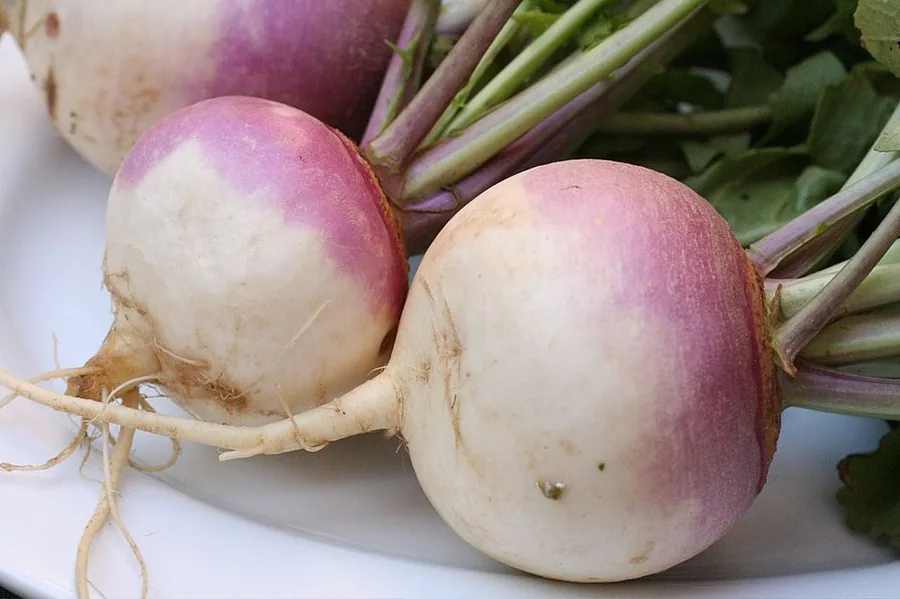
The classic heirloom most growers picture, throwing round white roots that blush purple where they push above the soil, plus reliable greens to match.
Hakurei
A quick-maturing salad turnip whose small, smooth white roots run so mild and sweet you can slice them raw straight into a salad.
Golden Ball
A yellow-fleshed heirloom that takes about 60 days and pays off the wait with a mild, faintly sweet flavor.
Seven Top
Grown for a heavy rush of greens rather than its root, which stays small and woody and is best left in the ground.
Just Right
A hybrid that delivers greens in about 28 days and white roots in roughly 60, so one sowing knocks out both.
Companions
Turnips do best next to cool-season plants that share their schedule without sharing their pests, and worst beside their own brassica cousins, which trade flea beetles, root maggots, and clubroot back and forth.
Plant near
peas: Cool-season legume sown on the same early-spring schedule; fixes nitrogen and does not compete heavily with the shallow turnip bed
onions: Alliums make compact, pest-light neighbors in the root bed and are not hosts for brassica pests
Keep apart
cabbage and other brassicas: Closely related cole crops share flea beetles, root maggots, and clubroot; clustering or rotating them in the same bed builds up these pests and diseases
How to propagate
Turnips take off straight from seed sown where they will mature, since they would rather not be moved, which makes them a blast to start. Grab a seed packet and a patch of loose soil and go.
SeedEasy
Direct sow in early spring as soon as the soil can be worked, and again in late summer (around August 1) for a fall crop; turnips do not transplant well and succession sowings every 10 days extend harvest · Seedlings emerge in about 10 days; greens are cuttable in about 4 weeks and roots reach harvest size in roughly 40-60 days
Turnips launch straight from seed sown where they will mature, since they never take to transplanting. Drop the seed a quarter to half an inch (0.5 to 1 cm) deep, an inch or two apart, in rows 18 to 30 inches (45 to 75 cm) apart, then thin the seedlings to 3 to 6 inches (8 to 15 cm) and munch the thinnings as greens. Sprouts punch up in about 10 days, greens hit cutting size in roughly 4 weeks, and roots bulk out in 40 to 60 days. Sow a fresh row every 10 days and the harvest just keeps rolling.
Myths
Turnip or rutabaga, the name is the only difference between them.
They are two separate crops. The turnip is Brassica rapa, driving quick-growing roots that are usually white-fleshed, while the rutabaga is Brassica napus, whose larger yellow-fleshed roots demand a longer season and more room. Sow and space the two as the different plants they are.
Turnips need pulling before the first frost arrives or the whole harvest is wasted.
A light fall frost flips that around and sweetens the roots. Only a hard freeze truly harms roots left in the soil, so the smart play is to harvest ahead of a hard freeze, not ahead of the first light one.
Turnips are only a fall crop.
Turnips are a cool-season vegetable with two sowing windows, one in early spring the moment the soil can be worked and another in late summer for a fall harvest. The single thing to dodge is letting the roots size up in the heat of midsummer.