Shrub · Fabaceae
Wisteria
Wisteria sinensis
Hand it full sun, a burly support, and two fearless prunings every year, and wisteria answers each spring with cascades of bloom.
Full sun
Every 5–10 days
1095–2555 days
USDA 5–9
Overview
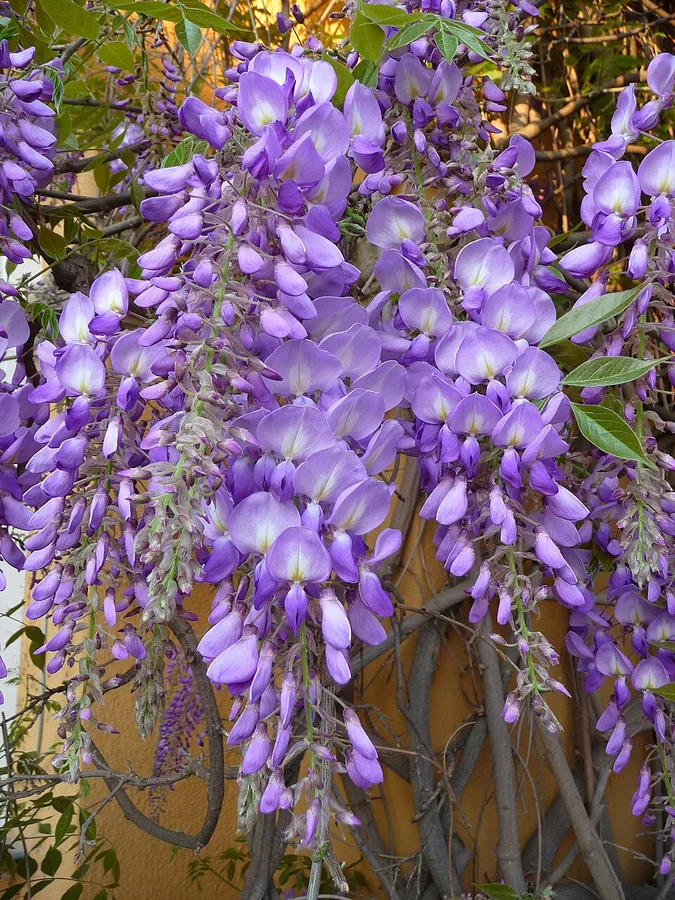
Almost nothing beats a wisteria in full bloom, when long racemes of blue-violet flowers pour down over an arbor in a wall of color. It is a woody, twining member of the pea family, and the raw vigor behind that show is exactly what makes it such a rewarding plant to grow. A mature vine acts more like a small tree than a delicate climber, and that is half the fun.
Two Asian species drive most gardens. Chinese wisteria twines counterclockwise and fires off nearly all its flowers at once, while Japanese wisteria twines the other way and rolls its racemes open slowly from base to tip. Both are stunning but invasive across much of the eastern US, which is why the native American and Kentucky wisterias earn a serious spot on your list.
Wisteria runs on patience and a firm hand, and both pay off big. A young plant may hold back for years before it flowers, then take off and climb trees and gutters the moment it gets rolling. Give it full sun, a rock-solid dedicated support, and a hard pruning twice a year, and it rewards the effort for decades.
Care
The short version: wisteria wants full sun, a very strong support set well away from trees and the house, and lean soil with little or no feeding. Water it deeply while it establishes, then prune hard in both summer and winter to keep it in bounds and fire up the flowers.
Light
Wisteria flowers best in full sun, and a site that soaks up direct light all day is what packs the vine with blooms. It will put up with partial shade, but shade is one of the top reasons a healthy-looking plant never flowers.
Water
Keep the soil moist but well drained while the plant digs in, watering deeply during dry spells. Once established it shrugs off drought fairly well, so let the top inch or so dry between waterings rather than keeping it soggy.
Soil
Wisteria is not fussy about soil and takes clay, loam, or sand plus wet or dry ground in stride. Aim for moist, well-drained loam with a pH between 6.0 and 7.0 and it will run with the rest.
Temperature
This is a tough, cold-hardy vine that handles a wide range, roughly -20°F to 100°F (-29°C to 38°C). The main weather risk is a late spring frost, which can wipe out the flower buds right before they open.
Humidity
Ordinary outdoor humidity suits wisteria fine, so there is no level to chase. What matters far more is air and light reaching the vine, which means keeping its rampant growth thinned out.
Feeding
Wisteria thrives on lean living, so keep the fertilizer bag shelved. Extra nitrogen only fuels foliage while the flowers sit it out, and a light low-nitrogen dose in spring is the absolute most it should get.
Pruning
Prune hard twice a year to keep the vine in check and fire up bloom. In summer cut the long whippy shoots back to five or six leaves, then in winter shorten those same shoots to two or three buds, cutting away anything girdling its support.
Repotting
Wisteria belongs in the ground rather than a pot, so it is not really repotted. On an established plant, root pruning can jolt a stubborn vine into flowering, and few or no blooms despite leafy growth is the sign it may help.
Size & spacing
This vine goes big, powering up 10 to 25 feet (3 to 7.5 m) and sprawling 4 to 30 feet (1.2 to 9 m) wide. A hefty support all its own, sited far from trees, walls, and neighboring plants, lets all that energy shine.
When to plant
Wisteria is a long-lived woody vine, so the timing to nail is planting, not a yearly sowing. Set new plants out in spring or fall, then hang in there, because the flowers can take several years and, once they arrive, they burst out in mid-to-late spring.
Northern hemisphere
Southern hemisphere
Typical months for a temperate climate: start earlier in warm zones, later where spring frosts linger.
- Plant: Spring or fall
- Harvest: Mid-to-late spring (April-May)
Hardiness
USDA hardiness zones: 5–9
Temperature: down to -29°C
Troubleshooting
Nearly every wisteria snag lands in one of two camps: a plant that will not bloom or one that grows too well for its own good. Read the symptom, size up the plant's age and where it sits, then jump in before the vine takes over. The three fixes below cover what growers hit most.
A powerhouse vine that muscles past its support
Wisteria packs real muscle as a heavy woody twiner that can rocket over 60 feet and blow past almost any support you build. Turn your back and it wraps tight around tree trunks and chokes them, then bows or snaps trellises, gutters, and downspouts under its own weight. Set it on a beefy dedicated arbor well away from the house, prune it hard twice a year, and cut loose anything it grabs that you never meant it to.
Fix:
- Provide a very strong, sturdy dedicated support (heavy arbor or metal structure)
- Prune hard twice a year and cut away any stems twining around trees, gutters, or downspouts
- Remove the plant entirely if it is engulfing trees or buildings
Vines that bolt for the woods
The Asian species are invasive right across the eastern and southeastern US, and they charge outward three ways at once: by seed, by runners, and by stems that root the moment they touch soil. Break free and they pile into dense thickets and shade out or drag down native trees. Cut escaped vines back to the root, keep knocking down the resprouts, and plant native American wisteria wherever wild woodland sits nearby.
Fix:
- Cut vines close to the root and repeatedly remove resprouts through the season
- Apply an appropriate systemic herbicide to cut stems in spring or summer where permitted
- Replace with a native, non-invasive alternative such as American wisteria (Wisteria frutescens)
Racing up the arbor but not blooming
A wisteria that charges up its support yet skips the flowers is almost always just too young, and seedlings often spend 3 to 7 years or more building toward that first burst of racemes. Too much nitrogen, a shady spot, or a late spring frost on the buds can stall it further. Get it into full sun, cut off the feeding, and prune twice a year to pack on the flowering spurs.
Fix:
- Be patient and let the plant mature; grafted or already-blooming nursery plants flower sooner than seedlings
- Stop applying nitrogen fertilizer
- Move or train the vine into a full-sun position
- Prune correctly twice a year (summer and winter) to build flowering spurs
Toxicity
Every part of wisteria is toxic, and the velvety seed pods and bean-like seeds top the list of hazards. They carry a lectin called wisterin along with toxic glycosides, and because the pods look like edible beans they have poisoned children more than once. Keep the seeds and pods away from pets, livestock, and kids, and clear fallen pods from the ground.
Toxic to
Cats · Dogs · Horses · Rabbits · Livestock · Birds · People
Cats Moderate
Let a cat chew the pods or seeds, the parts loaded with toxin, and it will usually vomit, sometimes with blood, then hit diarrhea, low energy, and dehydration.
Dogs Moderate
Dogs make a beeline for the bean-like pods and pay for it with heavy vomiting that may run bloody, loose stools, drooling, and a flat, dull mood. Track hydration closely while the upset stomach drags on.
Horses Moderate
The toxin charges through the whole plant, not just the seeds, so a horse that eats any part goes off its feed and turns dull, with vomiting, diarrhea, and drooling.
Rabbits Toxic
Wisterin and the plant's glycosides slam the door on every part for rabbits, and even a small nibble can trigger drooling, a painful gut, and runny droppings, so keep them well away.
Livestock Toxic
Cattle, goats, and sheep that graze the foliage, pods, or seeds can land in severe stomach upset, drooling, and dehydration, so fence the plant right off from any pasture.
Birds Toxic
The seeds and pods are toxic to birds, and the pods mimic the very beans a bird loves to peck. Expect vomiting, weakness, and dehydration if any gets swallowed.
People Caution
Those velvety pods pass for edible bean pods and have poisoned children who ate the seeds, and even a couple of seeds can set off severe vomiting, belly pain, bloody diarrhea, drooling, and dehydration, so keep kids well clear of them.
The pods resemble edible beans and have poisoned children; keep seeds and pods away from kids and pets.
Helpline numbers

United States
ASPCA Animal Poison Control: (888) 426-4435 (fee applies)
Poison Control: (800) 222-1222



Canada
Poison Centres: 1-844-764-7669
Varieties
Choosing a wisteria comes down to the showy but invasive Asian species or the better-behaved natives. These four cover the plants you are most likely to grab at the nursery.
Wisteria sinensis (Chinese wisteria)
It twines counterclockwise and throws open fragrant blue-violet to purple, pink, or white racemes 6 to 12 inches long almost all at once before the leaves for one knockout flush, though it is invasive across the eastern US.
Wisteria floribunda 'Macrobotrys' (Japanese wisteria)
It twines clockwise and dangles exceptionally long red-violet racemes, reported up to 2 to 4 feet, that open gradually from base to tip, and while it is cold hardy it is also invasive in the eastern US.
Wisteria frutescens 'Amethyst Falls' (American wisteria)
A native and far less aggressive pick with compact 4 to 6 inch lavender-purple racemes in May that bloom on new wood, so it often flowers while still young and rewards you fast.
Wisteria macrostachya 'Blue Moon' (Kentucky wisteria)
A very cold-hardy native whose silvery-blue racemes can rebloom through the season, a non-invasive winner for northern gardens.
How to propagate
Wisteria multiplies from a pegged stem, a summer cutting, or seed, though only the first two hand you a plant that flowers just like its parent.
LayeringEasy
Spring to summer · Several months to a year to root
Layering is the most reliable way to clone a wisteria you love. Peg a low, flexible stem down into the soil in spring or summer and let it work, since it can take several months to a full year to root. The payoff is a new plant that flowers exactly like its parent.
Stem cuttingsModerate
Summer (softwood/semi-ripe) · Several weeks to root
Snip softwood or semi-ripe cuttings from the current season's growth in summer and they root in a few weeks. This route holds the cultivar true, so the plant you raise blooms just like the one you took it from.
SeedModerate
Spring · Many years to first bloom
Seed sprouts easily in spring, but it tests any impatient grower, since seedlings vary and often take 7 or more years to flower. The seeds are also toxic, so handle them with care and keep them away from children and pets.
Myths
Pour on the fertilizer and wisteria bursts into bloom.
Piling on high-nitrogen fertilizer backfires, driving out leaves at the expense of flowers, and most wisteria blooms harder when left unfed. Full sun, correct twice-yearly pruning, and a little maturity are what really unlock the flowers.
Invasiveness runs through every wisteria, making the whole group a bad bet for gardens.
Only the Asian species, W. sinensis and W. floribunda, run wild in the eastern US. Native American wisteria (W. frutescens) and Kentucky wisteria (W. macrostachya) behave far better, and they deliver the same cascading flowers without threatening the woodland nearby.