Houseplant · Bromeliaceae
Urn Plant
Aechmea fasciata
Keep the central cup brimming and the light bright, and this bromeliad pays you back with months of color.
Bright indirect
Every 7–14 days
59–86°F · 15–30°C
USDA 10–11
Overview
Crack open the name and you find that watertight cup at the heart of the plant, a hollow vase built by leaves that overlap edge to edge. Out in nature this silver-banded rosette grips a tree branch and traps falling rain inside, sipping from the pool rather than from any soil. Move it onto a windowsill and it wants the exact same deal, which is what makes it such a fun oddball to grow once the rhythm sticks.
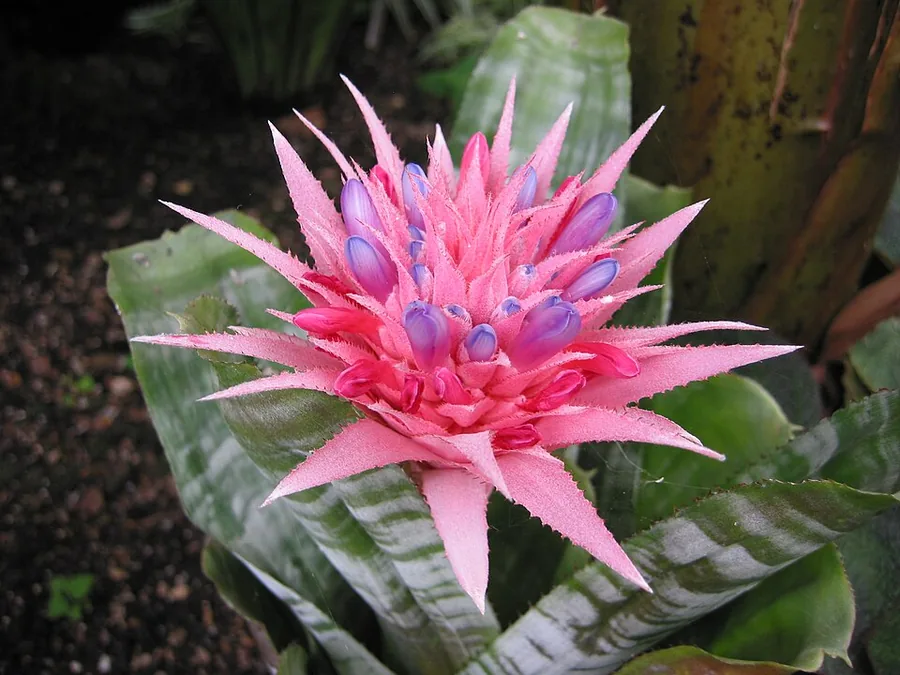
Then comes the showstopper. A grown rosette launches a long-lasting pink bract loaded with violet flowers that ripen to red, and the display runs strong for several months. Think of that bract as the payoff for waiting, because every rosette flowers a single time across its whole life before it eases out of the picture.
What reads like the final curtain is really a baton pass. As the parent fades, it fires up offsets called pups ringing its base, and each pup powers up into a fresh plant. Hand it bright filtered light and a full cup, and one urn plant keeps the relay running year after year.
Care
The short version: bright, indirect light, a central cup you keep brimming with fresh water while the potting mix dries out between drinks. Park it somewhere warm and humid, feed at half strength across the growing season, and give those spiny edges a little elbow room from the neighbors.
Light
Hand the urn plant bright, indirect light to pull the richest color and the surest chance of a bloom. Partial shade or medium indirect light will keep it ticking along, yet a too-dim spot is the number-one reason a healthy rosette never flowers.
Water
Here is the trick that makes a bromeliad a bromeliad: keep the central cup brimming with fresh water round the clock, while the potting mix dries out between drinks. Tip the cup empty now and then and refill it so nothing goes stale or stockpiles mineral salts. Hard tap water? Switch to rain or distilled, and aim to wet the mix about every 7 to 14 days.
Soil
Set it into a loose, fast-draining bromeliad mix, that acidic, bark-heavy blend marketed for orchids. Its roots clamp on as anchors more than they drink, so wet feet spell trouble, while an airy mix sends water straight through.
Temperature
Plain room warmth is all it asks, somewhere between 59°F to 86°F (15°C to 30°C). Hold it above 59°F (15°C) and shield it from cold drafts, since a chilly, damp combo is exactly what coaxes rot into the heart of the plant.
Humidity
Damp air keeps it happiest, in the band of 50% to 70% humidity. When the room runs dry, mist the foliage or perch the pot on a pebble tray to bump up the moisture circling it.
Feeding
Feed it monthly across spring and summer with a balanced liquid fertilizer trimmed to half strength or less. Pour it into the soil or spritz it on the leaves, but keep portions small, because this bromeliad runs on far less food than your average houseplant.
Pruning
When the flower stalk and pink bract turn brown, clip them off, and tidy up any dead or battered outer leaves. Once flowering wraps, the parent rosette winds down for good, so clear it away after the pups have settled in. Pull on gloves first, because those leaf margins carry small spines.
Repotting
Pot it up only on occasion, roughly every 2 to 3 years, mainly when you size up or split off pups. Keep an eye out for roots poking through the drainage holes, a top-heavy lean, or pups jamming the container, then graduate it into fresh bromeliad mix.
Size & spacing
Grown inside, the urn plant climbs to about 12 to 35 inches (30 to 90 cm) tall and fans out 12 to 24 inches (30 to 60 cm) wide. It puts on growth at a slow clip, so whatever size you carry home is roughly what you live with for quite a stretch.
Troubleshooting
Nearly every urn plant hiccup traces back to the cup or the roots, and it surfaces in the leaves or the core. Get sharp at reading those first warning signs and you can jump in before a minor stumble snowballs. Spot your symptom below, then move while quick action still pays off.
A mushy black core that comes apart in your hand
Here you are looking at crown rot, which strikes after old water lingers in the cup or the plant rides out a cold, soggy stretch. Tip out the urn and rinse it, shift the plant to a warmer brighter corner, and pull any sound pups to safety if the parent is already going down.
Fix:
- Drain and flush the cup, move to a warmer, brighter spot
- Reduce moisture and improve air circulation
- If the mother is collapsing, salvage healthy pups and discard the rotted rosette
A drooping plant sitting on dark, slimy roots
Blame root rot in a waterlogged mix, the kind that takes hold when the medium clings to moisture or drains at a crawl. Move it into a fresh, fast-draining bromeliad blend, snip off every rotted root, and feed the cup so the soil stops staying drenched.
Fix:
- Repot into fresh, fast-draining bromeliad mix
- Let the mix dry between waterings
- Trim away rotted roots
Tacky foliage dotted with white fluff or armored bumps
Spot that mess and you have caught scale insects or mealybugs sucking away at leaf joints and undersides. Swab each one off with cotton soaked in diluted alcohol, chase them down with insecticidal soap, and park the plant on its own until every last bug is gone.
Fix:
- Wipe pests off with a cloth or cotton swab dipped in diluted alcohol
- Treat with insecticidal soap or horticultural oil
- Isolate the plant until clear
A thriving rosette that stubbornly skips the bloom
Nine times out of ten it comes down to a shadowy spot or a rosette still short of full size. Slide it into brighter filtered sun and let a young plant keep growing, because each rosette earns just one bloom and only after it matures.
Fix:
- Move to a brighter spot with filtered light
- Allow the rosette to reach full size before expecting bloom
Crisped brown edges creeping along the leaves
Track this one back to a rootball baked bone-dry with the central cup running empty, then add parched indoor air and hard tap water on top. Top the urn back up, soak the mix, and pour rain or distilled water from now on so salts stop piling up.
Fix:
- Refill the central urn and water the mix
- Raise humidity by misting or using a pebble tray
- Flush the cup and mix with rain or distilled water
Toxicity
Pet owners can relax: the urn plant poses no chemical danger. The ASPCA marks it non-toxic to cats and dogs, and no poison turns up anywhere in this bromeliad. Your one watch-out is the leaf edges, lined with small spines that can scratch, so place it where curious pets and small children will not graze against them.
Safe for
People · Cats · Dogs · Horses · Rabbits · Livestock · Birds
Cats Safe
Per the ASPCA this bromeliad rates non-toxic to cats, so a curious chomp leaves a cat none the worse.
Dogs Safe
A dog can lounge beside this plant all day, and the odd gnawed leaf still spells no trouble.
Horses Safe
Horses pick up zero poisoning risk from the urn plant.
Rabbits Safe
Rabbits run no risk near it, though leafy greens ought to stay just a small slice of their diet.
Livestock Safe
Cattle, goats, and sheep can browse close by and stay perfectly clear of poisoning.
Birds Safe
Caged birds and yard poultry share its space with nothing to fear.
People Safe
It carries no toxins, so children and roaming toddlers stay safe right alongside it.
Leaf margins bear small spines/teeth that can scratch or prick skin, so handle the plant with care (gloves help). Any mild irritation from chewing would be physical/mechanical, not from toxins.
Varieties
Aechmea fasciata shows up in a handful of named forms, each putting its own spin on leaf color or flower. These are the ones that turn up most on shelves.
Aechmea fasciata var. purpurea
Look for a purple-red wash across its foliage that glows brightest underneath each leaf.
'Primera'
A vigorous trade favorite that grabs attention with crisp silver banding and an oversized pink flower head.
'Morgana'
Stays small and packs a punch with richly saturated rose-pink bracts.
How to propagate
The urn plant clones itself at no cost through the pups it pushes out after flowering. Skip the seed trays and rooting hormone entirely, because all this takes is good timing and a little patience.
Offsets & pupsEasy
After the mother rosette flowers and begins to decline, once pups reach about one-third to one-half the parent's size (roughly 6 in / 15 cm tall) · Several weeks to a few months to root and establish
Once the parent rosette flowers and starts winding down, it throws up offsets, the pups clustered at its base, and they carry the whole line forward. Hold off until each pup hits roughly a third to half the parent's size, about 6 inches (15 cm) tall, then twist or slice it loose with a clutch of roots hanging on. Tuck it into fresh bromeliad mix, keep it toasty and bright with the cup brimming, and allow several weeks to a few months for it to anchor in and take off.
Myths
The urn plant will poison cats and dogs.
On the ASPCA roster Aechmea fasciata sits squarely in the non-toxic column for cats and dogs alike. All you really have to dodge is a nick from those spiny leaf edges, never a thing inside the plant. No part of this bromeliad packs poison for a pet.
Water only the soil and leave the central cup bone-dry.
Out in the wild that cup is the plant's drinking fountain, so it craves a full reservoir. Top the central urn up with fresh water and let the potting mix run dry between rounds. Cup full, soil dry, and the plant thrives.
Flowering kills the whole plant, so toss it after the show.
Only the rosette that flowered bows out, and it lingers for a good while before it does. On the way out it launches offsets, the pups ringing its base, and each one springs into a brand new plant. A single bloom gifts you the next round.