Houseplant · Bromeliaceae
Earth Star
Cryptanthus bivittatus
Treat it to bright indirect light and steady humidity, and the earth star blazes with color all year.
Bright indirect
Every 5–7 days
61–84°F · 16–29°C
USDA 10–12
Overview
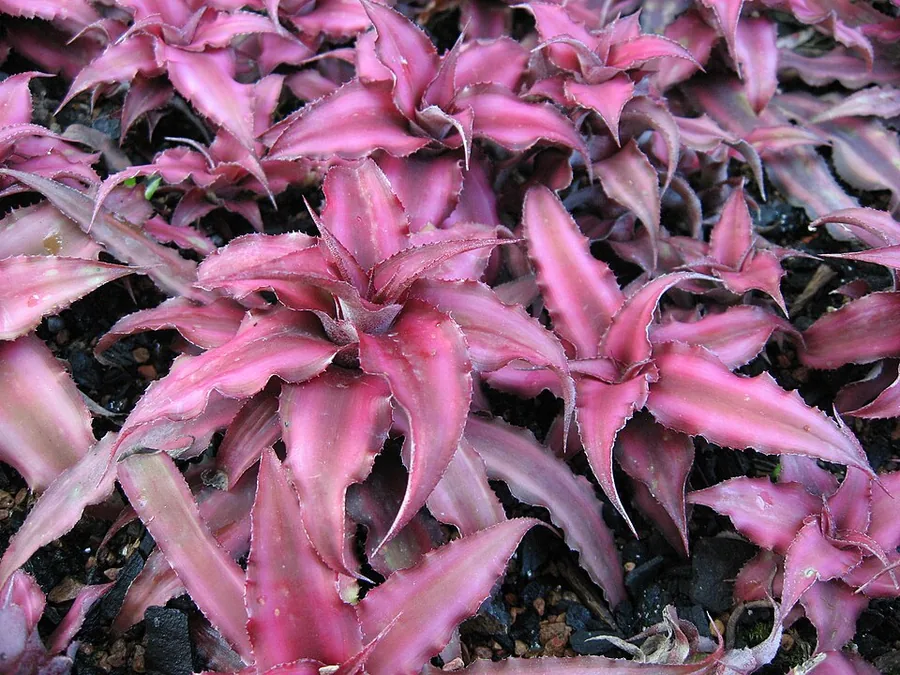
Meet the earth star, a small flat-growing bromeliad that fans out into a striking star-shaped rosette of stiff, wavy leaves. It breaks from its tank-forming cousins by rooting straight into the soil, and that is exactly what makes it a terrestrial bromeliad. Best of all, the green, pink, and red banding stays bold and bright all year long indoors.
This one packs a lot of character into a tiny footprint, standing just 3 to 6 inches (8 to 15 cm) tall and a touch wider, so it drops happily into a small pot, a dish garden, or a terrarium without ever taking over. It grows slowly, then puts on a real show, flowering once with small white blooms at its center before it bows out and passes the torch to its pups.
Growing it is genuinely rewarding once you nail the basics: warmth, humidity, and bright but filtered light. Push it into direct sun and the leaves bleach, leave it in gloom and the color drains away, but find that sweet spot and the bright striping rewards every bit of attention you give it.
Care
The short version: bright indirect light, a rich organic mix kept lightly moist but never soggy, plenty of warmth, and high humidity. Feed it monthly through the growing season, then sit back and watch it raise its own pups.
Light
Hand the earth star bright, indirect light and watch its color sing. It will scrape by in medium light or partial shade, but the color flattens there, and harsh direct sun bleaches the leaves outright. A window with a sheer curtain nails the sweet spot.
Water
Keep the rich organic mix lightly moist but well drained, splashing it about every 5 to 7 days once the top has dried a little. Never let it bake dry, and never pour water into the center, where standing water rots the crown. Forget the cup-filling trick, because this terrestrial bromeliad simply does not have one.
Soil
Pot it up in a rich, organic, well-drained mix, something peat- or sphagnum-based instead of a heavy standard potting soil. The roots crave a little acidity, a pH of 5.0 to 6.0, and they sulk hard in dense ground that traps water.
Temperature
Plain room warmth keeps it thriving, anywhere from 61°F to 84°F (16°C to 29°C). Steer it well clear of cold drafts and chilly winter windowsills, since it has zero tolerance for the cold.
Humidity
This plant drinks up humidity, peaking between 50% to 70%. Average indoor air usually runs drier, so a pebble tray, a cluster of plants, or a terrarium keeps it cruising. Catch the leaf tips browning near a vent and you have caught the dry air red-handed.
Feeding
Feed it monthly from mid-spring through early fall with a balanced water-soluble fertilizer cut to about half strength. It grows slowly and asks for little, so cut the feeding entirely once growth stalls in the cooler months.
Pruning
Pruning barely registers on the to-do list. Snap off any dead or damaged outer leaves as they crop up, and once the rosette has flowered and started to decline, cut away the spent mother plant after its pups have arrived.
Repotting
Repot just every 2 to 3 years, or sooner if pups crowd the pot, the mix dries out fast, or the rosette starts shoving up out of the soil. With growth this slow, it is in no rush at all for a bigger home.
Size & spacing
It stays compact, topping out at just 3 to 6 inches (8 to 15 cm) tall and spreading 6 to 12 inches (15 to 30 cm) across. That tidy size makes it a slam dunk for shallow dishes, terrariums, and tight windowsill corners.
Troubleshooting
Almost every earth star hiccup comes down to light, water, or air that has dried out, and the leaves wave the flag early. Spot the match below and make the quick fix before it spreads, and the plant bounces right back. Pests rarely crash the party, but a fast scan now and then keeps things humming.
Cottony patches, hard nubs, or sticky residue dotting the leaves
Cottony tufts, hard bumps, or sticky residue flag mealybugs or scale, while fine webbing in dry air outs spider mites instead. Hunt along the leaf bases and undersides, then wipe the pests off with a cotton swab dipped in isopropyl alcohol. Hit them again with insecticidal soap or horticultural oil, and quarantine the plant until it comes up clean.
Fix:
- Wipe off pests with a cotton swab dipped in isopropyl alcohol
- Treat with insecticidal soap or horticultural oil and repeat as needed
- Isolate the plant until the infestation clears
Bleached, burnt spots popping up on the sunniest leaves
Bleached or scorched patches on the brightest leaves shout too much light, and harsh midday sun is the real culprit. Direct rays overheat the rosette and bleach the most exposed leaves until the edges shrivel. Whisk the plant into bright but diffused light and treat it to only gentle morning or evening sun.
Fix:
- Move to bright but diffused/indirect light
- Provide only gentle morning or evening sun and shield from intense midday sun
Vivid color dulling and the pink stripes bleaching out
Stuck in deep shade, an earth star lets its bright pink and red striping slide into something muted and flat. The fix is a breeze: shift it to a brighter spot with bright indirect light, and the next flush of growth roars back vivid.
Fix:
- Move to a brighter spot with bright indirect light
Crisp brown leaf tips and margins on a plant that's otherwise thriving
Dry air usually drives brown, crispy tips, especially when the plant parks near a heat or air vent. The tips crisp up while the rest of the rosette stays in great shape. Pull it clear of the drafts, crank the humidity with a pebble tray or by grouping plants, and keep the mix evenly moist.
Fix:
- Move away from heating/cooling vents
- Raise humidity with a pebble tray or grouping plants and keep the mix evenly moist
Toxicity
Pet owners can dive right in, because the earth star is non-toxic. The ASPCA lists Cryptanthus as safe for cats and dogs, with no toxic compounds in any part of the plant. The only thing to watch is the stiff, wavy leaf edges, which can lightly scratch but pack no chemical hazard at all.
Safe for
People · Cats · Dogs · Horses · Rabbits · Livestock · Birds
Cats None
Cats can share the room without worry. The ASPCA finds no toxic principles at all, so a curious feline that swipes or gnaws on a leaf stays perfectly fine, aside from possible mild tummy trouble after a big bite.
Dogs None
Dogs have nothing to fear from it. There's no poison anywhere in the plant for them, and a really dedicated chewer walks away with, at most, a brief and mild bout of tummy upset from the fibrous foliage.
Horses None
Horses can nose around it freely. It carries no toxins whatsoever, so a quick nibble does nothing beyond the small upset that any strange new greenery tends to stir up.
Rabbits None
Rabbits can browse near it without any worry. There's no poison in it at all, and the foliage poses zero chemical danger if one takes a taste.
Livestock None
Grazing animals can crop at it safely. This non-toxic bromeliad contains nothing able to sicken sheep, goats, or cattle.
Birds None
Pet birds can peck away happily. Nothing in the plant is toxic, so a bird investigating the rosette comes to absolutely no harm.
People None
People have nothing to fear from it. The one point to note is the rigid, wavy leaf margins, which can nick small hands a little; beyond that it's a completely non-toxic plant.
Leaves are stiff with wavy, sometimes finely toothed edges that can lightly scratch; no chemical hazard. As with any plant, nibbling may cause mild stomach upset.
Varieties
Earth stars burst into a whole spectrum of colors and sizes, and a few standout forms turn up again and again in homes and garden centers. Get to know these by name.
Cryptanthus bivittatus var. atropurpureus
A darker color form of the species that flaunts deep reddish to purple-bronze foliage, recognized as a variety in Kew's Plants of the World Online.
'Minor' (Dwarf Rose-Stripe Star)
A compact dwarf form striped with rose-pink down its leaves, listed by the ASPCA among the non-toxic earth stars.
'Pink Starlite'
A crowd-favorite cultivar with broad creamy-pink and green banded leaves that blush a deeper pink when the light cranks up.
How to propagate
Earth stars practically propagate themselves, pumping out a fresh batch of pups every time the mother rosette wraps up its flowering.
Offsets & pupsEasy
After the mother rosette flowers and produces pups, typically anytime in the warm growing season · 4 to 8 weeks
Earth stars crank out new plants through offsets, or pups, that sprout at the center and base of the parent once it has flowered, usually during the warm growing season. Ease a pup free, press it into a moist organic potting mix, and keep it watered and humid. It roots and digs in fast, settling within 4 to 8 weeks.
SeedDemanding
Warm season under controlled humidity · Several months
Growing from seed is on the table, but it stays slow and rarely done at home. Sown in the warm season under controlled humidity, seedlings drag on for several months before they amount to much, which is why offsets stay the go-to move.
Myths
Just like other bromeliads, earth stars get their water poured right into their central cup.
Cryptanthus are terrestrial bromeliads with a flat rosette and no water-holding tank, so there is no cup to fill in the first place. You water them at the roots, growing them in soil and keeping the organic mix lightly moist instead of dumping water into the center.
Earth stars count as bromeliads, and bromeliads harm pets that chew them.
Not a chance with this one, since the ASPCA classifies earth star (Cryptanthus) as non-toxic to cats and dogs, with no toxic principles identified. Grab it with total confidence for a home full of curious animals.