Houseplant · Bromeliaceae
Flaming Sword
Vriesea splendens
Keep that central cup brimming and the light bright, and the flaming sword flies its bold red bract for months.
Bright indirect
Every 7–14 days
59–77°F · 15–25°C
USDA 10–12
Overview
The flaming sword rockets out of the Brazilian rainforest with real presence, growing up in the treetops rather than the ground and drinking from the cup at its center. Get to know that cup and the whole plant clicks into place. It is a bromeliad that rewards a keen grower fast.
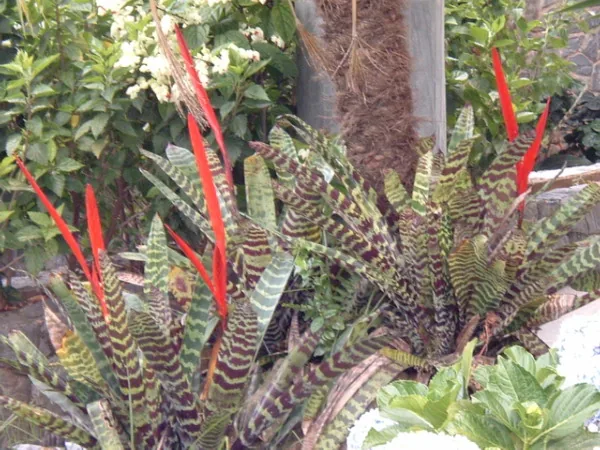
The payoff is that tall red bract shooting up from a rosette of strappy leaves, the classic form striped with purple-brown crossbands. The color powers on for months while the little true flowers pop and fade, and since it grows slowly and stays compact, it earns its spot without taking over.
Here is the part that hooks growers. Each rosette blooms once, gives its all, then bows out, but not before launching pups at its base that become the next generation. Bring one home and you are really starting a whole line to grow on.
Care
The short version: bright indirect light, a central cup kept brimming with fresh water, warm humid rooms, and a light feed through spring and summer, and it thrives.
Light
Set it in bright indirect light, that lively spot near a window where the glow lands but the direct beam does not. It gets by in partial shade or medium indirect light, but the colors really pop in brighter spots. Just keep it clear of harsh midday sun, which bleaches the leaves.
Water
Keep the central cup brimming with fresh, room-temperature water and flush it every week or two so it stays sweet, never stale. Let the overflow feed the roots, then let the top of the mix dry between waterings, since soggy roots quickly rot. Rainwater or tap water that has sat a few hours does the trick.
Soil
Pot it up in an airy, fast-draining bark mix built for orchids or bromeliads, never dense soil. The roots mostly grip and anchor, so a pH around 5.0 to 6.0 and sharp drainage count for far more than rich soil.
Temperature
Warm, steady rooms keep it charging along, between 59°F to 77°F (15°C to 25°C). Cold drafts and sudden chills set it back fast, so keep it well away from winter windows and vents.
Humidity
This one runs on humidity, hitting its stride at 50% to 70%. Dry indoor air browns the tips, so cluster it with other plants, park it on a pebble tray, or fire up a humidifier through winter.
Feeding
Feed it through spring and summer, about once a month, with a half-strength balanced liquid fertilizer poured straight into the cup. Steer clear of high-nitrogen feeds, which dump salts that scorch the leaves.
Pruning
There is next to nothing to fuss over. Snip the flower spike once it fades, trim off any dead or damaged leaves, and pull the spent mother rosette at the base once her pups are romping away on their own.
Repotting
You will rarely need to repot, since these small roots love to stay snug. The big moment is moving grown pups into their own small, heavy, well-drained pots once they are ready to stand alone.
Size & spacing
It stays compact for a flowering plant, shooting up 18 to 35 inches (45 to 90 cm) tall with a spread of 18 to 24 inches (45 to 60 cm). One rosette in its own pot is all the room it asks for.
Troubleshooting
Nearly every flaming sword hiccup comes down to water and light, and the good part is that each one is quick to turn around. Spot a stale cup, a scorching sill, or a heavy feed early, match it below, and get the plant back on track.
A soft, smelly center with leaves that pull right out
That is crown and root rot, the number one way a flaming sword goes down, so jump on it fast. It strikes when cold or stale water sits in the cup while the mix stays soggy below. Empty and flush the cup, let the mix dry harder between waterings, and if the mother is done for, rescue her pups and charge ahead with them.
Fix:
- Empty and flush the central cup, then refill with fresh tepid water
- Let the potting mix dry out more between waterings
- If the mother is severely rotted it cannot be saved -salvage and pot up healthy pups
Cottony white tufts or brown bumps with a sticky film
Those fluffy white clusters are mealybugs, and the hard brown limpets are scale. Both hunker down where the leaves meet the cup, drain the sap, and leave a sticky mess behind. Swipe them off with a cotton swab dipped in rubbing alcohol, rinse the leaves, and keep patrolling weekly until the plant is spotless.
Fix:
- Wipe pests off with a cotton swab dipped in isopropyl alcohol
- Rinse the foliage and improve air circulation
- Repeat weekly until clear; avoid pesticides not labeled safe for bromeliads
Dark spots and lesions marching across the leaves
That is fungal or bacterial leaf spot, which digs in when the air turns damp and still and water lingers on the foliage. Strip off the marked leaves, get the air moving around the plant, and keep the water flowing through the cup instead of letting it stall.
Fix:
- Remove affected leaves
- Improve air circulation and avoid wetting foliage in low light
- Keep water moving through the cup rather than stagnant
Bleached, dry patches on the side facing the window
Those pale, crispy patches are sun scorch from too much direct light, and they always hit hardest on the side aimed at the sun. Shift the plant back into bright indirect light or partial shade, then trim the badly burned tips.
Fix:
- Move to bright indirect light or partial shade
- Trim badly scorched leaf tips
Crusty white deposits and browning tips after feeding
That is fertilizer salt buildup, usually from feeding too strong or grabbing a high-nitrogen mix. The salts crust up on the leaves and scorch the tips brown. Flush the cup and the mix with clean water, then feed only at half strength and keep it light.
Fix:
- Flush the cup and potting mix with clean water
- Feed only dilute (half-strength) fertilizer sparingly
Toxicity
Here is a bonus for pet lovers: the flaming sword is non-toxic through and through. The ASPCA lists Vriesea as safe for cats and dogs, and the smooth, spineless, sap-free leaves keep it gentle for the whole household. Grow it anywhere you like.
Safe for
People · Cats · Dogs · Horses · Rabbits · Livestock · Birds
Cats None
The ASPCA lists the flaming sword as non-toxic to cats, so shrug off a curious nibble. A cat that really tucks into the leaves might bring a little back up, the way any plant can rattle a stomach.
Dogs None
Dogs are in the clear here too, with no toxin hiding in the smooth leaves. The worst a determined chewer might land is a passing bout of mild stomach upset from the fiber.
Horses Safe
Nothing in this bromeliad can harm a horse. It is an indoor plant they rarely cross paths with, and a stray mouthful would pass without any trouble.
Rabbits Safe
A rabbit can nibble a leaf without any risk, since the plant packs no toxic compound. Keep their diet built around hay and greens, and treat this as the occasional curiosity it is.
Livestock Safe
Cattle, goats, and sheep would take no harm from this plant. As a tender houseplant it almost never crosses their path, but a bite would still be safe.
Birds Safe
Pet birds can perch among the leaves or pick at them without trouble, since nothing in the foliage is poisonous. The spineless, sap-free leaves make it a gentle plant to keep near a cage.
People Safe
The flaming sword is safe to keep in a home with kids and easy to handle bare-handed, with no irritant sap or spines. It is grown for looks rather than the table, so there is no reason to taste it.
Spineless, smooth-leaved bromeliad with no irritant sap -safe to handle and keep around pets.
Varieties
The flaming sword name pulls together a lively little group of Vriesea, some grown for the flower spike and others for their striking leaves. These are the ones worth hunting down first.
Vriesea splendens 'Flaming Sword'
It is the species that named the whole group, flashing dark green leaves crossed by purple-brown bands under a flat, sword-shaped red bract held high.
Vriesea carinata (Lobster Claw)
Its plain green leaves throw the spotlight onto a branched, boat-shaped flower head splashed with red and yellow.
Vriesea fosteriana
Broad leaves boldly banded in maroon make this one a foliage star, grown for its markings more than any bloom.
Vriesea 'Christiane'
A compact hybrid that launches a branched yellow-and-red flower spike, perfect for growers tight on space.
How to propagate
The best part of growing a flaming sword is multiplying it, and the pups it fires off after flowering are your ticket. Seed is possible but slow, so save it for the specialists and start with pups.
Offsets & pupsModerate
After flowering, once the mother plant produces basal pups · Several months to over a year to reach blooming size; Vriesea pup more slowly than most other bromeliads
Pups are how nearly every grower multiplies a flaming sword. Wait until an offset hits about a third the size of its mother and pushes out a few roots of its own, then twist it free and pot it in a small, well-drained bromeliad or orchid mix. Play the long game after, since Vriesea pup more slowly than most bromeliads and can take several months to over a year to reach blooming size.
SeedDemanding
Rarely used; spring · Several years to reach maturity
Seed is one to leave to the specialists. It crawls along and disappoints next to dividing pups, and a seedling needs several years to reach maturity, so home growers almost never take the plunge.
Myths
Bromeliads should only be watered through the central cup, never the soil.
The cup does love to stay full, but it is built to overflow and send water trickling down to the roots. The mix still wants the occasional drink, as long as it drains fast so the roots never sit wet. Water the cup and the mix both, and keep that drainage sharp.
The plant is done for and should be tossed once the flower bract fades.
Each rosette blooms once and then eases into decline, which is just how it is wired, not a failure. Before it fades, it fires up pups at its base that grow into full replacements. Keep the plant, grow the pups, and you never buy another.
The flaming sword is dangerous to cats and dogs.
The ASPCA lists Vriesea and the flaming sword as non-toxic to both cats and dogs. It ranks among the safest flowering plants going for a home with pets.