Houseplant · Araceae
Anthurium
Anthurium andraeanum
Hand it warmth, steady moisture, and humid air, and the anthurium pushes glossy spathes month after month.
Bright indirect
65–85°F · 18–29°C
USDA 11–12
12–18 in · 30–46 cm
Overview
Anthurium hails from the warm, soaking forests of Colombia and Ecuador, where it lives as an epiphyte that grips tree bark instead of digging into soil. That backstory spells out exactly what it craves at home: light that comes filtered, air that never goes bone dry, and a pot that sheds water quickly. It shares a family with the peace lily and philodendron, and along with them comes the calcium oxalate that makes it a hazard around pets.
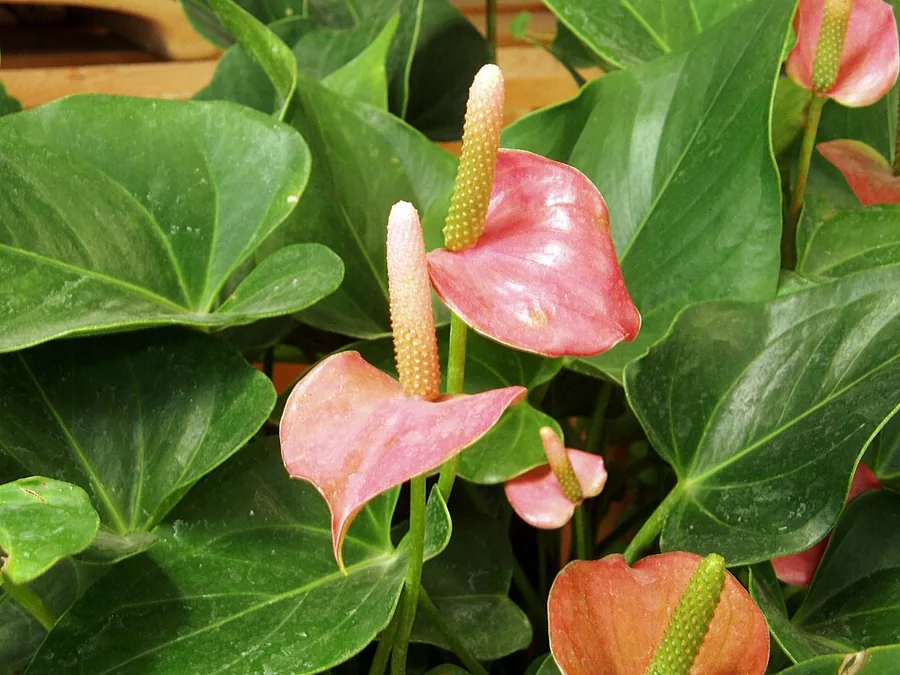
What folks point to as the flower really isn't. The glossy red, pink, orange, or white heart that catches your eye is a spathe, a modified leaf, while the actual flowers are the tiny bumps studding the pale spadix that rises out of it. Treat the plant well and it keeps throwing fresh spathes across much of the year, which is how it picked up names like flamingo flower and painter's palette.
Skip this one if you're just starting out. It pays back attentive care and turns sulky under neglect, pouting in dry rooms and rotting in waterlogged pots. Nail the light, water, and humidity, though, and it stays glossy and flowering well past the point where most houseplants quit.
Care
The short version: park it in bright, filtered light, keep the mix steadily damp without drowning it, hold temperatures above 65°F (18°C), and push the humidity into the 60% to 80% zone. Feed it weekly while the spring and summer growth runs, then treat it to a bigger pot after a couple of years.
Light
Set it in bright, indirect light beside a window but off the sun's direct line. Direct beams scorch the leaves, and deep shade hands you foliage with no flowers, so bright and filtered hits the mark.
Water
Water when the top inch of soil dries out, keeping the mix evenly moist all year while never letting it crisp up or stand in water. The fastest way to lose one is overwatering, since drenched soil rots the roots. Rainwater or filtered water serves it far better than hard tap water.
Soil
Pot it in a light, peaty mix that drains freely, the airy sort its epiphytic roots are built for. A slightly acidic blend at a pH of 6.0 or just below suits it best, and quick drainage is what holds root rot off.
Temperature
Keep things warm, between 65°F and 85°F (18°C to 29°C), and never let winter pull it under 60°F (16°C). Cold drafts and a chilly windowsill are a no-go for this plant.
Humidity
Here's the step most growers overlook. Anthurium thrives on high humidity, around 60% to 80%, well beyond what an ordinary heated room delivers, and dry air browns those leaf tips in a hurry. A pebble tray, a humidifier, or a steamy bathroom each pitch in.
Feeding
Across spring and summer, feed it weekly with a liquid fertilizer. Reach for a high-phosphorus formula to drive more blooms. Back off through the darker months as growth winds down.
Pruning
Snip off spent blooms to push the plant toward fresh ones, and wipe the broad leaves every so often so dust doesn't flatten their shine. Glove up, because the sap can irritate skin.
Repotting
Move it up every two years into a slightly bigger pot. A fresh mix clears out the mineral salts left behind by feeding, and it opens room for the roots before they begin circling the pot.
Size & spacing
Indoors it keeps to a tidy frame, climbing to 12 to 18 inches (30 to 46 cm) tall and fanning out 9 to 12 inches (23 to 30 cm) wide. That compact build slots right onto a shelf or tabletop.
Troubleshooting
Anthurium problems read like a map once you know the signs. Dry air writes itself on the leaf tips, weak light shows in missing blooms, and overwatering surfaces down at the roots. Spot what's happening below, then correct the condition driving it.
Limp, yellowing leaves sitting atop a swampy pot
Yellowing, drooping leaves sitting above wet soil point to rotting roots below. The trigger is overwatering and poor drainage, and underground those roots go brown and mushy. Dial back the water, move the plant into a fast-draining mix in a pot with drainage holes, and snip off whatever has rotted.
Fix:
- Reduce watering and allow excess water to drain
- Repot into a light, well-drained mix, removing rotted roots
- Use a pot with drainage
A sticky sheen, webbing, or cottony clusters dotting the leaves
Anthuriums attract the familiar lineup of indoor sap-suckers: aphids, spider mites, mealybugs, scale, whitefly, and thrips. Scan for stippled leaves, sticky film, fine webbing, or small cottony clumps. Pull an affected plant aside, wipe the bugs off the foliage, and treat it promptly so the trouble stays put.
Fix:
- Inspect plants regularly and isolate affected plants
- Wipe leaves and remove pests
- Treat with appropriate control measures
Leaves breaking out in spots, blight, or rot
Patchy spots and rotted areas on the leaves typically signal fungal or bacterial disease, which thrives in stale, waterlogged air. Get fresh air moving around the plant, swap in a light mix that drains well, and pull off any leaf that's gone bad.
Fix:
- Improve air circulation
- Use light, well-drained soil mixes
- Remove affected foliage
Plenty of leaves but few or no flowers
Leaves keep coming but the spathes stall? The cause is nearly always too little light. Shift the plant somewhere bright with the direct sun screened off, trim away tired spathes, and start feeding a high-phosphorus formula to spark a fresh round of color.
Fix:
- Move to a spot with bright, indirect light, out of direct sun
- Remove spent blooms
- Apply a high-phosphorus fertilizer to encourage flowering
Leaf tips drying to brown on vigorous green foliage
Crisp brown tips ringing healthy green leaves announce one thing: dry air, which tops the list of anthurium gripes in a heated home. Bump up the moisture in the air right around the plant and slide it away from heating vents and drafts, both of which parch the foliage and burn the edges.
Fix:
- Raise humidity around the plant
- Move away from drafts and dry-air locations such as heating vents
Scorch marks showing up on sunlit leaves
Bleached, burned blotches signal that direct sun is hitting leaves that simply can't handle it. Relocate the plant to bright but filtered light, and steer it clear of drafts and parched corners that drive the scorching further.
Fix:
- Move out of direct sunlight to bright, indirect light
- Relocate away from drafts and very dry spots
Toxicity
Keep this plant up and away. Every part packs sharp insoluble calcium oxalate crystals, the same irritant running through the arum family, and a single bite kicks off burning and swelling inside the mouth. The sap can leave bare skin sore too, so pull on gloves before you prune and park the plant well clear of pets and children.
Toxic to
Cats · Dogs · Horses · Rabbits · Livestock · Birds · People
Cats Moderate
Bite a leaf and a cat knows instantly, with a burning mouth, drooling, and a paw working at the face. Look for swollen lips and tongue, vomiting, and difficulty getting food down.
Dogs Moderate
A dog responds in the same fashion, drooling heavily and turning away from food after a chew. Lips, tongue, and mouth puff up and grow sore, with vomiting close behind.
Horses Moderate
On contact the crystals sting a horse's mouth, bringing pain, swelling, and a flood of drool that makes swallowing hard. Since horses cannot vomit, the irritation lingers in the mouth and throat.
Rabbits Toxic
Those oxalate crystals scorch a rabbit's tender mouth and gut, so stash the plant somewhere unreachable and never hand over a scrap of it.
Livestock Toxic
Grazers that take a bite of the foliage end up with a mouthful of stinging crystals, which brings on drooling, mouth pain, and an upset stomach. Wall the plant off wherever stock can get to it.
Birds Toxic
A nosy bird pecking at the leaves or sap runs into the same irritant crystals, which inflame the mouth and crop. Keep it clear of any room where birds fly loose.
People Caution
No piece of an anthurium belongs in anyone's mouth, and a bite triggers burning and swelling. Sap can redden and itch the skin as well, so reach for gloves and keep children at a distance.
Sap and tissue contain insoluble calcium oxalate crystals (raphides) that can cause skin/contact dermatitis; consider wearing gloves when handling or pruning
Helpline numbers

United States
ASPCA Animal Poison Control: (888) 426-4435 (fee applies)
Poison Control: (800) 222-1222



Canada
Poison Centres: 1-844-764-7669
Varieties
Anthurium andraeanum shows up in a spread of named cultivars, grouped mostly by spathe color. Here are several that NC State Extension records.
'Acropolis'
One of the Anthurium andraeanum cultivars NC State Extension lists by name.
'Baron'
One more Anthurium andraeanum selection appearing on NC State Extension's list of named cultivars.
'Cheers'
An Anthurium andraeanum cultivar on record with NC State Extension.
'Florida'
An Anthurium andraeanum cultivar entered in the NC State Extension records.
'Midori'
An Anthurium andraeanum cultivar catalogued by NC State Extension.
'Rosee Choco'
Yet another Anthurium andraeanum cultivar counted among NC State Extension's named selections.
How to propagate
Anthurium spreads by splitting an established plant or rooting a cutting, and both pay off best on a mature specimen rather than a young one.
DivisionModerate
Best done at repotting (every 2 years) · Unknown
The easiest route to more anthuriums is to divide a mature plant at repotting time, which lands at roughly every two years. Gently pull the clump apart so every section holds onto its own roots, then settle each division into its own pot.
Stem cuttingsModerate
During active growth · Unknown
Rooting a stem cutting taken while the plant is actively growing is another option. NC State Extension names this method alongside seed for propagating anthurium, and at home a cutting tends to be the more workable choice.
Myths
Those brilliant red hearts an anthurium pushes out are its flowers.
That shiny red, pink, orange, or white heart is actually a spathe, a modified leaf and not a bloom at all. The true flowers are the tiny bumps packed along the spadix, the pale white or cream column rising from the middle of the spathe.