Houseplant · Araceae
Arrowhead Plant
Syngonium podophyllum
It grows fast and fills out faster, and the arrowhead plant will climb or trail wherever you send it, all on bright indirect light.
Bright indirect
64–81°F · 18–27°C
USDA 10–12
3–6 ft · 0.9–1.8 m
Overview
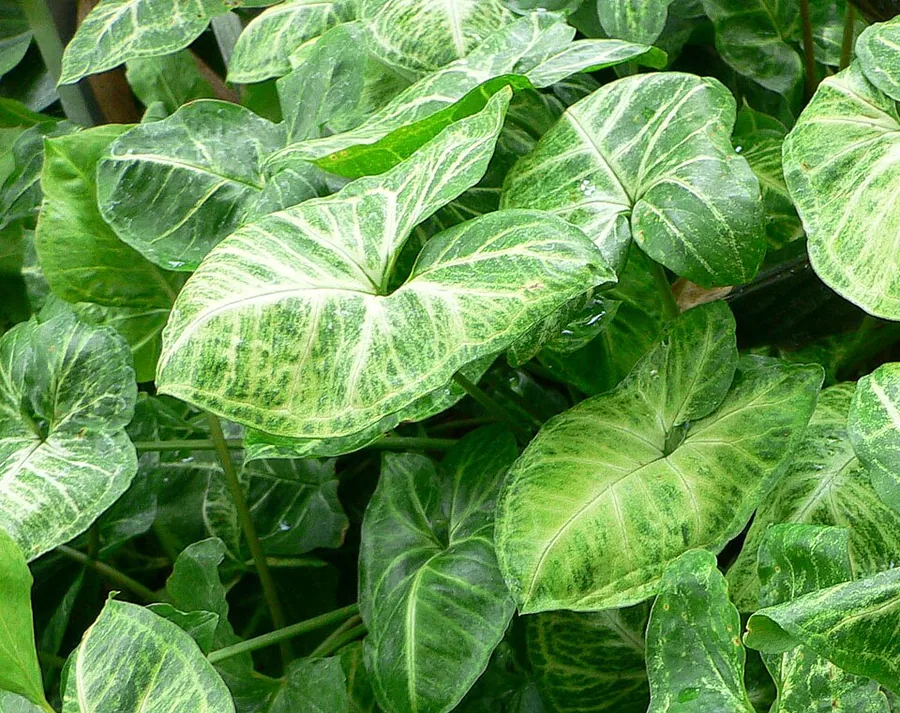
The arrowhead plant grabs its name from those young leaves that punch up in a crisp arrowhead shape on a low, bushy plant. It ranges from Mexico straight through tropical America, sits firmly in the arum family, and just keeps giving as one of the most forgiving houseplants going. Green, variegated, pink-veined, the lineup runs wide, so there is real fun in picking a favorite.
Then comes the best part, the way it transforms as it grows. That tidy juvenile takes off into a climbing vine, the stems racing out and the leaves splitting into several leaflets. The direction is entirely yours to drive. Run it up a moss pole, let it pour out of a hanging basket, or keep pinching it back to pack it into a dense, leafy mound.
And it rewards barely any effort. Bright indirect light, soil kept lightly moist, and warm air keep it surging, and it bounces back from the odd skipped watering. The one rule worth taking seriously is the sap, which holds calcium oxalate crystals that irritate mouths and skin, so park it somewhere pets and small children cannot get a bite of the leaves.
Care
The short version: hand it bright indirect light, keep the soil lightly moist but never soggy, and wrap it in warm, humid air. Dial the water down in winter, and give it a pole or basket the moment it starts to vine.
Light
Hand it bright, indirect light and the color pops and the growth piles on. It powers through medium light and even low light, but direct sun scorches the leaves, so pull it back from a hot window.
Water
Keep the soil lightly moist but never soggy all through the growing season, watering the moment the top starts to dry. Pull back hard from fall through late winter, when the plant slows and wet soil flips to root rot fast.
Soil
Pot it in a light, well-draining potting mix with a soil base. Free drainage is the whole game here, since water pooling at the roots is the quickest way to lose this plant.
Temperature
It thrives in ordinary room warmth, roughly 64°F to 81°F (18°C to 27°C). Steer it clear of cold drafts and chilly windowsills in winter, since it has zero tolerance for frost.
Humidity
This tropical lover wants high humidity, ideally 60% or more. It pushes on in average household air, but the leaves really shine with a humidifier nearby or a spot in a steamy bathroom or kitchen.
Feeding
Feed it through active growth in the warmer months with a balanced foliage-plant fertilizer. A few feedings across the growing season do the trick, and you can quit once growth slows in fall.
Pruning
It takes a hard cutting back and bounces right back, so prune with confidence. Pinch and prune to shape it, whether you are after a compact mound, a trailing basket, or a vine climbing a moss pole or trellis.
Repotting
Repot only when it outgrows its container and the roots crowd the pot. There is no fixed schedule; bump it up a pot size the moment it starts to look cramped.
Size & spacing
Indoors it shoots to about 3 to 6 feet (91 to 183 cm) as a climbing or trailing vine, spreading near 1 to 2 feet (30 to 61 cm). Give it room to vine or a support to climb, and keep air moving around the leaves.
Troubleshooting
Arrowhead plants are tough customers, and nearly everything that trips them up comes straight back to light or water. Catch the early signs on the leaves and stems, match them below, and knock out the cause before it spreads.
Stems and roots going soft, mushy, and rotten
Soggy soil throws the door open to soft rot, a bacterial decay that turns stems and roots to mush. Cut away the rotted tissue, then tackle the cause: swap in a light, well-draining mix and let the pot drain freely. Back the water right off through fall and winter, when the plant drinks far less.
Fix:
- Remove affected tissue
- Improve drainage and avoid waterlogged soil
- Reduce watering, especially from fall through late winter
Scorched, washed-out blotches blasting the leaves
Too much direct sun scorches arrowhead leaves, blasting washed-out or crisp patches wherever the light hits hardest. Shift the plant to bright indirect light or dappled shade and the fresh growth roars back clean.
Fix:
- Move plant out of direct sun to a bright indirect or part-shade location
Dark spots racing across the leaves
Distinct dark lesions usually flag bacterial leaf spot, which rides on wet foliage. Strip off the marked leaves and keep water off the leaves from there on. Strong air movement around the plant does most of the heavy lifting in shutting it down.
Fix:
- Remove affected leaves
- Avoid wetting foliage and improve air circulation
Webbing, fuzzy clumps, and sticky mangled new growth
A handful of common pests come knocking on arrowhead plants, and each one leaves its own tell. Spider mites stipple the leaves and spin fine webbing, mealybugs turn up as white cottony tufts, aphids pile onto soft new growth, and scale clamps onto stems as hard little bumps. Pull the plant aside the second any of them show, wash the pests off, and follow up with an insecticidal treatment.
Fix:
- Inspect and isolate the plant
- Wash off pests and treat with an appropriate insecticidal control
Stems shooting out long and bare, foliage sparse
This is the arrowhead plant hitting its stride, not a stumble. It starts bushy and compact, then kicks into its natural vining habit as it matures, so the stems shoot out and trail. Run it up a moss pole or trellis, let it spill from a hanging basket, or pinch the stems back to pack it full and tidy.
Fix:
- Provide a moss pole or trellis for the plant to climb
- Grow in a hanging basket to let stems cascade
- Prune or pinch stems to keep the plant compact and bushy
Toxicity
This is one to keep up and out of reach. Every part packs insoluble calcium oxalate crystals, and a single bite stings the mouth on the spot. The sap can irritate skin too, so handle cuttings with care and set the plant where pets and children cannot get at it.
Toxic to
Cats · Dogs · Horses · Rabbits · Livestock · Birds · People
Cats Moderate
Let a cat chomp a leaf and the sting lands right away. Look for gushing drool, frantic pawing at the mouth, a raw, puffed-up tongue and lips, and often vomiting and hard swallowing close behind.
Dogs Moderate
Dogs go the same route cats do. One touch lights up the mouth, so keep an eye out for drooling, swelling at the tongue and lips, vomiting, and a real hesitance to swallow.
Horses Moderate
Those crystals fire up the mouth and throat of a horse, kicking off drooling, swelling, and tough swallowing. Horses have no way to vomit, so the trouble sticks to its mouth and stomach.
Rabbits Toxic
Keep the arrowhead plant well out of a rabbit's reach. The same calcium oxalate crystals that harm cats and dogs irritate a rabbit's sensitive mouth and gut, and this is not a safe green to offer.
Livestock Toxic
Farm animals that chomp the foliage swallow a painful hit of oxalate crystals, with drooling and a swollen mouth the common outcome. Wall it off from any stock likely to graze it.
Birds Toxic
Birds get no free pass on the sap either. Let a pet bird peck the leaves and it can wind up with the same burning, swollen mouth, so keep those cages and perches nowhere near it.
People Caution
Nobody should be eating any part of this plant. Nip a leaf and a sharp burn floods the mouth, and the sap can sting bare skin, so scrub your hands after cutting and keep it clear of small children.
All parts contain insoluble calcium oxalate crystals; sap can irritate. UF/IFAS notes the toxic sap makes mechanical handling (e.g., string trimming) inadvisable outdoors
Helpline numbers

United States
ASPCA Animal Poison Control: (888) 426-4435 (fee applies)
Poison Control: (800) 222-1222



Canada
Poison Centres: 1-844-764-7669
Varieties
Growers have chased the arrowhead plant hard for leaf color and pattern, sweeping from near-white to bright green to deep pink veins. Here are a few of the named cultivars to hunt down.
'White Butterfly'
Its greenish-white leaves are washed with creamy white-yellow veins and edged in dark green, the palest pick of the lineup.
'Pink Allusion'
Bred in Florida, it runs deep pink veins down the centers of light olive-green leaves, and that pink keeps its punch as the leaves age.
'Robusta'
A named cultivar cranked out by commercial Syngonium growers, raised to UF/IFAS specs.
'Neon'
Yet another commercial selection called out in the UF/IFAS interiorscape Syngonium guidelines.
'Lemon Lime'
Another production cultivar drawn from those UF/IFAS guidelines, tagged for its vivid green tone.
How to propagate
Making more of this plant is almost too easy, and that is the joy of it. A cutting taken in the warm months roots practically on its own, and patient growers can air-layer a longer stem to start a fuller new plant.
Stem cuttingsEasy
Spring to summer · Roots in a few weeks
This is the easy win, and the plant practically pulls it off for you. Grab a tip or nodal cutting in spring or summer as long as it carries a node, and any aerial roots already on the stem give it a flying start. Stand it in water or moist potting mix and it roots within a few weeks.
Air layeringModerate
Spring to summer · Several weeks
Air layering takes more patience but pays off big, and it is the method commercial growers lean on to bulk up Syngonium. Wound a stem and wrap it in spring or summer, then wait several weeks for roots to form before you cut the new plant free.
Myths
Arrowhead plants are just philodendrons going by another name.
They bunk together in the arum family, which kicks off the confusion, but the arrowhead plant is Syngonium podophyllum, a separate genus from Philodendron. The foliage blows the cover: young leaves rock the arrowhead shape behind the name, then mature into compound leaves split into 3 to 11 leaflets, a trick philodendrons never pull.
Sources
- Plants of the World Online, Royal Botanic Gardens Kew
- NC State Extension Gardener Plant Toolbox
- Missouri Botanical Garden Plant Finder
- ASPCA Animal Poison Control
- Atlas of Florida Plants, Institute for Systematic Botany, University of South Florida
- UF/IFAS Plant Directory
- UF/IFAS EDIS (EP244, Cultural Guidelines for Commercial Production of Interiorscape Syngonium)