Ornamental · Polemoniaceae
Creeping Phlox
Phlox subulata
Give it full sun and sharp drainage, and creeping phlox throws down a spring carpet of color.
Full sun
Every 7–14 days
USDA 3–9
4–6 in · 10–15 cm
Overview
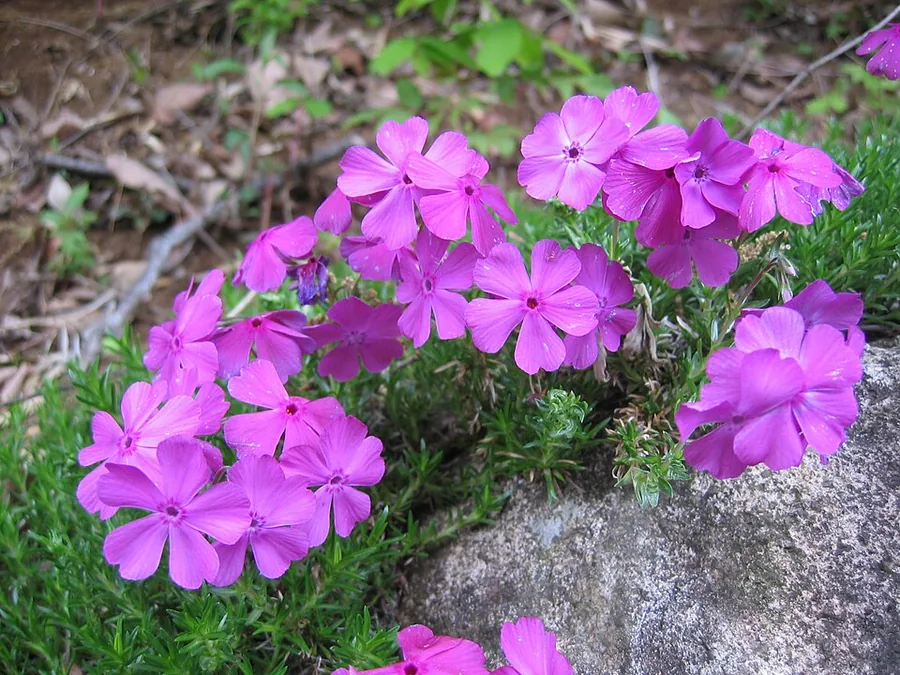
Spring really kicks off the moment creeping phlox hits its stride. This low, mat-forming perennial races into a dense carpet of needle-like foliage, then buries itself under a wave of flowers in early to mid spring. It dives straight into the dry, rocky ground of slopes, walls, and rock gardens, claiming the tough spots where plenty of other plants stall out.
And it keeps earning its place long after the petals drop. The evergreen mat powers through hot summers and brutal winters, brushing off cold all the way down to -40°F (-40°C). Once it digs in, it gets along on just sun and soil that drains.
Just keep it straight from garden phlox, the tall summer perennial that grabs the same name. Creeping phlox stays ankle high and creeps outward instead of shooting up, and that low, spreading drive is exactly what makes it such a winner between stones and along the front of a border.
Care
The short version: give it full sun and sharp-draining sandy or gravelly soil, and once it digs in, water only through long dry spells. Shear it back by half after the flowers fade and the mat bounces back dense and full.
Light
Creeping phlox blooms hardest in full sun, and it will take partial shade, though the flowers drop off the shadier it gets. Plant it in an open, sunny spot and it floods itself with color.
Water
Once it digs in, the plant turns drought tolerant and only wants water through long dry spells. It loves fast-draining ground and even powers through dry, rocky conditions, so let the top half of the soil dry between waterings.
Soil
Get it into sandy or gravelly, humus-rich soil that drains freely, since soggy roots are its one real enemy. A pH from 5.5 to 7.0 keeps it firing, and a slope or raised bed sends excess water packing.
Temperature
This is one rugged, cold-hardy plant that powers through -40°F to 95°F (-40°C to 35°C). It needs zero winter protection across its range and charges back every spring.
Humidity
Plain outdoor air does the job, so skip the humidity chase. What really counts is good drainage and airflow, since damp, stagnant conditions are what kick off foliar trouble.
Feeding
It runs great on lean soil and barely asks to eat. A light feed of balanced general-purpose fertilizer in spring is all it wants, and piling on more only pushes soft, floppy stems.
Pruning
The second the flowers fade, cut the stems back by about half. That single shearing drives the mat dense and compact, blocks the center from going woody and bare, and sharpens up the whole planting.
Size & spacing
The mat stays low, just 4 to 6 inches (10 to 15 cm) tall, while each plant runs 24 to 35 inches (60 to 90 cm) wide. Hand it that room and it weaves itself into one solid carpet.
When to plant
Creeping phlox lives for its spring show, so the year turns on planting it and giving it one well-timed cut. Set new plants out in spring or early fall, soak up the bloom from April into May, and shear the mat back the moment the flowers finish.
Northern hemisphere
Southern hemisphere
Typical months for a temperate climate: start earlier in warm zones, later where spring frosts linger.
- Sow: Usually propagated vegetatively rather than from seed; not typically sown indoors.
- Plant: Plant in spring or early fall in a sunny, well-drained site.
- Harvest: Blooms in early to mid spring, roughly April to May.
Hardiness
USDA hardiness zones: 3–9
Temperature: down to -40°C
Troubleshooting
Creeping phlox cruises along trouble-free most years, and what little crops up lands on the foliage or shows as a thinning mat. Learn the few signs below and you can pounce early. Match what you spot, then act while it still pays off.
Dotted, bleached foliage draped in delicate webs
Catch the foliage going speckled and dull with a hint of webbing underneath and you have likely met spider mites, which pile in during hot, dry weather and sap the color from the leaves. Knock them loose with a strong jet of water and keep the plants watered so they never stress out. Bring in insecticidal soap or horticultural oil if any mites refuse to quit.
Fix:
- Spray foliage with a strong jet of water to dislodge mites
- Improve airflow and avoid drought stress
- Treat with insecticidal soap or horticultural oil if needed
Curled, mottled foliage in humid, rainy runs
Long warm, soggy stretches let foliar nematodes push into the leaves and warp them, but jumping on it early keeps the planting on track. Snap off and bin the damaged foliage the moment it shows. Switch to watering at the base, open the bed up for air, and watch the trouble fade.
Fix:
- Remove and destroy affected foliage
- Avoid overhead watering and improve drainage
Stems snipped and munched at the mat's base
Spot clean little cuts on the stems near the soil and rabbits are almost certainly grazing the mat. Throw up a low fence or dab on a repellent and they move along. Fresh plantings pull them in fastest, so cover those right away wherever rabbit traffic runs high.
Fix:
- Use fencing or repellents to deter rabbits
Center of the mat turning hollow and twiggy
When the middle goes woody and hollow while the edges keep racing outward, the plant is begging for a cut it never got. Shear the stems back by roughly half right after the blooms fade and fresh, packed growth charges right back in. Dig up a few of the vigorous outer pieces and drop them into the gap to fill it even faster.
Fix:
- Shear stems back by about half after bloom to promote dense regrowth
- Divide and replant vigorous outer sections
Toxicity
Pet owners and anyone with grazing animals can plant with a grin: creeping phlox is safe all around. The ASPCA lists moss phlox as non-toxic to cats, dogs, and horses, and it poses no risk to other animals or people. Drop it anywhere you like.
Safe for
People · Cats · Dogs · Horses · Rabbits · Livestock · Birds
Cats Safe
Cats get the all-clear here, since the ASPCA lists moss phlox as non-toxic to them, so a curious nibble means nothing.
Dogs Safe
Dogs can dig in and chew the mat to their hearts' content, because the plant holds no toxin that touches them.
Horses Safe
Horses grazing near a planting stay safe, as creeping phlox packs nothing poisonous to them.
Rabbits Safe
Rabbits happily browse the foliage, and while they trim it down, it does them no harm whatsoever.
Livestock Safe
Cattle, goats, and sheep can graze right around it, since the plant carries nothing toxic to farm animals.
Birds Safe
Birds working the flowers or seeds come away just fine, with no harm from this plant.
People Safe
People are safe around it too, though it earns its keep as a show plant rather than something for the plate.
Varieties
Named cultivars run deep, separated mostly by flower color and how hard they fight off disease. These few are the ones to chase down.
Emerald Blue
A standout that piles bluish purple flowers thick across a low, even mat.
Fort Hill
A real fighter that stands firm against Phytophthora, the root and stem rot that takes out weaker plants.
White Delight
A bright white-flowered cultivar that also shakes off southern blight.
How to propagate
Pumping out more creeping phlox is a breeze, whether you split an old mat or root a handful of cuttings from a plant you already grow.
DivisionEasy
Divide in early spring or after flowering. · One growing season
The quickest way to grow your stash is to dig up an established mat and split it in early spring or once the flowers wrap up. Tear the strong outer pieces free of the spent center, plant them in well-drained soil, and they dig in over a single growing season.
Stem cuttingsEasy
Take cuttings in late spring or early summer. · Several weeks to root
Rooting stem cuttings in late spring or early summer is just as fun and easy. Tuck them into moist, well-drained media and let them go, and within a few weeks they strike roots and grow out as exact copies of the parent.
Myths
Buying creeping phlox gets you the very plant sold as garden phlox.
They borrow one name but go their separate ways. Creeping phlox hugs the ground in a mat and bursts into bloom in spring, while garden phlox climbs tall and upright and flowers in summer. They are two different species that grow nothing alike, so scan the label before you grab one.
Creeping phlox counts as a toxic plant for dogs and cats.
Great news for pet keepers: not a chance. The ASPCA lists moss phlox as non-toxic to dogs, cats, and horses, so a pet that grabs a mouthful of foliage runs no risk at all. Plant it wherever your animals love to roam and enjoy it.