Tree · Rosaceae
Pear
Pyrus communis
Plant a pair of pears for cross-pollination, drench them in sun, add patience, and reap fruit for decades.
Full sun
Every 7–14 days
USDA 4–8
40–50 ft · 12.2–15.2 m
Overview
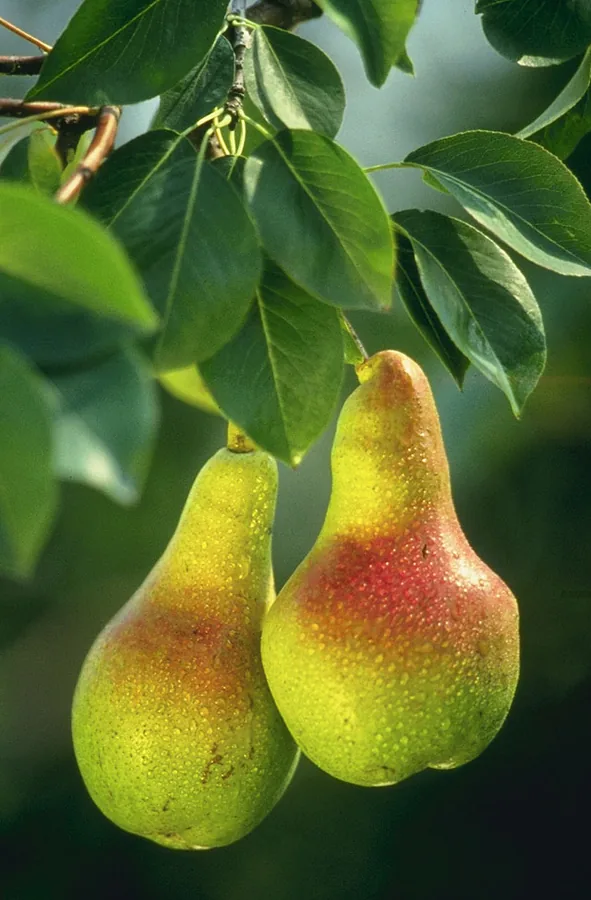
Planting a pear sets you up for the long game, and that is half the fun. Pyrus communis is a deciduous tree in the rose family, running with apples, cherries, and plums, and a thriving one shoots up 40 to 50 feet (12 to 15 m) tall and keeps going for generations. Spring drapes it in clouds of white bloom, and then the familiar bell-shaped fruit swells into view.
A pear really hits its stride with a companion nearby. Most crop poorly alone, so they bank on cross-pollination, which means slotting in a second compatible cultivar that blooms at the same time and letting the bees shuttle between them. Named varieties will not come true from seed either, so the tree you bring home is grafted onto a rootstock you choose, a full-size pear or a dwarfing quince.
Here is the twist that keeps new growers on their toes, and it is a satisfying one to nail. European pears ripen off the tree, not on it, so you pick them mature but still firm and coax them to a buttery finish indoors. Time that harvest, pair up a pollination partner, stay a step ahead of fire blight, and the tree just keeps delivering.
Care
The short version: load it up with full sun, deep and well-drained ground, plus a second pear close enough to pollinate. Water young trees faithfully, prune in the dormant weeks toward a single central leader, and hold nitrogen back so fire blight never gets going.
Light
Pears crop their heart out in full sun, where at least six hours of direct light a day powers strong flower and fruit set. A little afternoon shade is no big deal, but park one in real shade and you land weak growth and a thin harvest.
Water
Pour on about 1 inch of water a week, and keep young trees steadily moist while their roots dig in. Established pears shrug off dry spells with ease. Aim the water at the ground rather than over the canopy, since wet leaves roll out the welcome mat for disease.
Soil
Pears crave deep, fertile, well-drained loam, though they will muscle through clay or sand as long as water keeps moving. Dial in a pH of 6.0 to 7.5, landing on the slightly acidic to neutral side.
Temperature
These trees are tough as nails in the cold, cruising from about -20°F to 95°F (-29°C to 35°C) and right at home in USDA zones 4 through 8. That winter chill earns its keep, since the buds demand a cold rest before they break in spring.
Humidity
Regular outdoor air around 40% to 70% humidity keeps a pear cruising, so it barely registers. Airflow through the canopy is the real player, because still, damp conditions are exactly where fire blight and scab dig in.
Feeding
Feed in early spring before bud break with a balanced N-P-K fertilizer, roughly once a season, and the tree runs with it. Ease off the nitrogen, though, since a rush of soft, sappy growth is just the target fire blight loves to chase.
Pruning
Prune in late winter while the tree is dormant, steer a young one to a single central leader, and strip out crossing, dead, or diseased wood. If fire blight crashes in, cut 8 to 12 inches below the visible canker and wipe your tools clean between every cut.
Repotting
Pears rarely ride in containers, but a dwarf tree in a big pot thrives when you top-dress it each year and repot every 2 to 3 years. Swap in fresh soil at the same time to keep the roots charged.
Size & spacing
A standard pear rockets to 40 to 50 feet (12 to 15 m) tall and spreads 25 to 35 feet (7.5 to 10.5 m) wide, so hand it open ground well clear of buildings and power lines. A cross-pollinating pair still needs room for air to sweep between them.
When to plant
Get a pear into the ground while it is dormant and bare and you are off to a flying start. Plant in early spring, or in fall where winters stay mild, and it bursts into white bloom come early to mid spring. The fruit rolls in from late summer into fall, picked firm and ripened off the tree.
Northern hemisphere
Southern hemisphere
Typical months for a temperate climate: start earlier in warm zones, later where spring frosts linger.
- Plant: Early spring while dormant, or fall in mild-winter regions
- Harvest: Blooms early to mid spring; European pears are harvested mature but still firm in late summer to fall and ripened off the tree
Hardiness
USDA hardiness zones: 4–8
Temperature: down to -34°C
Troubleshooting
Pears tangle with just a short list of recurring troubles, and fire blight leads the pack by a mile. Keep your eyes on the new growth in spring and the fruit through summer, since that is where the first signs pop up. Match what you see below, then pounce before it runs through the tree.
Shoot tips blacken fast and hook over like a shepherd's crook
Meet fire blight, a bacterial infection that catches a ride in on the blossoms during warm, wet spring weather and then charges down the shoots. Get to know its calling cards fast: the hooked tip, scorched leaves welded to the wood, and beads of ooze dotting the cankers. Move on it by cutting the infected wood 8 to 12 inches below the damage on a dry day, and swipe your tools clean between cuts so nothing hitches along to healthy branches.
Fix:
- Prune out infected wood 8 to 12 inches below visible symptoms during dry weather
- Disinfect pruning tools between every cut and remove and destroy prunings
Sticky leaves coated in sooty black mold and curling fast
Sticky, sooty leaves put pear psylla in the frame, tiny insects that pile onto the new growth and drip honeydew, which the black sooty mold then colonizes into a dark film. Zero in on the fresh shoots and you will catch the little nymphs parked right in the droplets. Hit the overwintering pests early with a dormant horticultural oil before bud break, and only bring an insecticide into play once monitoring flags the numbers running high.
Fix:
- Apply dormant horticultural oil before bud break
- Use recommended insecticides only if monitoring thresholds are exceeded
Wormy fruit shot through with frass-packed tunnels, dropping early
A wormy pear points straight to codling moth, whose larvae drill into the developing fruit and stuff the tunnels with frass near the core. Slice a damaged pear open and the larva's route jumps out at you. Stay on top of it by clearing infested and dropped fruit the moment you spot it, and hang pheromone traps to pin down the moths' flight so any control lands right on target.
Fix:
- Remove and destroy infested and dropped fruit
- Use pheromone traps to time controls
Velvety dark spotting racing across leaves, fruit scabby and cracked
A wet spring hands you pear scab, a fungus that stamps velvety olive-to-black lesions across the leaves and roughens the fruit with corky, cracked patches. Break its cycle by raking up and destroying the fallen leaves where it overwinters, prune to throw open the canopy for airflow, and lean into resistant cultivars. When a soggy season really pushes, a fungicide through the infection period backs you up.
Fix:
- Rake and destroy fallen leaves
- Apply fungicides during the infection period if needed
Toxicity
The ripe flesh of a pear is a wholesome, safe fruit for people and harmless to most pets in small amounts, so you can grow it with an easy mind. The catch rides in the seeds, bark, and wilting leaves, which carry cyanogenic compounds common to the rose family. Scoop up fallen fruit and prunings, and keep seed-laden cores and wilted foliage clear of horses, livestock, and grazing pets.
Toxic to
Cats · Dogs · Horses · Rabbits · Livestock · Birds
Safe for
People
Cats Caution
A quick lick of ripe flesh will not faze a cat, so the parts to keep clear are the seeds and wilting leaves. A few chewed seeds or some wilted foliage can turn the stomach, and a true cyanide reaction, rare as it runs, brings on drooling and labored breathing.
Dogs Caution
A bit of ripe pear goes down fine with a dog, so the core is the piece to whisk away. Crunch through the seeds or graze wilted leaves and a dog may sour its stomach, and a big dose can leave it weak and panting from the cyanogenic compounds packed inside.
Horses Caution
Horses top the watch list, since they will hoover up windfall pears by the mouthful. Pile in enough fallen fruit, seeds, and wilted leaves and it can spark colic, and at the far end, cyanide poisoning that flares as trembling and gasping.
Rabbits Caution
A small bite of ripe pear makes a great treat for a rabbit, but the seeds and wilted greens stay out of the hutch. Their small size means even a modest amount of the cyanogenic parts can knock digestion off track.
Livestock Caution
Cattle, sheep, and goats will pile onto dropped fruit and the wilting leaves off pruned or storm-broken branches. That wilted foliage packs the most cyanide, and a big feed risks staggering, rapid breathing, and collapse.
Birds Caution
Chickens and other backyard birds will happily peck ripe pear flesh with zero trouble. The seeds are the snag, since they carry the cyanogenic compound, so scoop out the cores before sharing any.
People Ripe fruit safe
Ripe pear is a wholesome, safe fruit to dig into. Just skip making a habit of swallowing the seeds, which hold the same cyanogenic compound running across the rose family.
Pets nibbling a little ripe pear flesh are unlikely to be harmed, but discard cores and seeds. The main real-world concern is horses and livestock eating large quantities of fallen fruit and seeds or wilted foliage.
Helpline numbers

United States
ASPCA Animal Poison Control: (888) 426-4435 (fee applies)
Poison Control: (800) 222-1222



Canada
Poison Centres: 1-844-764-7669
Varieties
European pears show up under a handful of names you will meet over and over at the market and the nursery. These are the ones worth chasing down, and most want a partner to crop.
Bartlett (Williams)
The most widely grown European pear, flaunting a classic bell shape that flips from green to yellow as it ripens and shining just as bright fresh or canned.
Bosc
Instantly spotted by its long tapering neck and russeted cinnamon-brown skin, packing firm, dense flesh that holds its shape when you cook it.
Anjou (D'Anjou)
An egg-shaped pear whose green skin, or red on Red Anjou, clings to its color even when ripe, so you clock readiness by the softening at the neck.
Comice
The rounded greenish-yellow fruit crowned the Christmas pear and adored for its sweet, juicy, buttery flesh.
How to propagate
Pears get multiplied by grafting rather than by rooting cuttings or sowing seed, because a named variety only holds true when it is grafted onto a rootstock.
GraftingModerate
Whip-and-tongue bench graft in late winter while dormant, or chip/T-bud in summer · Grafted trees typically begin bearing in about 3 to 6 years
Named cultivars refuse to come true from seed, so growers graft them, and it is a genuinely rewarding skill to pick up. Run a whip-and-tongue bench graft in late winter while the wood sits dormant, or switch to chip or T-budding through summer. Pear seedling rootstock powers a full-size tree, quince reins it in small, and a handful of cultivars call for a compatible interstem to knit together. A grafted tree kicks into bearing in about 3 to 6 years, so the payoff is worth the wait.
SeedModerate
Sow after 60 to 90 days of cold, moist stratification in spring · Several years
Sowing pears from seed is a breeder's and nursery's playground, not a shortcut to cloning a tree you love. Drop the seed in spring after 60 to 90 days of cold, moist stratification to snap it out of dormancy. The seedlings need several years to get going and never come true to the parent, which is exactly why they end up as rootstock or breeding stock.
Myths
Pears ripen right on the branch, exactly like apples.
European pears like Bartlett, Bosc, Anjou, and Comice flip the apple playbook right over. Pick them mature but still firm and let them ripen off the tree, because fruit left to hang ripens from the inside out and slumps into a mealy, gritty mess. Asian pears break the rule and do ripen on the branch.
One pear tree alone fruits heavily without a partner.
One tree flying solo usually leaves the basket half empty. Most pears need a second compatible cultivar blooming at the same time to cross-pollinate and load up a good crop, so line up a pair right from the start.