Ornamental · Caryophyllaceae
Sweet William
Dianthus barbatus
Drop it into a sunny, sharply drained bed, let it seed itself, and Sweet William packs the garden with clove-scented clusters year on year.
Full sun
Every 3–7 days
USDA 3–9
12–24 in · 30–60 cm
Overview
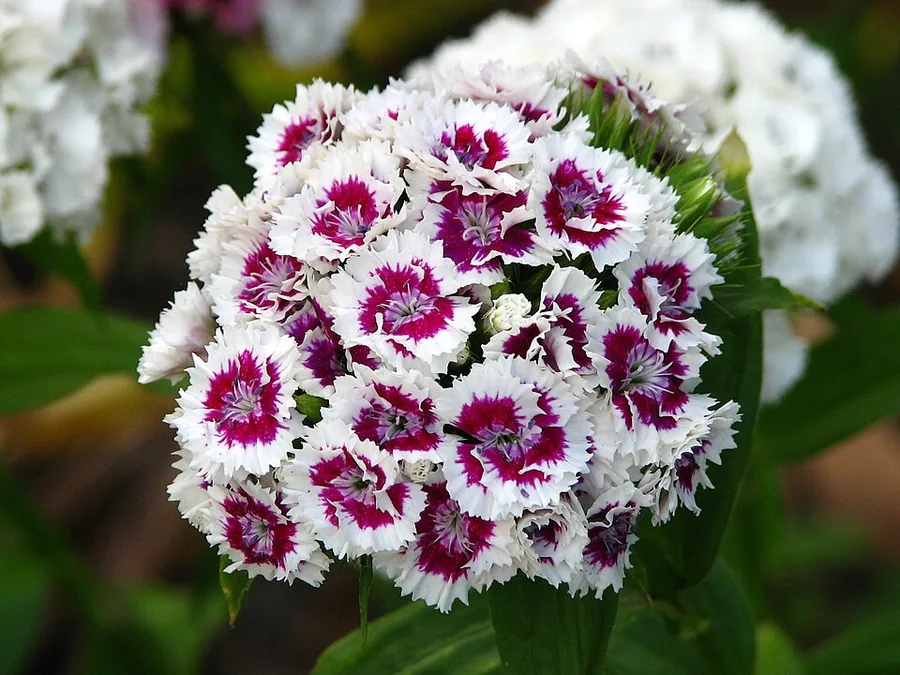
Sweet William is a cottage-garden classic worth getting excited about. It piles its small flowers into dense, flat-topped clusters across white, pink, red, and bicolors, and so many wear a contrasting eye that a patch practically hums with pattern. A card-carrying member of the pink family, it grows alongside carnations and garden pinks and hails from the mountains of southern Europe. The blooms throw off a light clove scent that keeps bees and butterflies working the flowers all day.
Get to know its clever life cycle and it becomes even more fun to grow. Most Sweet William runs as a biennial or short-lived perennial: it builds a leafy rosette the first year, then bursts into flower the next spring and early summer and sets seed. Let that seed drop and sprout, and the patch keeps reinventing itself, so a bed can power on for years even though each plant is only passing through.
The payoff comes fast for very little effort. Hand it full sun, soil that drains freely, and open air around the leaves, and you have ticked nearly every box. Nail the drainage and the rest takes care of itself, because soggy ground is the one thing that invites crown rot and the fungal problems that cut these plants short. Get that right and it just keeps rewarding you.
Care
The short version: grow Sweet William in full sun, with a little afternoon shade where it gets hot, in rich free-draining soil kept evenly moist and dry at the leaves; deadhead to push more bloom, and leave a few flowers to self-sow so it comes roaring back next year.
Light
Sweet William really turns on the flowers in full sun, though it will take a little afternoon shade where summers run hot. Push it into too much shade and the bloom thins while the stems go weak and start to flop, so give it all the light you can.
Water
Keep the soil evenly moist in a bed that drains fast, and never let it lurch from bone-dry to soaked. Water down low with a soaker or drip line to keep the leaves dry and happy. If overhead watering is your only option, run it in the morning so the foliage dries by nightfall and fungal disease never gets its foot in the door.
Soil
Plant it into deep, rich, free-draining loam or sandy loam, and mix in compost before you set anything out. It shrugs off a wide pH range from 6.0 to 8.0, so neutral to slightly alkaline ground that stumps fussier plants only makes it happier.
Humidity
Skip the humidity worries, since ordinary garden air is all it wants and there is no number to hit. What really moves the needle is airflow, because damp, crowded leaves are exactly the invitation rust and crown rot are looking for.
Feeding
Feeding is refreshingly minimal. Dig a balanced general-purpose fertilizer into the top 4 to 6 inches of soil while you build the bed, and that early charge of fertility drives the plants clean through the season.
Pruning
Deadhead the spent flowers and the plant answers with more bloom and a stronger push toward perennial habits. Just mind the catch with biennial plantings: strip off every flower and you shut down the self-seeding that fires up next year's plants, so leave a few blooms to set seed if you want an encore.
Size & spacing
Expect plants to hit 12 to 24 inches (30 to 60 cm) tall and fan out 6 to 12 inches (15 to 30 cm) wide. Give each one that room and air rushes through the clump, keeping the foliage crisp and dry.
When to plant
Sweet William plays a slow game, and it is well worth the wait. Sow in late winter to early spring, or in late summer to early fall, then move the young plants out around late spring. Most hold their flowers for the following year, opening from late spring into summer wherever the air stays cool, and the anticipation only makes the display sweeter.
Northern hemisphere
Southern hemisphere
Typical months for a temperate climate: start earlier in warm zones, later where spring frosts linger.
- Sow: Late winter to early spring, or sow in late summer/early fall for bloom the following year
- Plant: Direct sow or transplant in late spring; fall-sown seedlings may be set out for next-year bloom
- Harvest: Late spring to early summer, often continuing into summer in cooler climates
Hardiness
USDA hardiness zones: 3–9
Temperature: down to -40°C
Troubleshooting
Nearly every problem Sweet William runs into circles back to two culprits: soggy soil and stagnant air. Catch the early signals on the leaves and at the crown and you can jump on trouble before it costs you a plant. Track down the match below, then move fast while it counts.
The plant caves in and rots at the soil line
When a plant collapses and rots right at the base, crown rot is the culprit, and it moves in wherever the crown sits in soggy, poorly drained soil. There is no rescuing an affected plant, so pull it and toss it without delay. Then go on the offensive: sharpen the drainage, open up space for air to move, and aim your water at the base instead of over the top.
Fix:
- Remove and discard affected plants
- Improve soil drainage
- Avoid overwatering and overhead watering
One side yellows and wilts while the stems rot
Lopsided yellowing and wilting flags fusarium wilt, a soil fungus that jams the stem from the inside, and nothing turns it around once it lands. Pull the plant, destroy it, and steer clear of replanting Dianthus in that soil. Kick off fresh with clean, free-draining soil and disease-free seed or cuttings, and the next round gets a fair shot.
Fix:
- Remove and destroy infected plants
- Avoid replanting Dianthus in the same soil
- Use pathogen-free planting material
Rusty blisters popping up on the leaves
Those raised, rust-red bumps spell rust, a fungus that jumps onto damp foliage whenever the air stalls. Strip off the marked leaves and burn or bin them, then spread the plants out so a breeze can rip through. Keep water off the foliage, and only bring in a protective fungicide if the spots keep marching outward.
Fix:
- Remove and destroy infected foliage
- Improve air circulation
- Apply a protective fungicide to healthy plants if needed
Ragged holes and glistening trails on the leaves
Chewed, ragged leaves paired with a glistening trail hand you slugs and snails, and they surge after damp weather. Head out at dusk and pick them off by hand for an easy win. Sweep away the leaf litter and boards they hide beneath, shift watering to the morning to dry the surface, and lay down baits or barriers anywhere they keep charging back.
Fix:
- Hand-pick slugs and snails in the evening
- Remove garden debris that provides shelter
- Use slug baits or barriers as needed
Toxicity
Sweet William is a joy to grow, but it earns a mild toxic label rather than a clean bill. Like the rest of the dianthus and carnation crowd, it packs saponins that can upset a pet's stomach, and the sap leaves some people with itchy skin. Go ahead and enjoy the petals when the plant is grown clean, but skip the leaves and keep curious pets and kids away from the foliage.
Toxic to
Cats · Dogs · Horses · Rabbits · Livestock · Birds · People
Cats Mild
A cat that chews a leaf will likely drool, be sick, or run into some diarrhea, and a brush against the plant can raise a patch of mild skin irritation.
Dogs Mild
Let a dog gnaw the foliage and expect an upset stomach with vomiting and loose stools, plus mild dermatitis wherever the sap lands on skin.
Horses Caution
The very saponins that bother cats and dogs can hand a grazing horse a mild stomach upset, so keep clumps well out of its reach.
Rabbits Caution
Count it as off-limits for rabbits, since the foliage can churn up their sensitive gut and the risk simply is not worth it.
Livestock Caution
Grazing livestock rarely make a beeline for it, but a mouthful of leaves can stir mild digestive trouble from the plant's saponins.
Birds Caution
Little points to birds eating it, yet the irritant compounds make keeping curious pet birds away from the foliage the smart move.
People Caution
Tuck into the petals when the plant is grown clean, but leave the leaves alone to dodge a mild stomach upset, and pull on gloves since the sap leaves some people with itchy, irritated skin.
Wear gloves when handling, as contact with the plant can cause mild skin irritation in sensitive individuals.
Helpline numbers

United States
ASPCA Animal Poison Control: (888) 426-4435 (fee applies)
Poison Control: (800) 222-1222



Canada
Poison Centres: 1-844-764-7669
Varieties
Half the fun is picking a favorite, and Sweet William delivers a whole cast of named selections, from snappy little dwarfs to smoldering dark-flowered forms. Here are a few worth chasing down.
Pinocchio
A compact dwarf that slots straight into bedding schemes and containers.
Sooty
The showstopper with near-black flowers in deep maroon, riding above dark, moody foliage.
Nigrescens
A dark-leaved standout that fires deep crimson blooms over bronze-purple foliage.
How to propagate
Multiplying Sweet William is genuinely satisfying, whether you let it fling its own seed around or split a thriving clump to spread the wealth.
SeedEasy
Direct sow in late spring for bloom the following year, or sow in late summer/early fall; some cultivars bloom the first year if started early. · Germination in about 1 to 2 weeks; plants typically bloom the season after sowing for biennial types
Seed is the easiest and most rewarding way in. Sow it straight into the ground in late spring for flowers the next year, or in late summer and early fall for the same result, and a few cultivars will even bloom the first year when you start them early. Seedlings burst up in 1 to 2 weeks, and since most are biennial they save the big show for the season after sowing. Let it drop seed each year and the patch renews itself, running on like a long-lived perennial.
DivisionEasy
Divide established clumps in spring or early fall · Several weeks to re-establish roots
For the short-lived perennial forms, lifting and splitting an established clump keeps the whole thing vigorous. Divide in spring or early fall, get the pieces back in the ground right away, and give them several weeks to root down before they take off again.
Myths
Sweet William is a rock-solid perennial that comes back on its own every year.
Truth is, it runs as a biennial or short-lived perennial and keeps returning by dropping seed. Snip off every bloom and you kill the reseeding that powers its comeback, so leave a few flowers to set seed if you want plants next year.
Sweet William flowers are just a pretty face with no other use.
Not so, the petals are edible when the plant is grown clean, and cooks sometimes candy them with sugar to jazz up a cake. The leaves, though, play by different rules and can trigger a mild stomach upset if eaten.