Houseplant · Asparagaceae
Agave
Agave americana
Blast it with full sun and gritty, fast-draining soil, leave the watering can alone, and agave races ahead on neglect.
Full sun
50–86°F · 10–30°C
USDA 8–11
6–10 ft · 1.8–3 m
Overview
Agave hits a room like living sculpture, a tough succulent out of the dry country of Mexico and the American Southwest that packs water away to power through long droughts. Each plant throws out a wide rosette of thick, blue-green leaves capped with a hard, needle-sharp point, and a grown one can fan out as wide as it stands tall. Drop it in a pot and it stays trimmer, which is how most people run it indoors or out on a patio.
Best part? This plant asks for next to nothing. Hand it strong light and gritty soil that drains in a blink, then back off, because it would far rather be ignored than fussed over. The single thing that trips it up is wet feet, since waterlogged roots rot in a hurry, especially across a cool winter.
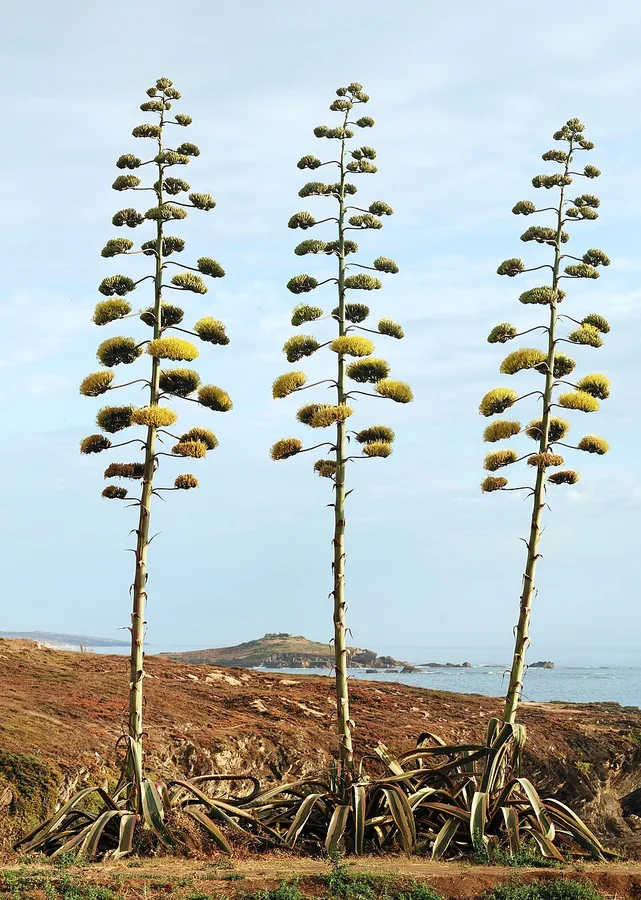
Agave runs monocarpic, so the central rosette gets exactly one bloom, launching a towering stalk skyward after ten or twenty years before it tips over for good. Way ahead of that finale, it keeps firing offsets out around the base, and the plant barrels on through those pups even as the parent clocks out.
Care
The short version: blast it with full sun, set it in gritty soil that sheds water fast, and wait for bone-dry soil before the next drink. Hold it warm and frost-free, feed it next to never, and snap on gloves first, since the spines bite and the sap stings.
Light
Agave craves full sun, the more the merrier, and it'll happily grab a spot that blazes from morning to night. It scrapes by in partial sun or bright indirect light, but a dim corner leaves it pale and leggy. Walk it into strong light step by step so the leaves don't scorch.
Water
Drench it once, then let the soil dry out completely before you go again, a gap that often runs to weeks. Drought is this plant's home turf, and it laughs off a dry stretch far easier than a soggy one. Sodden roots rot in no time, so whenever you waver, sit on your hands.
Soil
Set it up in a gritty, sharply drained sandy or cactus mix that shoots water right on through. Anything from 6.0 to 7.5 on the pH dial works great, ranging slightly acidic up to slightly alkaline. The deal-breaker is a mix that sits damp.
Temperature
Agave thrives between 50°F and 86°F (10°C to 30°C). It powers through real heat without a flinch but balks at cold, wet conditions, so keep it frost-free and on the dry side once winter lands.
Humidity
This dry-climate plant runs best on low humidity and wants zero misting. Damp, stagnant air drags it down, so give it elbow room and let the air whip freely around the leaves.
Feeding
Agave barely wants feeding. A dilute, low-nitrogen cactus and succulent feed once or twice over spring and summer does the trick, and loads of plants storm ahead on none. Overfeed and you only force soft, weak growth.
Pruning
Not much action here. Just clip off dead, shrivelled, or damaged lower leaves at the base, and gear up with thick gloves and eye protection first, thanks to the spine, the toothed edges, and the irritant sap.
Repotting
Repot only every 2 to 3 years, or once it's clearly jammed, since agave hates getting jostled. Keep watch for roots punching out the drainage holes or pups packing the surface, then bump it up just one pot size into fresh gritty mix.
Size & spacing
Out in the ground a grown plant rockets to 6 to 10 feet (1.8 to 3 m) tall and spreads about the same, so hand it real room and steer the spiny leaves off the paths. A pot reins it in smaller and slower, which is how most indoor growers keep its size in line.
Troubleshooting
Almost every agave snag boils down to water or light. Pour on too much water and the roots rot; starve it of light and it turns pale and leggy. Pin down the match below and jump on it early, while a quick fix still pays off big.
A squishy base and a rosette buckling inward
Spot root and crown rot early and you can still turn it around, even though it almost always starts with one watering too many or a mix that clings to moisture. A cold, soggy winter pushes it along. Down tools on the watering, lift the plant out, slice off every soft and blackened scrap with a clean blade, let the cuts harden into a callus, and replant it into a bone-dry gritty mix to start fresh.
Fix:
- Stop watering immediately
- Unpot and cut away all soft, rotted tissue with a clean blade
- Let the cut surfaces callus, then repot in dry gritty cactus mix
- Withhold water until new root growth resumes
Pale, stretched leaves straining toward the window
Park agave somewhere dim and it shoots upward and fades while it hunts for light, a stretch called etiolation. The fresh growth flops over and that crisp, tight rosette loosens and drops its shape. Spring it back by shifting it to the brightest spot going, full sun if you can manage, and dial the strong light back up in stages so nothing scorches.
Fix:
- Move to the brightest available spot, ideally full sun
- Reintroduce direct sun gradually to avoid scorch
Cottony white fluff and brown bumps packed into the leaf joints
Those are mealybugs and scale, a duo that burrows into the snug crannies where the leaves meet the heart of the plant, and they pounce on a stressed indoor agave. Charge a cotton swab with 70 percent isopropyl alcohol and swipe them off, then keep scouting every week until not one comes back. Pull the plant aside on its own while you clear it so the rest of the collection stays clean.
Fix:
- Wipe insects off with a cotton swab dipped in 70 percent isopropyl alcohol
- Repeat weekly until clear
- Isolate from nearby plants
Bleached scorch firing up the sun-facing leaves
That bleaching is sunburn, and it flares when a plant jumps into blazing direct sun before it has toughened up, or when a heatwave rolls through. Let it run dry for too long and the tips brown as well. Ramp the light up across a week or two instead of overnight, throw a touch of shade across the meanest afternoon sun, and clip away only what has genuinely died off.
Fix:
- Increase light gradually rather than abruptly
- Provide light shade during the most intense afternoon sun while acclimating
- Trim only fully dead tissue
Toxicity
Good news up front: nothing about agave poisons from the inside, and the ASPCA's toxic plant list skips right over it. The real dangers are physical ones. That sap is loaded with calcium oxalate and saponins ready to scald and blister skin or sting a mouth that bites in, and the tip of every leaf is a rigid, dagger-like spine ringed with teeth keen enough to sink a deep puncture. Pull on gloves, cover your eyes, and stash it well out of reach of pets and children.
Toxic to
Cats · Dogs · Horses · Rabbits · Livestock · Birds · People
Cats Mild
A cat that bites a leaf might drool, paw at its mouth, or throw up a little, and sap landing on skin or eyes can sting. Watch the sharp tip most of all, since it can punch a puncture.
Dogs Mild
Chewing leaves a dog drooling with a mildly upset stomach, and the sap can irritate skin or eyes. Those stiff leaf spines pack the real injury risk, since they puncture in a flash.
Horses Caution
Agave won't poison a horse from the inside, but a nosy one that mouths the leaves picks up mild mouth and stomach irritation from the sap. The far bigger danger is the rigid tip, which can drive home a deep puncture wound.
Rabbits Caution
Calcium oxalate and saponins in the sap fire up a rabbit's mouth and gut, so this one is off the menu entirely. Stash it well beyond reach, dodging both the stinging sap and those needle-tipped spines.
Livestock Caution
Cattle, goats, and sheep won't take a systemic poisoning, but the irritant sap can leave a mouth sore and a stomach churning. The toothed edges and spear-tipped leaves are the real menace to grazing animals.
Birds Caution
Nothing on record shows birds being systemically poisoned, yet the sap still irritates, so steer it clear of beaks and feathers. A pet bird is way likelier to catch a spine than to come to grief from a bite.
People Caution
The sap can burn, blister, and inflame skin the moment it touches, and a chewed piece sparks mild mouth and digestive irritation. Glove up and shield your eyes, since the dagger-like tip and toothed edges injure far more people than the sap ever pulls off.
Handle with thick gloves and eye protection: each leaf ends in a very sharp, rigid terminal spine and the margins carry hooked teeth that can cause deep puncture wounds or eye injury, and the irritant sap can blister skin.
Helpline numbers

United States
ASPCA Animal Poison Control: (888) 426-4435 (fee applies)
Poison Control: (800) 222-1222



Canada
Poison Centres: 1-844-764-7669
Varieties
Past the plain blue-green species, a handful of agave forms pop up the most, loved above all for the way bright edges and pale stripes light up the leaves. These are the standouts worth knowing by name.
Agave americana 'Marginata'
Wide creamy-yellow bands blaze along its blue-green leaves and outline the entire rosette.
Agave americana 'Mediopicta Alba'
One bold creamy-white stripe shoots straight down the center of every blue-green leaf.
Agave americana var. expansa
It cranks the plain species up into a bigger, looser, wider-spreading plant.
How to propagate
Agave multiplies in a snap, mostly because the plant cranks out pups around its base and does the heavy lifting for you. Seed is an option too, though next to nobody takes it.
Offsets & pupsEasy
Spring to summer during active growth · Several weeks to a few months to root
Pups are the quick, satisfying way to crank out more agave, and the plant practically hands them over. As it grows through spring and summer, pop a rooted offset off the base, let the cut firm up into a callus, and tuck it into dry gritty mix, where roots break in across several weeks to a few months. The founding rosette blooms once in decades and then steps off, but the offsets surge forward and keep the line alive.
SeedModerate
Spring in warm conditions · Several months to over a year to reach a handling size
Sure, you can chase agave from seed too, though barely anyone bothers. Scatter fresh seed across a gritty mix in spring warmth, then settle in to wait, because a seedling can take several months to over a year to bulk up to a size you can handle. Pups blow seed away on speed and ease, which is exactly why seed stays the long shot.
Myths
Agave is a kind of aloe, exactly as the name American aloe makes you think.
Not so fast: agave lands in the Asparagaceae family and aloe in the Asphodelaceae, so they aren't close kin at all. The plump rosettes do look alike, and that's where the match ends. American aloe is nothing but a misnomer.
With a name like century plant, agave surely waits a full 100 years to bloom.
It does flower once before the main rosette dies, but that show usually fires off at about 10 to 25 years, nowhere near a hundred. The century plant tag is just folklore that ran way past the facts.