Houseplant · Aizoaceae
Baby Toes
Fenestraria rhopalophylla
Hand it bright light and the barest splash of water, and this cluster of window-tipped toes just keeps going.
Bright indirect
50–77°F · 10–25°C
USDA 9–11
1–3 in · 3–8 cm
Overview
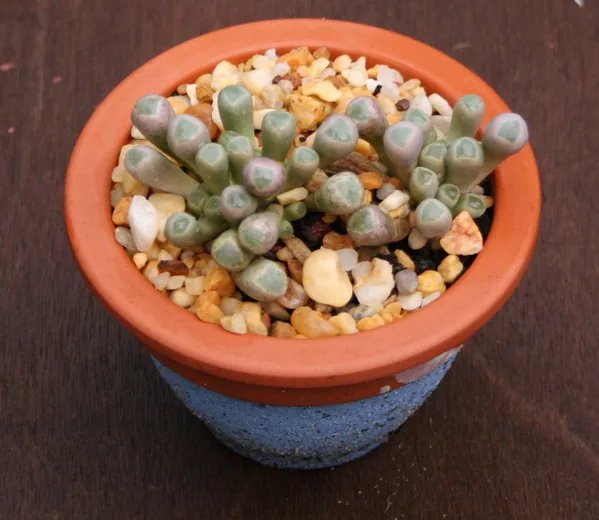
Baby toes packs a lot of character into a tiny package, growing as a tight cluster of upright, club-shaped leaves that each wear a clear pane on top like a little window. The wild backstory makes it even better: out in South Africa the plant lives half-buried in sand with only those windows poking up, channeling light down to the leaf while the rest stays cool below the surface. Grown as a houseplant, it keeps things low and slow, never climbing past 1 to 3 inches (3 to 8 cm) tall.
The name absolutely lands once you look at it. Those fat, rounded leaf tips really do read as a bunch of pale toes wriggling up out of the pot. Stick with a clump until it matures and late summer to autumn brings the payoff, daisy-like yellow to white flowers on short stalks, nearly as wide as the whole plant.
Here is the best part: baby toes thrives on a light touch, which makes it a genuinely fun grow. The one trap to dodge is overdoing the watering can, since the swollen leaves rot fast in damp soil. Dial in the gritty soil and the sparing water and this little plant will hold a bright sill happily for years.
Care
The short version: bright light, a sharply drained gritty mix, and barely any water. Give it the occasional soak in the cooler months, keep it nearly dry all summer, and steer well clear of soggy soil.
Light
Baby toes craves bright light, ideally bright indirect with a hit of gentle direct sun. Ease it into full sun and it eats it right up, but park it somewhere too dark and it stretches and splays open, throwing away the tight little cluster that earned its name.
Water
This is the make-or-break, so keep things lean. Water sparingly and only in the cooler growing season, let the gritty mix dry out all the way between drinks, and hold the plant nearly dry through summer while it naps. Pile on the water and the club leaves split, burst, or rot, fast.
Soil
Set it up in a very gritty, sharply drained mineral or cactus mix that water blasts straight through. A pH anywhere from 6.0 to 7.5 suits it just fine. If the soil clings to moisture past a day or two, stir in more grit or pumice and it will perk up.
Temperature
Plain old room warmth keeps it happy, within a comfortable 50°F to 77°F (10°C to 25°C). It is not frost-hardy, though, so keep it indoors or scoop it up and bring it in before the cold rolls in.
Humidity
Low humidity? It could not care less. This desert plant actually loves dry air, so you get to skip the misting and the pebble tray entirely.
Feeding
Feed it rarely, and only while it is actively growing in the cooler months. A heavily diluted, low-nitrogen cactus or succulent fertilizer every now and then is all it asks, since too much just pumps out soft, floppy growth.
Pruning
Good news, there is no real pruning to bother with. Just pluck or snip off any shriveled or rotted leaves here and there to keep the clusters looking sharp.
Repotting
Repot only every 2 to 3 years, or whenever a clump clearly bursts out of its pot and roots start shooting through the drainage holes. Bump it into fresh gritty mix and a slightly bigger container, then hold off watering for a few days so any jostled roots can settle.
Size & spacing
Baby toes stays pint-sized, topping out at just 1 to 3 inches (3 to 8 cm) tall while spreading into a clump 4 to 8 inches (10 to 20 cm) across over time. That tiny footprint makes it a knockout in a shallow dish or wedged onto a packed windowsill.
Troubleshooting
Baby toes throws very few curveballs, and the ones it does throw all come back to water or light. Soft, splitting leaves shout too much water, while pale, stretching ones beg for more sun. Crack those two signals and you have already solved most of what could ever go sideways.
Swollen leaves that split, burst, or go soft
Almost every time, the answer is overwatering, and it strikes hardest in summer when the plant is resting and barely sipping. The fat club leaves grab more water than they can hold, so they crack or melt into mush. Cut the water, let the gritty mix dry out completely, pop off any rotted leaves, and shift the plant somewhere brighter with better airflow to turn it around.
Fix:
- Stop watering immediately and let the mix dry out completely
- Remove rotted leaves
- Move to a brighter, well-ventilated spot
- Repot into a grittier mineral mix if soil holds water
Pale, stretched leaves leaning toward the window
Reaching, washed-out leaves angling for the glass mean the plant is flat-out starved for light. That tight little cluster splays apart and drops its shape. Move it somewhere brighter, just ramp the light up over a week or two so the leaves toughen up instead of scorching.
Fix:
- Move to a brighter location with strong indirect or gentle direct light
- Acclimate gradually to stronger light to avoid scorching
Toxicity
Pet people and parents, you can dive right in, because baby toes is non-toxic and totally safe to keep. The ASPCA does not list Fenestraria among its toxic plants, so a sneaky nibble from a cat, dog, or kid will not poison anyone. The worst a big mouthful of the watery leaves brings on is a passing upset stomach, and that is it.
Safe for
People · Cats · Dogs · Horses · Rabbits · Livestock · Birds
Cats Safe
Baby toes is safe for cats, so a curious nibble will not poison one. A cat that wolfs down a mouthful of the fleshy leaves might drool or get a quick upset stomach, just like with any oddball plant.
Dogs Safe
Dogs can hang around this plant with zero poisoning risk. The worst a determined chewer runs into is a bit of loose stool from the watery leaf flesh, and that clears up by itself.
Horses Safe
There is nothing in baby toes that can harm a horse. It is way too small to tempt a graze anyway, so it is no real concern around a stable or paddock.
Rabbits Safe
Rabbits can chomp the leaves with no toxic effect. The juicy flesh is loaded with water, so a rabbit that scarfs a big helping might get loose droppings, but nothing past that.
Livestock Safe
Cattle, goats, and sheep get no poisoning from this succulent. It carries none of the toxins lurking in dangerous range plants, and its tiny size keeps it off the menu anyway.
Birds Safe
Pet birds and backyard poultry are in no danger around baby toes. A bird that pecks at a leaf just grabs a harmless taste of plant sap and not much else.
People Safe
Baby toes is not poisonous to people, kids included. Nobody grows it for the table, but a leaf a curious toddler crams in their mouth does no harm beyond a possible mild stomach ache.
Varieties
Baby toes turns up as one main form, and the fun difference comes down to flower color.
Fenestraria rhopalophylla subsp. aurantiaca
This is the one you will usually track down for sale, and it fires off bright yellow to orange flowers instead of the white blooms of the typical subspecies.
How to propagate
Bulking up your baby toes is a breeze once you have a clump going, and it is a slower but satisfying job from seed.
Offsets & pupsEasy
Cooler growing season · 4 to 8 weeks to root
The easy win is to divide an established clump during the cooler growing season. Tease a cluster apart, let any torn or cut surfaces dry and callus over for a day or two so they do not rot, then nestle the pieces into a gritty mix. New roots dig in within about 4 to 8 weeks, and you are off.
SeedModerate
Cooler growing season · Several weeks to germinate, months to size up
Seed is the slower, more patient adventure, but it pays off. Scatter it across the surface of a gritty mix in the cooler season, keep it lightly moist and warm, and seedlings push up over several weeks. From there it is months of careful, sparing watering before they bulk up into proper little plants, so settle in and enjoy the ride.
Myths
The leaf windows mean the plant wants deep shade indoors.
Plot twist: it is the exact opposite. Those clear panes on the leaf tips evolved so the plant could live buried in sand with just the windows showing, funneling light straight down into the leaf to keep it cranking away underground. In a pot, baby toes still wants loads of bright light to hold its tight, compact shape, so go ahead and hand it a sunny spot.