Houseplant · Aizoaceae
Split Rock
Pleiospilos nelii
A tiny stone-mimic succulent that looks like a cracked pebble and pays you back with sun-fueled flowers.
Full sun
50–86°F · 10–30°C
USDA 9–11
2–3 in · 5–8 cm
Overview
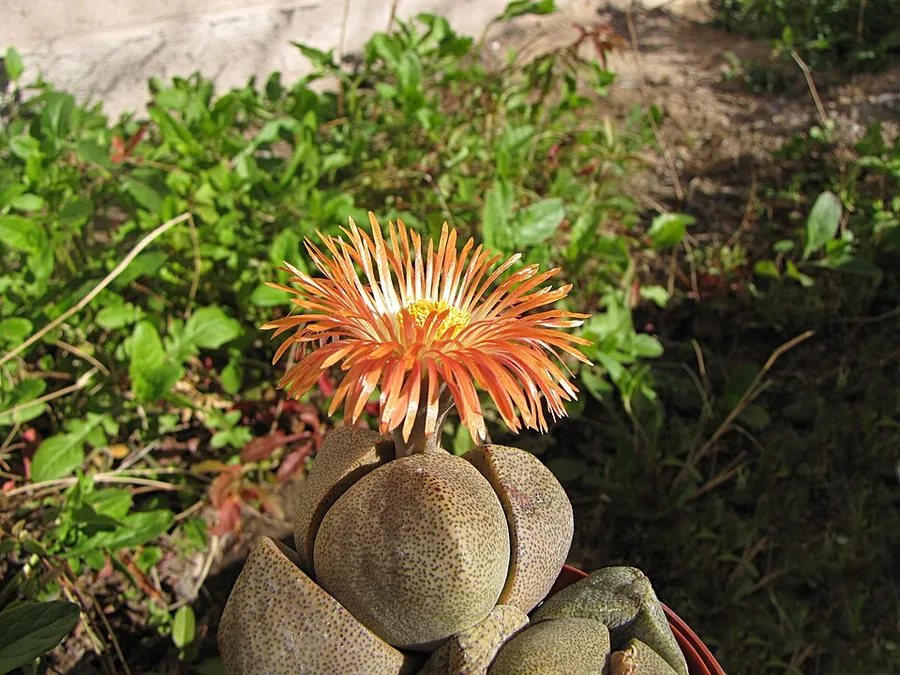
Split rock is one of the most fun succulents a windowsill can hold, a little South African stone-mimic that fools the eye. It sits in the mesemb branch of the family Aizoaceae, and its fat, cracked leaves bulge into a body about the size of a large pebble. Drop it into a gritty pot and it turns into a dead ringer for cracked granite, the same clever camouflage that keeps it hidden in the wild.
Growth here is slow and deliberate, and the plant stays tiny at just 2 to 3 inches (5 to 8 cm) tall, which only adds to the charm. It thrives year-round on a bright sill, wearing one or two leaf pairs at a time. Watch the real spectacle each year as a brand-new pair muscles up from inside the old one and drinks it down to a papery husk.
Master one thing and this plant sings, and that thing is water, not feeding or pruning. Split rock runs on a strict cycle and craves a bone-dry summer rest, so easing off the watering can is the real skill to learn. Nail the timing and it rewards you with a brilliant, daisy-like bloom in late winter or spring.
Care
The short version: pour on the brightest light you can find, plant it in a sharp gritty mix, and water only through spring and autumn growth, keeping it bone dry during dormancy and leaf renewal.
Light
Chase the brightest spot in the house for split rock, and full sun on a south-facing sill is the goal. That flood of light is what keeps the body plump and stone-tight, while a dim perch stretches it pale and tall and steals its shape.
Water
This is where split rock really tests you, so lean into the dry stretches. Water only during active growth in spring and autumn, and only once the soil has bone-dried right through. Hold it completely dry through summer dormancy and every day a new leaf pair is emerging, because a drink then bursts and rots the leaves fast.
Soil
Pack it into a very gritty, sharply draining mineral or cactus mix that refuses to hold water. It shrugs off pH anywhere from 6.0 to 7.5, so forget chasing a number and chase fast drainage instead.
Temperature
It cruises happily between 50°F and 86°F (10°C to 30°C), which normal room warmth covers all year long. Hand it a cooler, dry spell over summer and it rests exactly as it should.
Humidity
Here is a gift for anyone with dry rooms, because low humidity is precisely what this desert dweller craves. Dry air keeps it thriving, while damp, stagnant air is the fast track to rot.
Feeding
Feed with a light touch and only through the spring and autumn growth spells. A dilute, low-nitrogen cactus or succulent feed delivers plenty, since piling on more just pushes soft growth this tough little plant never asked for.
Pruning
Skip the pruning entirely, and never take a blade to the plant. Let the old leaf pair shrivel as the new one drinks it in, then peel off the papery remains once they have given all they have.
Repotting
Repot only now and then, roughly every 2 to 3 years or whenever it bursts its pot. Catch roots pushing out the drainage holes or the plant heaving up out of the soil, and treat it to a fresh gritty mix.
Size & spacing
It stays gloriously tiny, topping out at 2 to 3 inches (5 to 8 cm) tall and spreading 3 to 4 inches (7 to 10 cm) wide. One plant packs a small pot with plenty of character all by itself.
Troubleshooting
Almost every split rock puzzle points straight back to water at the wrong moment, and the leaves broadcast it loud and clear. Get in the habit of checking whether they feel firm, mushy, or are stacking up, and you can jump in before rot takes over. Spot the match below and move quickly.
Leaves bursting open or going soft and translucent
Soft, splitting leaves scream rot from overwatering, and it nearly always traces to a drink at the wrong moment. The danger spikes during summer dormancy and while a new leaf pair shoves out, when the plant wants zero water. Cut the watering off, slice away the mushy tissue with a clean blade, and shift it into a grittier, faster-draining mix.
Fix:
- Stop watering immediately
- Cut away rotted tissue with a clean blade
- Repot into a much grittier, faster-draining mix
- Allow the plant to dry out fully before any further water
Leaf pairs piling up instead of drawing down
A thriving split rock runs on just one or two leaf pairs. Catch three or more stacking up and it usually means the plant was watered or fed during leaf renewal, so the old pair never got used up. Cut off the water, let the plant feast on those old leaves, then fire the normal dry cycle back up once the extras vanish.
Fix:
- Withhold water so the plant draws on the old pair
- Resume the normal dry-cycle once excess pairs are reabsorbed
Stretched, pale growth losing its rock-like punch
When a split rock shoots up tall and fades pale, it is flat-out starved for light. That tight, stone-mimicking body only holds its shape under strong sun, and a dim sill drags it loose. Rush it to the brightest spot you have, one soaking up several hours of direct sun.
Fix:
- Move to the brightest available position with several hours of direct sun
Toxicity
Great news for a busy household with pets and kids: split rock is not toxic. The ASPCA leaves it off the lists, and its mesemb relatives carry no known poisons. The worst that happens is a quick stomach upset if a pet gulps down a bit of the gritty, fibrous leaf.
Safe for
People · Cats · Dogs · Horses · Rabbits · Livestock · Birds
Cats None
A curious cat is completely safe alongside this one. Chew a leaf and the fibrous tissue might spark a quick, mild stomach upset, but nothing toxic ever kicks in.
Dogs None
Dogs run zero poisoning risk here. The most a determined chewer runs into is brief drooling or loose stool from the gritty leaf, and it clears up on its own.
Horses None
Horses face no poisoning worry from it. And since the plant stays so small, there is barely a bite for a horse to grab anyway.
Rabbits None
No toxin here can touch a rabbit. A nibbled leaf might pass with a bit of gas, since that dense succulent tissue falls way outside a normal diet.
Livestock None
Goats, sheep, and cattle meet no toxic threat here. At worst a grazing animal picks up a mild, brief digestive grumble from the gritty mouthful.
Birds None
Pet birds stay safe around it, with no poisoning ever logged. A bird that pecks a leaf risks nothing beyond a slightly upset crop from the fibrous bite.
People None
Growing and handling it is fully safe for adults and kids alike. It is no food plant, though, so there is no reason to take a bite.
Its sharp gritty soil and fibrous leaf tissue could cause minor mechanical or digestive upset if a pet chews and swallows large amounts.
Varieties
Just two forms show up in collections, and color is what sets them apart. Both are well worth chasing down.
Pleiospilos nelii (species)
The wild species flaunts grey-green, fissured leaves that balloon into a near-round body, a spot-on match for a cracked stone.
Pleiospilos nelii 'Royal Flush'
This cultivar ditches the usual grey-green for deep purple to reddish leaves while holding fast to the same split-stone shape.
How to propagate
Split rock builds up slowly, but growing more is a genuine thrill. Raise fresh plants from seed, or split a settled clump the next time a repot rolls around.
SeedModerate
Sow in warm conditions during spring or autumn · Several months to over a year to reach a recognizable plant
Fire up seed sowing in the warmth of spring or autumn, scattering it across a gritty mix and keeping it just moist until it sprouts, then flipping straight to the strict dry cycle. Pack in some patience, because a seedling takes several months to more than a year to grow into a real plant.
DivisionModerate
During active growth when repotting an established clump · Several weeks to a few months
Once a clump spreads out, divide it during active growth while you repot. Tease off an offset with a few roots, let the cut surfaces dry and callus, then drop it into a dry gritty mix. A division roots in and settles within a few weeks to a couple of months.
Myths
Split rock is really just a Lithops.
Not so, since the two land in separate genera even though both belong to the mesemb group. Split rock is a Pleiospilos, packing far fatter and fewer leaves than a true Lithops, so that likeness is skin deep and no more.
Water it on a regular schedule like every other succulent.
This one refuses that, running on a strict cycle and demanding a bone-dry summer rest. Watering it year-round on autopilot bursts and rots the leaves, and that is the quickest way to kill it dead.