Ornamental · Polygonaceae
Buckwheat
Fagopyrum esculentum
Sow it into warm ground and watch buckwheat race across bare soil, smother weeds, and buzz with bees within weeks.
Full sun
Every 5–10 days
70–90 days
USDA 3–10
Overview
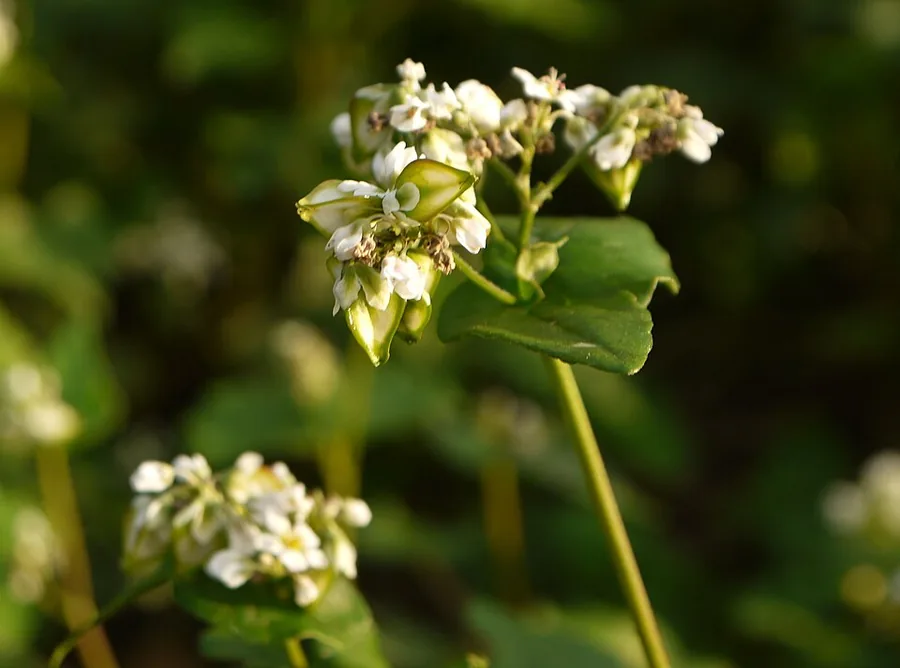
Few plants get going as fast as buckwheat. The name fools a lot of people, since it has no link to wheat and is not even a grass. It is a broadleaf pseudocereal in the knotweed family, raised both for its triangular grain and as a quick summer cover crop. Sow it and within weeks it carpets bare soil with heart-shaped leaves and a haze of small white to pinkish flowers.
Where buckwheat earns its keep is buying time and tidying the soil. A stand smothers weeds before they take hold, scavenges phosphorus and hands it to later crops, and pulls in bees and other pollinators in droves. It will not fix nitrogen, since it is no legume, so pair it with a legume cover crop when that is what you are after.
Buckwheat asks for next to nothing and grows on poor, low-fertility ground that would starve fussier plants. The catch is its tender streak. It wilts in heat and dies at the first frost, so slot it in as a warm-season filler between main crops rather than a year-round fixture.
Care
The short version: get seed into warm ground the moment frost clears, hand it a bright, quick-draining spot kept evenly damp, forget the feed entirely, and flatten it at first bloom before it can set seed.
Light
Buckwheat performs best in full sun and takes partial sun without much complaint. More light means faster cover and better flowering, which is the whole point of growing it.
Water
Give it steady, even moisture, since buckwheat is not drought tolerant and wilts fast in hot, dry spells. It also hates wet feet and fails on waterlogged or heavy soils, so the goal is moist but well drained.
Soil
It thrives on light to medium, well-drained loams and actually prefers low-fertility ground, performing poorly on heavy, wet, or high-lime sites. A pH anywhere from 5.0 to 7.0 suits it, and it shrugs off poor and slightly acidic soil better than most crops.
Temperature
Buckwheat is a warm-season annual that runs from about 45°F to 95°F (7°C to 35°C). It is frost-tender, so a single cold night kills it, and it sulks in extreme heat.
Humidity
Ordinary outdoor humidity is all it needs, so there is no number to chase. It cares far more about cool, moist soil than about the air around it.
Feeding
Skip the fertilizer. Buckwheat grows on low-fertility soils by design, and extra nitrogen just makes it flop over. It is no legume and fixes no nitrogen, but it does scavenge phosphorus and leave it more available for the next crop.
Pruning
Growing it as a cover crop, mow or till at early bloom, roughly 7 to 10 days after the first flowers open. That ends the crop before viable seed forms and keeps it from reseeding as a weed.
Repotting
none
Size & spacing
Plants reach 2 to 4 feet (60 to 120 cm) tall with a slim spread of 6 to 12 inches (15 to 30 cm). Since you sow it thickly as a stand rather than spacing it out, that narrow footprint is what lets it knit together and shade out weeds.
When to plant
Buckwheat runs on warmth and takes no cold at all. Direct sow it into warm soil from late spring through midsummer once all danger of frost has passed, watch the flowers open within 3 to 6 weeks, then either terminate it at early bloom as a cover crop or harvest the grain at about 10 to 12 weeks, ahead of the first fall frost that ends it.
Northern hemisphere
Southern hemisphere
Typical months for a temperate climate: start earlier in warm zones, later where spring frosts linger.
- Sow: Not recommended; direct sow only.
- Plant: Direct sow in warm soil after all danger of frost has passed, late spring through midsummer.
- Harvest: Small white to pinkish flower clusters appear within about 3 to 6 weeks; grain harvested at about 10 to 12 weeks.
Hardiness
USDA hardiness zones: 3–10
Temperature: down to -40°C
Troubleshooting
Buckwheat carries few real pests, so most trouble traces back to timing and weather rather than disease. Read the signs below, match them to what you are seeing, and act while it still pays off.
Uninvited buckwheat springs back up in later crops
Spot stray buckwheat popping up in a later crop and you are watching volunteer reseeding at work, which kicks in when a stand flowers and drops ripe seed before you cut it down. Timing solves it cleanly. Run the mower or tiller at early bloom, around 7 to 10 days after the first flowers open and well before any seed hardens, then hoe out the heart-shaped seedlings while they are still small.
Fix:
- Mow or till at early bloom, about 7 to 10 days after flowering begins, before any seed hardens
- Cultivate or hoe out volunteer seedlings while young
- Avoid letting any stand mature fully to seed
One cold snap blackens and topples the stand
Watch a whole stand turn dark and slump after one chilly night and you are seeing exactly what a frost-tender warm-season annual does, because buckwheat cannot push through a single near-freezing night. Nothing brings it back once frost lands, so call it the natural close of the crop and turn the soft residue into the soil. Sow only after frost clears, and for grain, bring the harvest in ahead of the first fall frost.
Fix:
- Accept frost kill as the natural end of the crop and incorporate residue
- For grain, harvest before the first frost
Thin, weak stand in hot or dry ground
A sparse, struggling stand usually points to a spot that pushed buckwheat too hard, because it is not drought tolerant and droops fast in midday heat, yet it also gives up on heavy, soggy, or high-lime ground. Aim for the comfortable middle and you turn it around. Sow into light to medium, well-drained soil that holds even moisture, and keep clear of both parched and waterlogged spots.
Fix:
- Sow into adequately moist, well-drained soil
- Avoid heavy, wet, or droughty sites
No nitrogen payoff for the crop coming next
Plenty of growers expect a nitrogen lift here and come up empty, because buckwheat is a non-legume in the knotweed family and pulls no nitrogen from the air, however green the stand looks. Put it to work on what it truly delivers: fast weed cover, phosphorus it scavenges and shares, and a quick load of green growth. When the soil genuinely needs nitrogen, grow a legume cover crop alongside it or right after it.
Fix:
- Use buckwheat for weed smothering, phosphorus scavenging, and quick biomass rather than nitrogen
- Pair or follow with a legume cover crop if nitrogen is needed
Toxicity
The grain is a wholesome, gluten-free food and the flowers are a prized honey and pollinator source, so for people the verdict lands firmly good. The caution is the green plant. Its flowers and foliage carry a pigment called fagopyrin, and grazing animals that eat large amounts and then stand in the sun can develop fagopyrism, a sunburn-like skin reaction. The seed itself holds none of it.
Toxic to
Cats · Dogs · Horses · Rabbits · Livestock · Birds
Safe for
People
Cats Caution
Cats mostly ignore greens, so the worry stays small, yet a cat that puts away a good helping of the flowering plant can end up queasy, and the fagopyrin it takes in may leave pale or thin-furred skin touchy in the sun. One easy step covers it: keep a curious cat clear of cut bouquets and standing plants in bloom.
Dogs Caution
A dog that grabs the odd leaf will almost surely shrug it off, though packing away a lot of the green, flowering plant can stir up a stomach upset. Watch pale-skinned or short-haired dogs for redness and itching on exposed skin after a stretch out in the sun.
Horses Moderate
Grazing horses sit at real risk, since heavy feeding on flowering buckwheat plus time in the sun can set off fagopyrism. The white-marked and lighter zones of the muzzle and legs may blister, peel, and itch. Move affected horses out of direct sun and off the plant straight away.
Rabbits Moderate
Keep rabbits from grazing a lot of the green plant. The fagopyrin packed in the leaves and flowers can push light skin and thin-furred spots, the ears above all, to react under sunlight with sore, sunburn-like patches.
Livestock Moderate
Cattle, sheep, goats, and pigs land at the top of the fagopyrism list. Graze a lot of flowering buckwheat, stand out in the sun, and their light-colored or exposed skin can swell, blister, and itch. Keep them off heavy stands in bloom.
Birds Caution
Birds tuck into the cleaned grain happily and it does them no harm, since the seed holds no fagopyrin. The green plant is the part to mind: heavy feeding on the flowering tops could leave bare or pale-skinned birds touchy in the sun, so the caution rides with the foliage, never the seed.
People Grain safe
Tuck into the hulled grain and buckwheat flour with confidence, since they are a wholesome, gluten-free food and safe to eat. The lone caveat is the raw green plant: in rare cases, handling or eating a great deal of the flowering tops has left light skin touchy in the sun, so keep in mind that the seed is the part people eat, not the foliage.
The cleaned grain and buckwheat flour are safe to eat. Keep pets and livestock from grazing large amounts of the flowering green plant, and be aware that affected light-skinned animals (and rarely people) should be kept out of direct sun after heavy ingestion.
Helpline numbers

United States
ASPCA Animal Poison Control: (888) 426-4435 (fee applies)

United Kingdom
Animal PoisonLine: 01202 509000 (fee applies)

Australia
Animal Poisons Helpline: 1300 869 738
Varieties
A few buckwheat types keep turning up, whether you want grain, flour, or a fast cover crop. These are the ones worth knowing by name.
Common buckwheat (Fagopyrum esculentum)
Grow buckwheat and this is almost certainly the one in your rows, a fast warm-season broadleaf carrying white to pinkish flowers, with named cultivars like Mancan and Manor that pull double duty for grain and cover.
Tartary buckwheat (Fagopyrum tataricum)
A hardier cousin bearing small greenish self-pollinating flowers, this species takes the cold better and packs more rutin, though the grain reads noticeably more bitter.
Silverhull
An old common-buckwheat type that millers prize, Silverhull carries silvery-gray, thin-hulled seed that grinds into flour with hardly any effort.
How to propagate
Buckwheat could not be easier to grow from seed, which is the only route most people take.
SeedEasy
Direct sow in warm soil after all danger of frost, late spring through midsummer. · Germinates in about 3 to 5 days and covers the ground within a few weeks.
Buckwheat is about the most forgiving thing you can grow from seed, and direct sowing is how nearly everyone gets it going. Scatter it into warm soil once all danger of frost has passed, any time from late spring through midsummer, and watch it break ground in just 3 to 5 days. From there it races to blanket the soil within a few weeks, which is exactly what makes it such a strong weed smotherer.
Myths
Buckwheat is basically a wheat, a cereal grass loaded with gluten.
The name throws people off. Buckwheat is a broadleaf pseudocereal in the knotweed and smartweed family, tied to neither true wheat nor cereal grasses. It is naturally gluten-free, which is why its flour works so well for anyone who cannot eat wheat.